
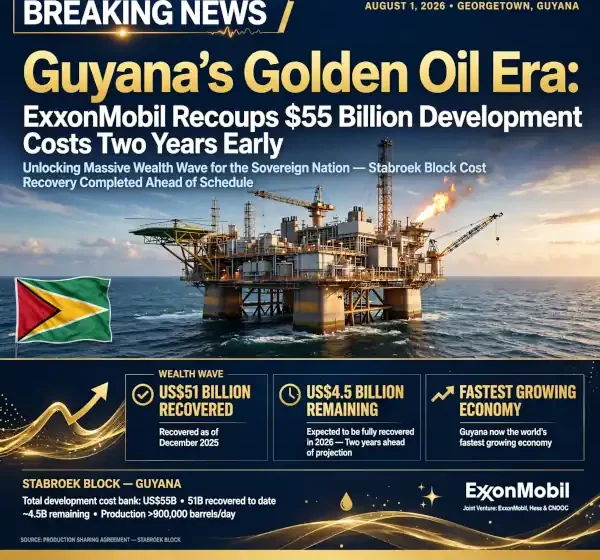
Guyana’s Golden Oil Era: ExxonMobil Recoups $55 Billion Development Costs Two Years Early, Unlocking Massive Wealth Wave for the Sovereign Nation

GEORGETOWN, Guyana & HOUSTON — In a landmark financial and operational milestone for South America’s newest energy giant, the ExxonMobil-led consortium operating offshore Guyana has fully recouped its initial multi-billion-dollar development costs. The achievement—reached nearly two years ahead of original industry projections—signals a massive shift in how crude oil revenues will be shared, clearing the path for Guyana to secure a substantially larger share of profits from its vast petroleum reserves.
According to statements from ExxonMobil Chief Financial Officer Neil Hansen and corporate earnings filings, the joint venture’s accelerated cost recovery stems from an unprecedented pace of offshore execution and lower-than-projected development expenses in the ultra-deepwater Stabroek Block. As a direct result, Guyana is set to capture a significantly higher proportion of “profit oil,” marking a historic transition from capital payback to long-term national wealth accumulation.
The Financial Turning Point: Cost Oil vs. Profit Oil
Under the terms of the 2016 Production Sharing Agreement (PSC) governing the 6.6-million-acre Stabroek Block, the operator consortium—composed of ExxonMobil (45% operator), Chevron via its acquisition of Hess Corporation (30%), and China’s CNOOC (25%)—was permitted to allocate up to 75% of total gross crude production toward “cost oil”. This operational mechanism enabled the energy firms to recover their massive cumulative capital investments, which reached $55 billion spent on exploration, seismic mapping, drilling rigs, and complex Floating Production, Storage, and Offloading (FPSO) vessels deployed since 2014.
The remaining 25% of output was designated as “profit oil,” split evenly (50/50) between the Guyanese government and the corporate consortium.
With the $55 billion initial cost ceiling now formally cleared ahead of schedule, the dynamics of the contract undergo a fundamental shift. Because less revenue is required to service historical capital expenditures, a far larger slice of daily production immediately reclassifies into the profit oil bucket.
┌────────────────────────────────────────────────────────────────────────┐
│                   STABROEK BLOCK REVENUE MECHANISM                     │
├────────────────────────────────────────────────────────────────────────┤
│ PREVIOUS COST-RECOVERY PHASE:                                          │
│ ┌──────────────────────────────────────────────┬─────────────────────┐ │
│ │ Up to 75% Cost Recovery (Exxon & Partners)   │ 25% Profit Oil      │ │
│ └──────────────────────────────────────────────┴─────────────────────┘ │
│                                                  ├── 12.5% Govt Share  │
│                                                  └── 12.5% Consortium  │
│                                                                        │
│ NEW POST-PAYBACK PHASE:                                                │
│ ┌──────────────────────┬─────────────────────────────────────────────┐ │
│ │ Substantially Lower  │ EXPANDED PROFIT OIL POOL                    │ │
│ │ Cost Recovery Burden │ (Split 50/50 between Government & Consortium) │ │
│ └──────────────────────┴─────────────────────────────────────────────┘ │
└────────────────────────────────────────────────────────────────────────┘
For ExxonMobil, this structural shift means booking approximately 100,000 fewer net barrels per day (bpd) starting in the third quarter of 2026, as extra physical crude barrels transfer to the state. However, owing to higher net profit margins per remaining barrel, Exxon expects its long-term free cash flow from Guyana to double by 2030 relative to 2025 baselines. For the government in Georgetown, the shift generates an immediate and sustained windfall for the Natural Resource Fund (NRF), the nation’s sovereign wealth instrument.
Unprecedented Ramping: From 2015 Discovery to 900,000+ BPD
Guyana’s transformation from an agrarian economy into a top-tier global offshore basin is widely considered one of the fastest oil developments in modern industrial history. Since ExxonMobil’s initial Liza-1 discovery in May 2015, the consortium has logged more than 30 major offshore discoveries across the Stabroek Block, establishing an estimated recoverable resource base exceeding 11 billion barrels of oil equivalent.
National oil production recently breached the milestone of 900,000 barrels per day. This rapid expansion has been propelled by four mega-FPSO vessels operating in deepwater fields:
-
Liza Destiny (Liza Phase 1): Commenced production in December 2019, establishing Guyana’s maiden oil exports.
-
Liza Unity (Liza Phase 2): Added substantial deepwater capacity in early 2022.
-
Prosperity (Payara Field): Achieved first oil in late 2023, rapidly ramping output beyond initial nameplate ratings.
-
ONE GUYANA (Yellowtail Field): The largest vessel deployed to date, which achieved first oil in August 2025 and reached its full capacity of 250,000 bopd ahead of schedule, pushing national output past the 900,000 bpd mark.
Guyana Offshore Production Capacity Trajectory (Stabroek Block)

1,800,000 bpd ─────────────────────────────────────────────────── 1.7M (2030 Target)
1,500,000 bpd ──────────────────────────────────────────────────
1,200,000 bpd ──────────────────────────────────────────
  900,000 bpd ───────────────────────── 900K+ (2025-2026)
  600,000 bpd ─────────────────
  300,000 bpd ─────────
            0 ─┴────────┬────────┬────────┬────────┬────────┬───
               2020    2022     2024     2026     2028     2030
The consortium is maintaining a relentless development pace. The fifth and sixth offshore developments—Uaru and Whiptail—are scheduled for operational startup in 2026 and 2027, respectively, each adding another 250,000 bpd of capacity. A seventh sanctioned project, Hammerhead, is designed to contribute 150,000 bpd by 2029. With an eighth project (Longtail) currently under regulatory review, total production capacity from the Stabroek Block is on track to reach 1.7 million barrels per day by 2030.
Tech-Driven Exploration and Corporate Stakes
During ExxonMobil’s second-quarter earnings call, CEO Darren Woods highlighted that the company’s exploration activities in Guyana remain far from complete. Exxon has increasingly leveraged advanced artificial intelligence algorithms and high-performance computing to process complex 3D seismic and subsurface geological data, allowing reservoir engineers to identify undrilled prospects and optimise well positioning with unprecedented precision.
Financial performance across the consortium reflects the underlying quality of the asset. In fiscal year 2025, ExxonMobil’s local operating arm, ExxonMobil Guyana Limited (EMGL), generated gross revenues of approximately GY$1.71 trillion (~US$8.1 billion). Net profits reached GY$982.5 billion (~US$4.67 billion). These massive cash flows occurred despite a drop in global crude oil prices from a 2024 average of $82 per barrel to $68 per barrel in 2025, proving the asset’s resilience against market volatility.
Geopolitics, Regional Alliances, and Border Disputes
The acceleration of Guyana’s energy sector occurs against a dynamic geopolitical backdrop. As crude supplies face disruptions elsewhere due to ongoing conflicts in the Middle East, South America’s Atlantic margin has emerged as a critical pillar of global energy security.
However, regional security considerations remain prominent. A portion of the western Stabroek Block continues under force majeure due to a long-standing border claim by neighbouring Venezuela over the Essequibo region. The territorial dispute is currently awaiting a final binding judgment by the International Court of Justice (ICJ) in The Hague.
Simultaneously, the broader “Petro-State Corridor” encompassing Guyana and neighbouring Suriname is taking firm hold. While Guyana expands its production footprint, Suriname is advancing toward its own offshore deepwater developments, positioning the joint border region as one of the most concentrated offshore production zones in the Western Hemisphere.
The Domestic Paradox: Transforming Capital into Infrastructure
For Guyana’s population of approximately 800,000 to 1 million citizens, the rapid surge in crude oil revenues brings both extraordinary opportunity and complex economic challenges. The country has consistently posted double-digit real GDP growth rates, elevating its status in international financial rankings.
Yet, the domestic economy illustrates the classic friction between offshore wealth creation and onshore execution. Local citizens and business leaders frequently point to ongoing structural bottlenecks:
-
Grid Reliability: Despite soaring state revenues, industrial centres and residential areas still experience periodic electrical grid blackouts, prompting urgent government investment in gas-to-energy projects and solar infrastructure.
-
Transportation & Logistics: Secondary roads, bridges, and port facilities require deep upgrades to keep pace with heavy industrial logistics and urban expansion.
-
Economic Diversification: Officials are under pressure to allocate expanding oil revenues into agriculture, healthcare, education, and manufacturing to prevent “Dutch Disease”—where an over-reliance on petroleum weakens non-resource sectors.
With initial payback thresholds now cleared, the Guyanese government will see a substantial boost in direct cash inflows into the NRF. Policy leaders in Georgetown face the crucial task of turning these incoming energy revenues into long-term infrastructure, sustainable public utilities, and economic opportunities that extend well beyond the oil sector.
Key Summary Table: Guyana’s Oil Sector at a Glance
| Indicator / Metric | Data / Status | Details & Context |
| Primary Offshore Block | Stabroek Block | 6.6 million acres, operated by ExxonMobil |
| Estimated Resource Base | 11+ Billion Barrels | Oil equivalent discovered across 30+ major finds |
| Consortium Ownership | Exxon (45%), Chevron/Hess (30%), CNOOC (25%) | Exxon serves as the primary operator |
| Current Production Rate | 900,000+ bpd | Powered by Liza 1, Liza 2, Payara, & Yellowtail FPSOs |
| Capital Recouped | $55 Billion | Reached ~2 years faster than the original schedule |
| Next Offshore Projects | Uaru (2026), Whiptail (2027) | Each project is designed to add 250,000 bpd |
| 2030 Production Target | 1.7 Million bpd | Projected across 8 dedicated floating production vessels |