
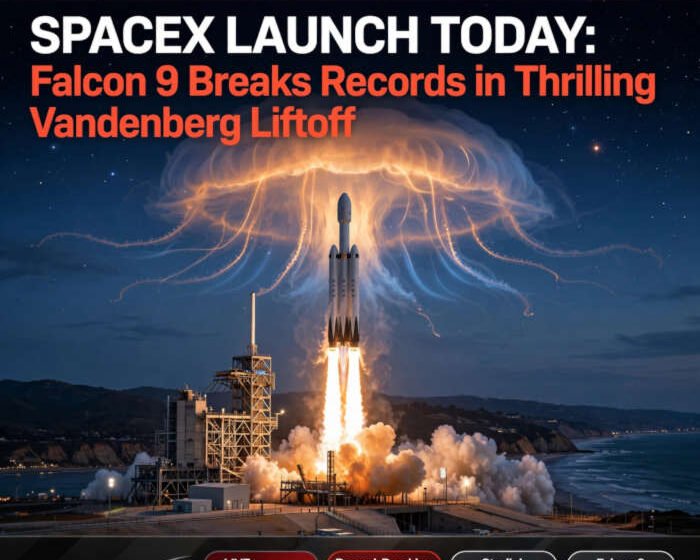
SPACEX LAUNCH TODAY: Falcon 9 Breaks Records in Thrilling Vandenberg Liftoff

VANDENBERG SPACE FORCE BASE, CALIFORNIA: In this USA News today daily updates, read all about the SpaceX launch today reports. Night skies across Southern California erupted in a brilliant blaze of fiery orange and roaring exhaust early this morning as SpaceX executed another flawless orbital insertion. For aerospace enthusiasts, satellite communications investors, and space tracking experts watching the live stream, the focus was squarely on one headline: SpaceX launch today.
Liftoff occurred precisely at the opening of the targeted window from Space Launch Complex 4 East (SLC-4E) at Vandenberg Space Force Base. Pushing past heavy coastal fog and atmospheric pressure variations, the legendary Falcon 9 workhorse carried another heavy payload of 24 next-generation Starlink V2 Mini satellites into low Earth orbit (LEO).
Beyond expanding global high-speed satellite internet infrastructure, this specific mission broke critical aerospace engineering records. The first-stage booster supporting today’s flight—booster tail number B1081—achieved an extraordinary milestone by completing its 26th operational launch and ocean landing.
The Historic 26th Flight of Booster B1081
To truly appreciate why today’s SpaceX mission dominates real-time news trends and commercial spaceflight discussions, look directly at the rapid reuse metrics driving commercial launch logistics. A decade ago, landing an orbital-class rocket booster once seemed impossible; today, SpaceX routinely flies individual first stages over two dozen times.
Booster B1081 has built a storied flight pedigree. Prior to lifting today’s Starlink 17-52 payload, this veteran booster successfully launched NASA astronauts on the historic Crew-7 mission to the International Space Station, boosted CRS-29 commercial resupply cargo, powered high-priority national security payloads for the National Reconnaissance Office (including NROL-186 and NROL-48), and delivered international scientific research satellites like NASA’s PACE and ESA’s EarthCARE into orbit.
               [ SPACEX FALCON 9 STAGING SEQUENCE ]

 [00:00] Liftoff from SLC-4E (Vandenberg Space Force Base)
    |
    v
 [02:25] Main Engine Cut-Off (MECO) & Stage Separation
    |
    +---> [Upper Stage] -> Merlin Vacuum Engine Burns -> LEO Orbit
    |
    v
 [08:35] [Booster B1081] -> Entry Burn -> Autonomous Grid Fin Control
    |
    v
 [08:45] Precise Precision Touchdown on Droneship 'Of Course I Still Love You'
Following stage separation roughly two and a half minutes into flight, the upper stage’s single Merlin Vacuum engine continued igniting to push the 24 Starlink V2 Mini satellites into their designated deployment orbit. Meanwhile, booster B1081 flipped orientation, re-entered Earth’s thick atmosphere using hypersonic grid fins for stability, executed a controlled entry burn, and touched down gracefully on the autonomous droneship Of Course I Still Love You positioned hundreds of miles offshore in the Pacific Ocean.
High-Volume Satellite Infrastructure and Low-Latency Broadband Demand
The driving force behind SpaceX’s relentless launch cadence is the voracious global demand for low-latency, high-bandwidth satellite internet access. The Starlink mega-constellation now operates thousands of active satellites in low Earth orbit, delivering reliable connectivity to remote rural communities, maritime shipping fleets, commercial aviation corridors, and emergency disaster response units worldwide.
Today’s payload utilised Starlink V2 Mini satellites, which feature significantly upgraded key components compared to first-generation models:
-
E-band Backhaul Antennas: Providing up to four times more capacity per satellite than older hardware generations.
-
Argon Ion Thrusters: Offering higher thrust and specific impulse for orbital positioning and active space debris avoidance manoeuvres.
-
Direct-to-Cell Capability: Supporting seamless satellite cellular connectivity for unmodified consumer smartphones in remote dead zones.
| Metric / Parameter | Falcon 9 / Starlink V2 Mini Specs | Industry Impact |
| First-Stage Reusability | 26 Flights (Booster B1081) | Drastically lowers cost per kilogram to LEO |
| Payload Capacity | 24 Starlink V2 Mini Satellites | Adds massive terabits of global network capacity |
| Landing Location | Droneship Of Course I Still Love You | Zero land-based infrastructure required downrange |
| Turnaround Cycle Time | ~36 Days between flights | Enables weekly commercial launch schedules |
Sonic Booms and Coastal Visibility Across California
Residents living along California’s Central Coast—stretching from Santa Barbara and San Luis Obispo down to Ventura County—woke up early to observe today’s trajectory. Depending on localised atmospheric temperature layers and cloud coverage, thousands of coastal observers reported seeing the brilliant high-altitude plume created by the rocket’s engines breaking through the upper stratosphere.
The U.S. Space Force issued advance notifications advising local communities that the launch trajectory could produce audible sonic booms as the returning booster passed back through the sound barrier during descent. Although SpaceX optimised the descent angle to minimise ground impact, coastal residents reported distinct thunderous cracks echoing across valleys as booster B1081 decelerated toward its Pacific ocean landing site.
The Broader Space Economics: Starship V3 and Artemis Moon Missions
While Falcon 9 continues its reign as the world’s most reliable operational launch vehicle, SpaceX engineers are simultaneously pushing hard on next-generation heavy-lift capabilities. Today’s launch comes amid significant aerospace developments across SpaceX’s broader programs.
NASA Ames Research Centre recently completed extensive transonic and supersonic wind tunnel testing on a 1.2% scale model of the upgraded Super Heavy Version 3 rocket. These tests provide essential aerodynamic data for the upcoming Starship Human Landing System (HLS), which NASA selected to carry American astronauts from lunar orbit down to the Moon’s surface during the historical Artemis III mission.
  [ FALCON 9 vs. STARSHIP V3 SCALE & CAPABILITY ]

  Falcon 9 (Operational)         Starship V3 (In Testing)
  +--------------------+        +--------------------+
  | Height: 70 meters  |        | Height: 124+ meters|
  | Payload: ~23 tons  |        | Payload: 100+ tons |
  | Partial Reusable   |        | Fully Reusable     |
  +--------------------+        +--------------------+
Concurrently, astronomers and space tracking experts are monitoring an incoming lunar impact event involving a discarded SpaceX upper stage from an earlier 2025 mission. The hardware is projected to strike the lunar surface near Einstein Crater on the Moon’s western limb at 5,400 mph, providing scientists a rare opportunity to analyse artificial impacts and lunar dust plume formation.
Commercial Aerospace Satellite Launch Schedule and Future Outlook
The commercial space launch market continues to see extraordinary growth, driven largely by reusable rocket architectures and expanding commercial satellite constellations. Industry analysts project commercial launch revenues to top $15 billion over the coming fiscal cycle as global telecommunications providers, national defence agencies, and deep-space scientific initiatives compete for limited manifest slots.
SpaceX shows zero signs of slowing down its launch pace. With SLC-4E at Vandenberg in California and SLC-40 and LC-39A at Cape Canaveral in Florida operating around the clock, the company remains on track to complete well over 140 orbital missions this year alone.
As booster B1081 rides the droneship Of Course I Still Love You back into port for post-flight inspection and refurbishment, launch technicians are already prepping the pad for the next upcoming mission.
For space enthusiasts, investors, and broadband consumers following today’s historic liftoff, one thing remains crystal clear: the routine, high-frequency access to space pioneered by SpaceX is no longer the future—it is today’s everyday reality.