
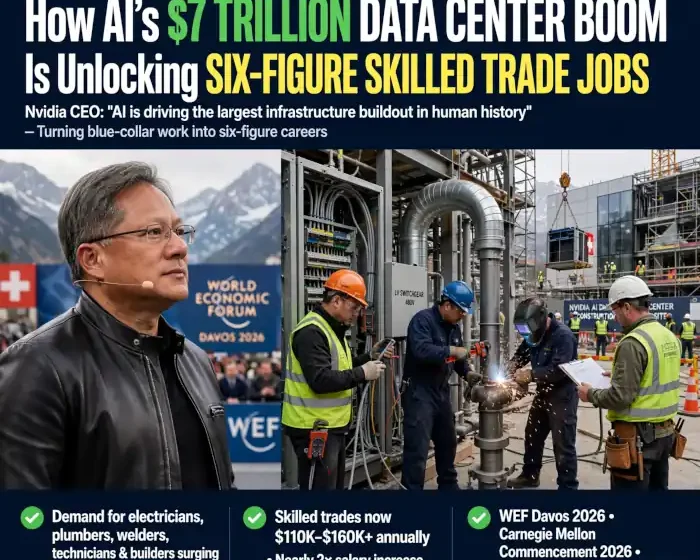
Jensen Huang Construction Careers Forecast: How AI’s $7 Trillion Data Center Boom Is Unlocking Six-Figure Skilled Trade Jobs

BREAKING NEWS | TECH & CAREERS TRENDING NOW
Nvidia CEO Jensen Huang says ‘a lot’ of six-figure jobs in plumbing and construction will soon be unlocked because someone needs to build new AI centres. According to Nvidia’s CEO, the next wave of six-figure opportunities won’t be found in a Wall Street cubicle or a Silicon Valley Slack channel. Instead, high-paying careers will partially come by picking up a wrench—literally.
As tech giants race to build sprawling data centres totalling $7 trillion in global capital outlays by the end of the decade, Huang believes the world is on the cusp of what he calls the “largest infrastructure build-out in human history,” which will create “a lot of jobs.
Speaking at recent global tech and economic summits, the leader of the world’s most valuable semiconductor company delivered a bold wake-up call to job seekers, students, and corporate professionals alike: the artificial intelligence revolution isn’t just a software story—it is a physical, industrial expansion requiring hundreds of thousands of master electricians, industrial plumbers, steelworkers, and specialised network installation technicians.
The $7 Trillion AI Infrastructure Surge: Why Data Centres Need Physical Builders
While much of the public debate surrounding artificial intelligence focuses on automated coding, generative text, and white-collar workforce displacement, the physical reality of AI is immensely physical.
Hyperscale cloud providers like Microsoft, Alphabet (Google), Amazon Web Services (AWS), and Meta are spending hundreds of billions annually on next-generation computing facilities. However, housing hundreds of thousands of high-density Nvidia graphics processing units (GPUs) requires far more than basic warehouse space.
“First of all, this is the largest infrastructure build-out in human history. That’s going to create a lot of jobs. And it’s wonderful that the jobs are related to tradecraft. We’re going to have plumbers and electricians and construction and steel workers and network technicians… Salaries have gone up nearly double. We’re talking about six-figure salaries for people who are building chip factories or computer factories or AI factories.”
Jensen Huang, CEO of Nvidia
Why AI Factories Demand Specialised Skilled Trades
Unlike traditional enterprise server rooms, modern “AI Factories” generate unprecedented thermal and electrical loads:
-
Extreme Electrical Capacity: High-density GPU racks consume up to 100 kW per cabinet—demanding complex utility substations, high-voltage transformers, and heavy-gauge industrial wiring installed by certified electrical contractors.
-
Advanced Liquid Cooling Infrastructure: Traditional air conditioning cannot cool intense AI clusters. Data centres are shifting to liquid-to-chip cooling, necessitating master plumbers, pipefitters, and hydraulic engineers to route high-pressure closed-loop liquid systems.
-
Structural Precision: Mega-facilities housing millions of pounds of computing equipment demand heavy industrial concrete work, structural steel reinforcement, and vibration-isolated foundations.
Blue-Collar Trade Careers vs. Software Engineering: A Paradigm Shift
For decades, career advice heavily prioritised four-year computer science degrees and software development. However, the economic landscape is rapidly shifting. AI coding assistants are streamlining entry-level software engineering tasks, while the supply of physical trade labour has hit critical nationwide shortages.
Huang noted that if he were a 20-year-old student graduating today, he would seriously consider physical sciences and vocational tradecraft over pure software development.
According to data from the U.S. Bureau of Labour Statistics (BLS) and industry trade groups, the United States was already facing a deficit of nearly 500,000 construction and trade professionals before the AI surge. The convergence of the CHIPS and Science Act (building domestic semiconductor manufacturing fabs) and the hyper-expansion of data centres has turned that deficit into a lucrative gold rush for skilled workers.
Top Six-Figure AI Construction & Trade Careers Forecast
The explosive demand for data centre infrastructure management and heavy commercial construction has driven salaries for specialised trade professionals into upper-tier compensation brackets.
| Career Field / Speciality | Primary Role in AI Infrastructure | Expected Hourly Pay / Salary Range | Education / Entry Pathway |
| High-Voltage Electrician | Power grid integration, transformer installation, and rack wiring. | $105,000 – $165,000+ | Electrical Apprenticeship / IBEW Certification |
| Industrial Pipefitter / Plumber | Chilled liquid cooling loops, manifold routing, and backflow systems. | $98,000 – $150,000+ | Journeyman Plumbing License / Vocational Program |
| Data Centre HVAC & Thermal Tech | Liquid-to-air heat exchangers, precision chillers, and climate monitoring. | $95,000 – $140,000+ | HVAC/R Certification / EPA 608 License |
| Structural Steel & Concrete Specialist | Building fab reinforced foundations and structural containment frameworks. | $90,000 – $135,000+ | Ironworkers Union / Specialised On-the-Job Training |
| Fibre Optic & Network Installer | High-speed optical interconnects, server rack patching, and fibre splicing. | $85,000 – $130,000+ | FOA Certification / Network Trade Technical School |
| Data Centre Construction Manager | Overseeing multi-billion-dollar hyperscale facility builds. | $130,000 – $210,000+ | B.S. in Construction Management / PMP |
The ROI of Vocational Education in the Age of Artificial Intelligence
Higher education costs have reached historic highs, leaving millions of college graduates burdened with student loans while navigating a volatile job market. In contrast, vocational training programs, trade apprenticeships, and commercial licensing pathways offer a high return on investment (ROI) with near-zero initial debt.
Key Benefits of Entering the AI Construction Workforce:
-
Earn While You Learn: Paid trade apprenticeships allow candidates to receive full-time wages while completing required field hours and classroom training.
-
Absolute Job Security Against Automation: While software algorithms can write code or draft legal contracts, an AI agent cannot install a 500-kVA transformer or weld high-pressure cooling pipes in a physical facility.
-
Unprecedented Overtime and Prevailing Wage Rates: Federal and corporate backing for domestic semiconductor fabs and clean energy infrastructure guarantees union prevailing wages, per-diem bonuses, and extensive overtime pay.
Global Impact: Semiconductor Fabs and “AI Factories” Worldwide
Huang’s forecast extends far beyond North America. Countries across Europe, Asia, and the Middle East are investing heavily in sovereign AI infrastructure—ensuring national data remains on local soil, powered by domestic computing hubs.
From Taiwan Semiconductor Manufacturing Company (TSMC) expanding massive fabrication facilities in Arizona to major data centre hubs rising in Northern Virginia, Texas, Ireland, and Singapore, the global shortage of skilled tradecraft labour has become the primary bottleneck for tech giants.
Tech executives across the industry are echoing Huang’s sentiment:
-
Ford Motor Co. CEO Jim Farley noted that America currently lacks the backfill workforce required to support ambitious datacenter and EV energy goals.
-
Palantir CEO Alex Karp highlighted that vocational training is “irreplaceable,” emphasising that hands-on skills represent the backbone of the modern economy.
-
CoreWeave CEO Michael Intrator pointed out the urgent “physicality” of cloud computing, calling for aggressive recruitment in carpentry, plumbing, and electrical tradecraft.
How to Capitalise on the Skilled Trades Boom
For individuals looking to pivot into high-paying AI construction and trade careers, industry experts recommend taking actionable steps today:
-
Target High-Demand Trade Specialities: Focus on electrical systems, industrial instrumentation, pipefitting, commercial HVAC, or fibre optic networking.
-
Enrol in Registered Apprenticeships: Connect with local union halls (such as the IBEW or UA) or accredited vocational institutes offering direct-placement programs.
-
Gain Specialised Certifications: Obtain OSHA 30-Hour Safety Training, NICET certifications, or FOA (Fibre Optics Association) credentials to stand out to commercial data centre general contractors.
-
Explore Data Centre Operations (DCOps): For tech-adjacent professionals, transitioning into facility management, power monitoring, and hardware installation offers a direct bridge into six-figure infrastructure roles.
As Jensen Huang succinctly put it: “Everybody should be able to make a great living. You don’t need to have a PhD in computer science to do so.” The next decade belongs to the builders powering the AI revolution.