
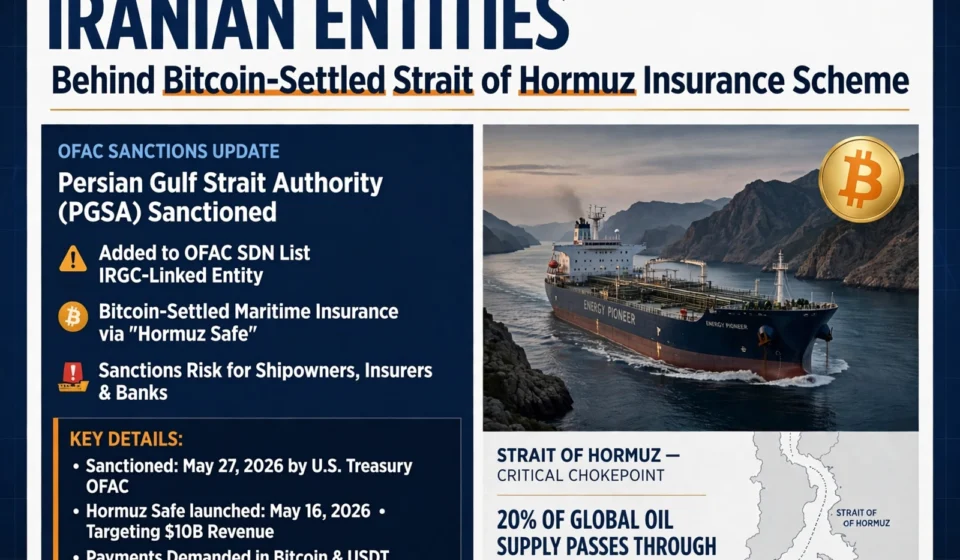
U.S. Treasury Sanctions Iranian Entities Behind Bitcoin-Settled Strait of Hormuz Insurance Scheme

Insuracne News USA: The U.S. Department of the Treasury’s Office of Foreign Assets Control (OFAC) has issued targeted sanctions against two Iranian entities—Persian Gulf Marine Insurance Company (PGMIC) and HormuzSafe Marine Services Authority (Hormuz Safe). The action disrupts a sophisticated maritime extortion scheme that compelled commercial shipping vessels transiting the Strait of Hormuz to purchase mandatory, Islamic Revolutionary Guard Corps (IRGC)-approved insurance coverage, primarily settled in Bitcoin and other digital assets.
The enforcement action highlights the growing intersection of maritime supply chain vulnerabilities, geopolitical tension in critical energy chokepoints, and modern cryptocurrency sanctions-evasion tactics.
Executive Summary
The Strait of Hormuz is the world’s most vital maritime oil transit chokepoint, through which roughly 20% of global petroleum passes daily. Due to heightened geopolitical instability and economic pressures stemming from triple-digit domestic inflation, the Iranian regime sought new avenues to monetize maritime passage and bypass international banking restrictions.
┌─────────────────────────────────────────────────────────────────────────┐
│              STRAIT OF HORMUZ MARITIME TRANSIT SCHEME                    │
└─────────────────────────────────────────────────────────────────────────┘
                                   │
      1. Commercial Vessels Transiting Strait of Hormuz
                                   │
                                   ▼
      2. Forced to Acquire IRGC-Approved Insurance Coverage
                                   │
              ┌────────────────────┴────────────────────┐
              ▼                                         ▼
   PGMIC (Policy Brokerage)               Hormuz Safe (Platform)
              │                                         │
              └────────────────────┬────────────────────┘
                                   │
                                   ▼
      3. Digital Asset Settlement (Bitcoin / Crypto Rails)
                                   │
                                   ▼
      4. Funds Funneled to IRGC & Shadow Fleet Operations
Under the guise of providing legitimate maritime services—including traffic control, security, and emergency response—PGMIC and Hormuz Safe required ship owners and operators to purchase protection policies. Treasury officials emphasized that the specific risks covered by these policies, such as vessel boarding, detention, and asset seizure by IRGC naval forces, were risks created directly by Iran.
Alongside the designation of these two insurers, OFAC also sanctioned eight shadow fleet crude oil tankers and their operators for facilitating illicit petroleum transfers.
Technical Mechanics: How the Crypto Insurance Engine Operated
Developed under the direction of Iran’s Ministry of Economic Affairs and Finance, the Hormuz Safe digital platform functioned as an alternative financial gateway designed to bypass traditional SWIFT networks and Western clearinghouses.
Key Operational Characteristics:
-
Digital Settlement Layer: The platform accepted direct payments in Bitcoin (BTC) and selected stablecoins. By leveraging pseudonymous blockchain rails, the regime intended to obscure payment flows and avoid correspondent bank monitoring.
-
Policy Authorization: Insurance policies were brokered through PGMIC and verified by the Persian Gulf Strait Authority (PGSA)—an IRGC-backed administrative body designated by OFAC earlier.
-
Revenue Projections: State-linked reports indicated the platform aimed to generate up to $10 billion annually from transiting commercial vessels, effectively establishing a mandatory digital toll system on global shipping.
                 TRADITIONAL vs. SANCTIONED TRANSIT MODEL

   Aspect            Traditional P&I Club           Hormuz Safe Scheme
  ───────────────────────────────────────────────────────────────────────────
   Settlement        Fiat (USD / EUR via SWIFT)     Crypto (BTC / Stablecoins)
   Underwriter       Global Marine Insurers         IRGC-backed (PGMIC)
   Primary Risk      Natural Hazards & Piracy       State-Sponsored Seizure
   Compliance        OFAC & IMO Cleared             Designated / Blocked
Legal and Regulatory Enforcement Framework
OFAC’s designation blocks all property and interests in property of PGMIC and Hormuz Safe within U.S. jurisdiction or in the possession of U.S. persons.
Key Legal Instruments Applied:
-
Executive Order 13902 & E.O. 13224: Targets key sectors of the Iranian economy—including its financial, petroleum, and maritime transportation networks—and entities providing material support to foreign terrorist organisations (FTOs) like the IRGC.
-
Secondary Sanctions Exposure: Non-U.S. financial institutions, crypto exchanges, and foreign maritime companies that facilitate transactions with or provide services to these sanctioned entities risk losing access to the U.S. financial system.
-
Crypto Address Blacklisting: Blockchain analytics platforms and wallet providers have integrated associated address clusters into automated compliance and transaction monitoring engines to flag or freeze related inflows.
Compliance & Risk Mitigation Guide for Shipping and Crypto Enterprises
For maritime operators, logistics managers, and virtual asset service providers (VASPs), this regulatory action introduces severe compliance requirements.
For Maritime & Logistics Companies:
-
Refuse Illicit Toll Payments: Transacting with Hormuz Safe or PGMIC—even under threat of delay or detention—constitutes a direct violation of U.S. sanctions law and carries severe civil and criminal penalties.
-
Implement Enhanced Route Planning: Shipowners operating near the Persian Gulf must maintain real-time tracking, report unauthorized communications from regional authorities, and work with flag state registries to establish secure transit protocols.
-
Conduct Strict Counterparty Screening: Verify that all local maritime agents, tug operators, and regional brokers do not maintain commercial ties with PGMIC or PGSA.
For Crypto Exchanges & VASPs:
-
Automate Real-Time On-Chain Screening: Deploy advanced blockchain intelligence tools to identify, flag, and block transactions linked to known Iranian state infrastructure, mining pools, or regional payment processors.
-
Monitor High-Risk Wallet Behaviour: Track transaction patterns involving round-number Bitcoin transfers coinciding with vessel transits through Middle Eastern shipping corridors.
-
Submit Suspicious Activity Reports (SARs): Ensure immediate regulatory filing when detecting attempts to use digital assets for maritime toll fees or unverified cargo insurance payments.
Strategic Outlook for Global Supply Chains
The Treasury’s targeted action reflects an ongoing shift toward identifying and neutralising state-sponsored cryptocurrency schemes. As regional tensions continue to impact international shipping routes, enforcement agencies are increasingly focusing on the digital payment infrastructure used to monetise sovereign chokepoints.
Commercial fleets operating in high-risk maritime zones must balance operational safety with strict international compliance, ensuring that digital asset tools are not leveraged by sanctioned state actors to weaponise global trade.