
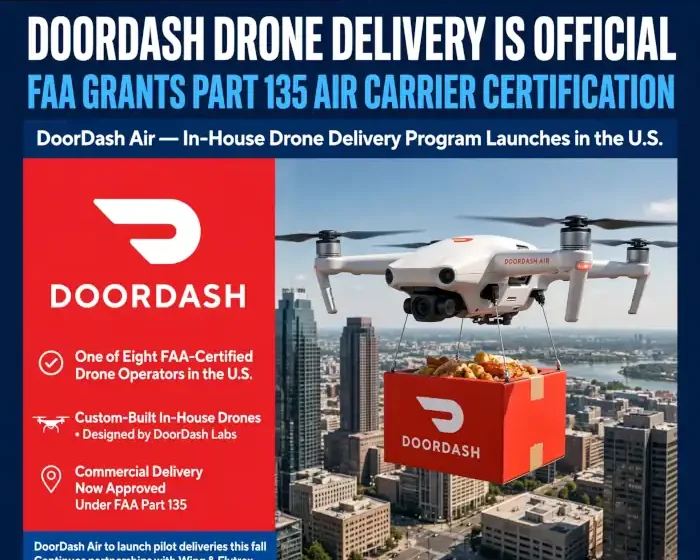
Federal Aviation Administration Grants DoorDash Air Part 135 Approval for Commercial Drone Delivery 2026

SAN FRANCISCO, CA : Breaking American news on the USA Federal Aviation Administration granting DoorDash Drone Delivery 2026. Is officially a major development for last-mile delivery, autonomous logistics, and food-technology infrastructure; the Federal Aviation Administration (FAA) has officially granted Part 135 Air Carrier Certification to DoorDash Air.
This federal regulatory milestone authorises the food delivery giant to operate its own proprietary, commercial drone fleet across the United States. Developed entirely in-house by DoorDash Labs—the company’s internal hardware, robotics, and artificial intelligence innovation division—the program shifts DoorDash from an app-based gig economy marketplace into a certified, operating commercial air carrier.
DoorDash becomes only the eighth operator in U.S. history to earn the FAA’s coveted Part 135 certification, joining an elite group that includes Alphabet’s Wing, Amazon Prime Air, and Zipline. The certification opens up significant commercial possibilities for local merchants, supply chain managers, and e-commerce platforms looking to automate short-range freight logistics and dramatically reduce delivery transit times.
The Regulatory Breakthrough: Unpacking FAA Part 135 Certification
Earning an FAA Part 135 Air Carrier Certificate requires passing a rigorous, multi-stage evaluation process. The mandate ensures that commercial unmanned aircraft systems (UAS) meet the same stringent airworthiness, maintenance, and flight safety standards as traditional commuter airlines.
For DoorDash, securing this certification required years of continuous safety testing, flight simulations, and software validation across several core areas:
-
Aircraft Airworthiness and Redundancy: Verification that the hardware, battery systems, and flight controllers can handle adverse weather, rotor failure, and localised signal disruptions.
-
Maintenance & Quality Assurance: Establishment of FAA-approved inspection protocols, fleet maintenance infrastructure, and component tracking.
-
Beyond Visual Line of Sight (BVLOS) Operations: Compliance with airspace safety guidelines required to navigate dense suburban and urban air corridors safely without ground-spotter reliance.
-
Fail-Safe Protocol Integration: Deployment of autonomous parachute recovery systems, obstacle detection sensors, and emergency landing algorithms.
“We want drone delivery to work for any merchant, anywhere. We’re building the full stack to make that possible—from the ground infrastructure to the drone itself, and the handoff systems that make it work together seamlessly,” stated Harrison Shih, Head of DoorDash Air. “Advances in hardware, compute, and AI are creating extraordinary new capabilities for local commerce, and becoming a certified air carrier accelerates everything we’re building.”
While last-mile delivery represents one of the fastest-growing segments of commercial real estate and e-commerce, it remains the most expensive and inefficient leg of the supply chain.
Internal data from DoorDash reveals a clear structural challenge within suburban logistics: 20% of all customer orders fall within a 3-to-5 mile radius of the merchant. However, because human couriers (“Dashers”) often avoid mid-range trips due to road congestion, traffic signals, and return-trip friction, these orders take approximately 25% longer to fulfill than shorter 1-to-2 mile deliveries.
┌─────────────────────────────────────────────────────────────────────────┐
│              THE SUBURBAN DELIVERY FRICTION MATRIX                      │
├─────────────────────────────────────────────────────────────────────────┤
│ SHORT-RANGE (0 – 2 Miles):                                              │
│ [High Dasher Availability] ──> Fast Completion ──> High Driver Earnings │
│                                                                         │
│ MID-RANGE (3 – 5 Miles):                                                │
│ [Traffic & Friction] ──> 25% Longer Wait Times ──> Sub-Optimal Fulfillment│
│                                                                         │
│ DOORDASH AIR SOLUTION:                                                  │
│ [Autonomous Flight] ──> ~25 Min Average ──> Bypasses Traffic & Congestion│
└─────────────────────────────────────────────────────────────────────────┘
By deploying autonomous delivery drones for these 3-to-5-mile mid-range routes, DoorDash frees up human drivers to focus on higher-earning, shorter trips or complex deliveries (such as multi-story apartment complexes and bulk catering orders). During recent commercial pilots, aerial deliveries achieved average fulfilment times of just 25 minutes, while participating local restaurants reported up to a 30% increase in total order volume due to faster turnover and expanded delivery coverage areas.
The Multi-Modal Fleet Matrix: AI-Driven Autonomous Routing
DoorDash Air will not operate as an isolated silo. Instead, it will be integrated into DoorDash’s proprietary Autonomous Delivery Platform (ADP).
When a customer places an order via the DoorDash app, advanced machine learning algorithms automatically evaluate multiple real-time factors—including package weight, merchant kitchen prep times, outdoor weather conditions, airspace traffic, customer landing space, and driver availability—to select the optimal fulfilment method.
Comparative Overview: Last-Mile Delivery Channels
| Channel / Mode | Ideal Operating Radius | Primary Target Payload | Operational Strengths | Key Constraints |
| Human Couriers (Dashers) | 0 – 10+ Miles | Unlimited (Large/Bulk) | Complex navigation, apartment doors, high flexibility | Traffic delay, higher cost per mile, and labour availability |
| DoorDash Air (Drones) | 2 – 5 Miles | 3 – 8 lbs (Small/Medium) | 25-min delivery speed, zero traffic, lower fuel costs | Weather restrictions, weight limits, outdoor landing area are required |
| Dot Autonomous Robots | 0 – 1.5 Miles | 5 – 15 lbs | Low operational cost, bike lane/sidewalk access | Speed capped at 20 mph, limited to flat urban/suburban zones |
| Third-Party Partners (Wing, Flytrex) | Variable Partner Networks | Standard Merchant Goods | Rapid deployment in select suburban pilot regions | Third-party software integration overhead |
Hardware, Ground Infrastructure, and Fall 2026 Deployment
Unlike tech companies that license third-party aircraft, DoorDash Labs has spent years designing a custom hardware stack tailored specifically to restaurant meals, grocery staples, and convenience items. Key technical components of the infrastructure include:
-
Custom Modular Airframe: Engineered to keep hot foods warm and cold drinks upright during high-speed transit.
-
Precision Tethering System: Rather than landing on driveway pavement, the drone hovers overhead and gently lowers payloads via automated tether mechanisms, preventing noise disturbance and ground hazards.
-
Merchant Handoff Hubs: Specialised ground infrastructure installed at partner storefronts allows restaurant staff to load payloads into standardised delivery pods without requiring aviation expertise.
-
Autonomous Airspace Logistics Management: Cloud-native fleet management software monitors real-time flight telemetry, battery discharge cycles, and geofenced no-fly zones.
           [ Merchant Hub ]  ───>  [ Automated Loading Pod ]
                                           │
                                           ▼
                                [ DoorDash Air Drone ]
                                           │
                                  (BVLOS Air Passage)
                                           │
                                           ▼
                                [ Precision Tether Drop ]
                                           │
                                           ▼
                                [ Customer Front Yard ]
DoorDash is scheduled to host a major product unveiling event in San Francisco on September 29, 2026, where it will detail exact aircraft specs, initial launch markets, and commercial rollout dates for Fall 2026.
Market Outlook
The commercial drone logistics industry is entering a period of rapid consolidation and commercial scaling. Industry analysts estimate the global drone delivery market will exceed tens of billions in valuation over the next decade, fueled by advancements in battery energy density, AI computer vision, and streamlined federal regulations.
By combining its existing network of millions of active consumers and merchant partners with an owned air-carrier fleet, DoorDash establishes a strong defensive moat against competitors. The integration of DoorDash Air into the broader delivery ecosystem showcases how artificial intelligence, autonomous robotics, and modern aerospace engineering are coming together to redefine urban and suburban commerce.