US Stock market today: Dow, S&P 500, Nasdaq futures steady after Korean tech slump and Middle East geopolitical shock

U.S. Stock MARKET today Slide After Fed Pause, Escalation in Iran War
Wall Street experienced a turbulent trading session as major benchmark indexes posted sharp losses. Investors digested a hawkish pause from the Federal Reserve, escalating military tensions between the United States and Iran, and a massive sell-off in Asian semiconductor giants led by South Korea’s Kospi.
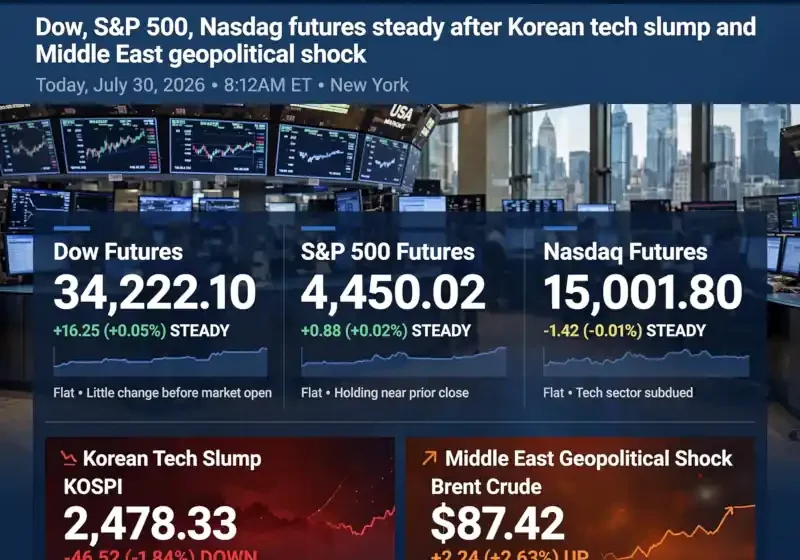
The Dow Jones Industrial Average suffered a steep drop, declining over 1,100 points, or 2.19%, to close at 51,594.14. The broader S&P 500 fell 1.52% to finish at 7,316.15, marking its lowest closing level in a month. Meanwhile, the tech-heavy Nasdaq Composite plummeted 1.74% to end at 24,442.94, taking the index down nearly 9% from its record peak.
Investors seeking answers to why the stock market is down today point to a combination of monetary policy uncertainty, soaring geopolitical risks in the Middle East, and growing anxiety over corporate capital expenditure in artificial intelligence.
Key Market Benchmarks at a Glance
| Index / Metric | Closing Level / Price | Daily Change | Percentage Change |
| Dow Jones Industrial Average (DJIA) | 51,594.14 | -1,129.03 | -2.19% |
| S&P 500 Index | 7,316.15 | -111.36 | -1.52% |
| Nasdaq Composite Index | 24,442.94 | -420.02 | -1.74% |
| WTI Crude Oil (Futures) | ~$89.68 / barrel | +$5.60 | +6.70% |
| U.S. 10-Year Treasury Yield | 4.62% | +12 bps | — |
1. Federal Reserve Holds Rates Steady with Hawkish Dissents
The primary domestic catalyst weighing on U.S. stocks was the Federal Reserve’s policy announcement. The Federal Open Market Committee (FOMC) voted to hold the benchmark federal funds rate unchanged in the 3.50% to 3.75% range.
While a rate pause was widely anticipated by institutional investors, the underlying details of the meeting unsettled equity markets:
-
Three Hawkish Dissents: Unusually, three of the 12 voting FOMC members dissented from the decision, arguing for a 25-basis-point rate increase due to persistent inflationary pressures driven by rising global commodity costs.
-
Resurgent Inflation Concerns: With consumer price inflation hovering above target for over five years, surging crude oil prices have renewed fears of a “stagflationary” spiral.
-
September Rate Hike Bets Rise: Following Fed Chairman Kevin Warsh’s press conference, interest rate futures priced in a greater than 80% probability of a rate hike at the upcoming September FOMC meeting.
“The central bank is caught between slowing economic momentum and sticky commodity inflation,” noted Ryan Detrick, Chief Market Strategist at Carson Group. “With oil breaking out higher due to Middle East hostilities, the market is quickly repricing from rate cuts to potentially another rate hike before the end of the year.”
2. Geopolitical Escalation: U.S.-Iran Military Conflict Hits Oil & Sentiment
Beyond central bank policy, geopolitical risk returned with a vengeance as news broke of renewed military escalation between the U.S. and Iran.
Reports that Iranian Revolutionary Guard forces launched missile strikes toward American operational bases in the Middle East—though largely intercepted by U.S. Central Command—sent oil futures surging. West Texas Intermediate (WTI) crude oil leaped nearly 7% to settle near $90 a barrel.
The sudden spike in energy costs dragged down consumer discretionary stocks, airlines, and industrial manufacturers. Heavy industrial leaders in the Dow Jones index suffered some of the sharpest sell-offs, pushing the 30-stock benchmark to its worst single-day loss of the summer.
3. South Korean Tech Rout Spills Over to Wall Street
The broader risk-off mood across international equity markets was compounded by an unprecedented plunge in South Korea’s benchmark Kospi index.
South Korean semiconductor behemoths SK Hynix and Samsung Electronics suffered massive double-digit percentage declines, triggering automatic “sidecar” trading halts in Seoul. The sell-off was triggered by:
-
AI Monetization Fears: Growing skepticism regarding whether hyperscale tech companies are generating sufficient return on investment (ROI) relative to their colossal capital expenditure on AI infrastructure.
-
Rising Competition from China: Emerging Chinese chip manufacturers rolling out low-cost alternatives and advanced lithography tools, threatening Korean market share in memory chips.
This Asian market crash reverberated across Wall Street during the trading day. U.S. chip giant stocks fell sharply, pulling the Philadelphia Semiconductor Index lower for a third consecutive session.
Tech Big-Tech Earnings Under the Microscope
As the regular trading session closed, the focus shifted rapidly to megacap technology earnings. Investors are demanding tangible revenue growth from companies committing hundreds of billions of dollars to artificial intelligence systems.
-
Meta Platforms: The social media giant saw its shares slip 4% in extended trading after revealing an increased capital expenditure forecast for 2026, projecting AI-related capex between $130 billion and $145 billion.
-
Microsoft: In contrast, Microsoft edged higher post-market after reporting stronger-than-expected quarterly cloud revenue growth, demonstrating that enterprise spending on Azure AI capabilities remains robust.
S&P 500 Sector Performance Breakdown (Daily)
--------------------------------------------------
Industrials             [████████████████] -3.24%
Information Tech        [████████████]     -2.50%
Financials              [█████████]        -1.80%
Consumer Discretionary  [████████]         -1.45%
Energy                  [░░░░░░░░░░░]      +2.10%
--------------------------------------------------
What’s Next for the Market?
As stock market futures attempt to stabilize after the bell, institutional traders are preparing for a volatile rest of the week. Wall Street will closely monitor incoming U.S. jobless claims, core inflation metrics, and official updates on military developments in the Persian Gulf.
With the Dow Jones, S&P 500, and Nasdaq index all trading below key technical moving averages, traders emphasize that market stability will likely depend on whether energy prices stabilize and big tech delivers solid forward guidance.