U.S. Mortgage Rates Surge Near One-Year Highs as Geopolitical Tensions Drive Up Treasury Yields

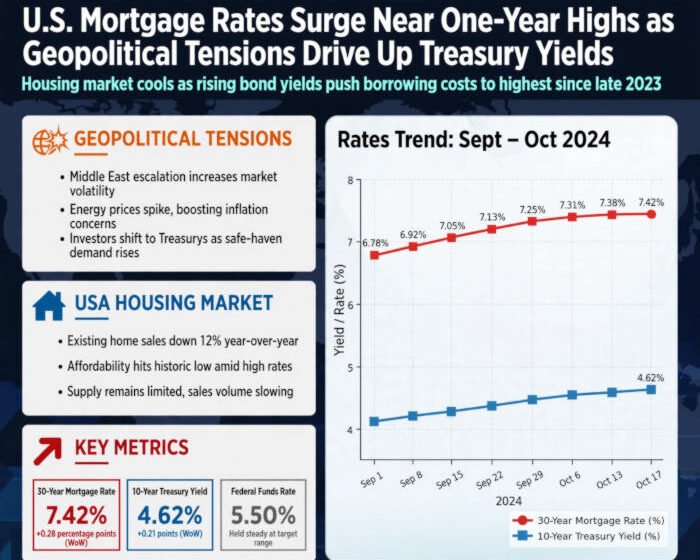
WASHINGTON — U.S. residential borrowing costs jumped sharply last week, with benchmark mortgage rates approaching or exceeding one-year highs across nearly all major home loan products. A sudden military escalation between the United States and Iran renewed energy market volatility, sending crude oil prices surging and driving up inflation-sensitive U.S. Treasury yields that directly underpin home loan pricing.
According to weekly survey data released Wednesday by the Mortgage Bankers Association (MBA), average contract interest rates rose significantly across fixed- and adjustable-rate products during the week ended July 24. The sustained rate climb is worsening housing affordability and putting an immediate freeze on home purchase and refinancing demand across the country. Use the Mortgage calculator now
Key Mortgage Benchmark Metrics
| Mortgage Loan Product | Rate (Week Ended July 24) | Weekly Change | Historical Context |
| 30-Year Fixed-Rate Mortgage | 6.76% | +7 basis points | Just shy of a 1-year high |
| 15-Year Fixed-Rate Mortgage | 6.15% | +11 basis points | Highest in just over a year |
| 5-Year Adjustable-Rate Mortgage (ARM) | 5.98% | +2 basis points | Upward movement alongside fixed rates |
Geopolitical Shock and Yield Curve Pressures
The sudden surge in residential borrowing costs is tied to macro-geopolitical developments in the Middle East. A resumption of active fighting involving U.S. and Iranian forces triggered an abrupt rally in energy futures, with West Texas Intermediate (WTI) crude oil climbing toward multi-month highs.
Because energy price spikes historically feed into broader consumer inflation, bond market investors reacted by selling off benchmark 10-year U.S. Treasury notes. The resulting rise in Treasury yields quickly spilled over into mortgage-backed securities (MBS) markets, forcing primary lenders to adjust consumer loan rates upward.
Broad Market Mechanism:
Geopolitical Conflict ➔ Crude Oil Surge ➔ Inflation Risk Rises ➔ Treasury Yields Spikes ➔ Mortgage Rates Rise
Federal Reserve Hawkish Stance Weighs on Housing Outlook
Adding further upward momentum to interest rates, market sentiment shifted ahead of the Federal Reserve’s monetary policy decision. With persistent inflationary pressures renewed by energy market volatility, investor expectations for near-term interest rate cuts have virtually evaporated.
Instead, fixed-income markets are increasingly pricing in the likelihood that central bank policymakers could resume benchmark rate increases later this summer to keep inflation expectations anchored. As long as monetary policy remains in restrictive territory, analysts caution that mortgage rates have little near-term room to retreat.
“Higher borrowing costs are compounding the existing inventory and pricing challenges across the U.S. real estate sector,” noted MBA economists in commentary accompanying the data. “As contract rates push further toward the 7% threshold, prospective buyers are increasingly priced out, leading to a visible deceleration in purchase application volume.”
Impact on U.S Housebuyer Demand and Refinancing
The sharp uptick in interest rates immediately cooled prospective home buyer and homeowner activity across the board:
-
Purchase Demand Drops: Overall mortgage application volume pulled back as high monthly debt-service calculations forced first-time buyers to pause their home searches.
-
Refinancing Market Freezes: With rates sitting near 12-month highs, mortgage refinancing activity declined steeply, remaining down significantly compared to periods when rates hovered closer to 6%.
-
Shift to Adjustable-Rate Mortgages (ARMs): To bypass elevated fixed rates, a growing share of buyers turned to short-term adjustable-rate mortgages. While 5-year ARMs offer lower initial payments (~5.98%), industry analysts warn they expose buyers to future interest rate resets if borrowing costs remain elevated long-term.
Outlook for the Second Half of 2026
The sudden reversal in mortgage rate momentum poses a challenge for the broader U.S. housing recovery. While spring and early summer data showed modest improvements in home inventory levels across several regional markets, the combination of elevated home prices and sub-7% interest rates creates a severe affordability hurdle.
Real estate economists emphasise that unless energy prices stabilise and geopolitical tensions in the Middle East ease, home loan rates are expected to hover in the mid-to-high 6% range through the remainder of the third quarter.