
Trump Admin CISA Midterm Security: DHS Rebuilds Infrastructure Ahead of Elections

Trump Admin CISA Midterm Security: DHS Rebuilds Infrastructure Ahead of Elections
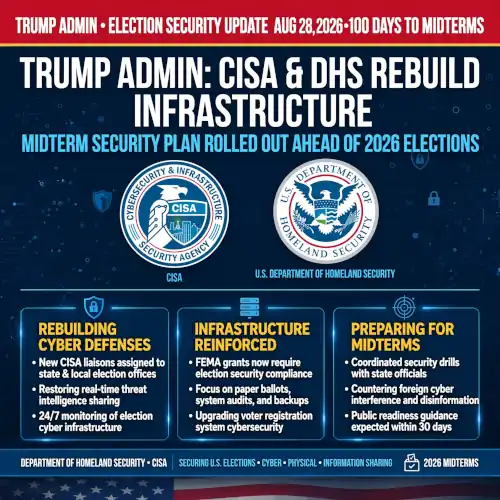
WASHINGTON — Trump admin CISA midterm security initiatives are under intense public scrutiny as federal cybersecurity authorities scramble to rebuild critical defense systems just months before voting begins. In a major operational shift, the Department of Homeland Security (DHS) and the Cybersecurity and Infrastructure Security Agency (CISA) are attempting to rapidly reconstitute America’s federal election security apparatus.
The Trump admin CISA midterm security push follows a widespread internal restructuring that previously forced out dozens of senior cybersecurity specialists and threat intelligence analysts, leaving state and local election administrators to source alternative risk mitigation resources on their own.
Trump Admin CISA Midterm Security: Overhaul and Operational Realities
According to internal administration memos and briefing summaries provided to Capitol Hill staff, federal officials are reassigning remaining agency staff into new regional liaison roles. The initiative aims to re-establish trusted communication channels with state, county, and municipal IT directors before mail-in ballots begin reaching voters in early autumn.
Under the updated Trump admin CISA midterm security blueprint, federal authorities plan an aggressive timetable to redeploy cyber resources, borrowing tactical frameworks previously used during large-scale global event security deployments, such as the World Cup. CISA has promised to release a public roadmap within 30 days detailing both physical and digital security assets available to local jurisdictions.
However, closed-door congressional briefings reveal significant internal strain. Recently reassigned CISA officials conceded to legislative aides that severe staffing deficits have compromised the agency’s capacity to deliver baseline operational support, tabletop emergency simulations, and vulnerability assessments typically provided ahead of major national elections.
+-----------------------------------------------------------------------------------+
|                      FEDERAL ELECTION SECURITY RESTRUCTURING                      |
+-----------------------------------------------------------------------------------+
|                                                                                   |
|    HISTORICAL BASELINE                        2026 EMERGENCY FRAMEWORK            |
|    • Dedicated embedded cyber advisors        • Consolidated regional liaisons    |
|    • Continuous automated penetration tests    • On-demand advisory tools         |
|    • Customized statewide simulations         • Templated tabletop exercises      |
|    • Real-time interagency threat feeds       • Decentralized state fusion feeds  |
|                                                                                   |
+-----------------------------------------------------------------------------------+
State and Local Municipalities Turn to Enterprise Solutions
Faced with months of reduced federal engagement under the Trump admin CISA midterm security transition, state election directors and county clerks have taken proactive steps to safeguard their digital systems. Rather than waiting for centralized assistance, state governments have allocated state rainy-day funds and local capital budgets toward enterprise cybersecurity solutions, managed security services providers (MSSPs), and cloud data protection platforms.
To bridge critical operational gaps, local administrators are investing heavily in commercial tools, including:
-
Managed Threat Detection and Response (MDR): Continuous endpoint monitoring and automated anomaly detection to prevent unauthorized database access.
-
Cyber Liability Insurance and Risk Assessment: Comprehensive policy coverage paired with third-party compliance audits to mitigate financial and legal exposure from ransomware or data breaches.
-
Zero-Trust Network Architecture: Implementing multi-factor authentication (MFA) and granular identity access management (IAM) across all voter registration and ballot tracking networks.
-
Third-Party Penetration Testing Services: Hiring independent cybersecurity consultants to execute rigorous vulnerability testing on municipal network perimeter defenses.
Operational Challenges in the Main Body of Election Infrastructure
Security experts and non-partisan voting rights advocates warn that implementing major technical changes this late in the election cycle introduces distinct operational risks. Modifying firewall rules, deploying unvetted software patches, or restructuring system access controls weeks before voting commences can lead to unintended administrative disruptions.
Most state election systems rely on a complex ecosystem combining legacy state databases with modern local network architecture. Ensuring seamless interoperability while defending against sophisticated distributed denial-of-service (DDoS) attacks, phishing campaigns, and insider threats requires dedicated, long-term technical partnership rather than last-minute administrative interventions.
As the deadline approaches for CISA’s public resource plan, state election directors continue building local resilience. By combining regional cyber fusion centers, private cloud security infrastructure, and independent risk management protocols, election workers across the country are striving to ensure that every vote remains accurate, verifiable, and secure against digital threats.