
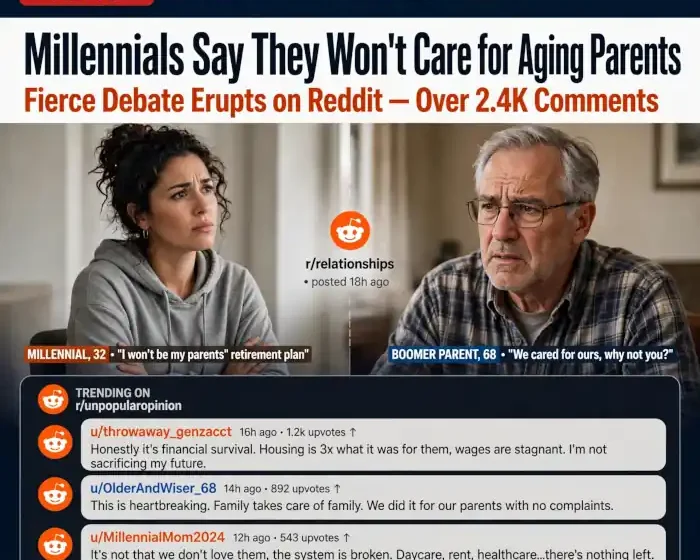
Millennials Say They Won’t Care for Aging Parents: Fierce Debate Erupts on Reddit

USA: A high-stakes generational rift has spilled into public view, sparking intense debate across Reddit communities, online forums, and social media platforms. At the center of the controversy is a candid admission from a growing cohort of Millennials: they refuse—or are structurally unable—to act as primary caregivers for their aging Baby Boomer parents.
What began as isolated threads on subreddits like r/Millennials, r/Futurology, and r/CaregiverSupport has exploded into a broader cultural conversation. The discussion touches on economic survival, generational wealth disparities, mental health boundaries, and the collapse of the traditional American family care network.
The Spark: A Viral Reddit Thread Exposes Hidden Tension
The controversy surged after multiple viral threads detailed the impending eldercare crisis facing adult children born between 1981 and 1996.
In one thread upvoted thousands of times, a user posed a blunt question: “Why isn’t anyone talking about the fact that Millennials will be expected to be FREE caregivers for their elderly parents—if they aren’t already?”
“Overlooked in the many staggering challenges that Millennials face is that they’re also on the hook to be unpaid caregivers for their elderly relatives,” the original poster wrote. “You think you can take that job across the country to pay off student loans? Think again… Given older Americans’ life expectancies and the lack of nursing home beds, you will be their caregiver, and you will most likely do it for free for decades.”
The post ignited a wave of responses. While some commenters expressed a willingness to support loving parents, a substantial and vocal group declared that they will not step into the role of caregiver. Their reasons range from severe economic constraints to ruptured family relationships and emotional trauma.
┌───────────────────────────────────────────────────────────────────────────┐
│                    THE MILLENNIAL ELDERCARE DILEMMA                       │
├──────────────────────────────────┬────────────────────────────────────────┤
│ STRUCTURAL & FINANCIAL BARRIERS  │ PSYCHOLOGICAL & RELATIONAL BARRIERS     │
├──────────────────────────────────┼────────────────────────────────────────┤
│ • Housing & space limitations    │ • Boundary setting & non-contact status│
│ • Skyrocketing eldercare costs   │ • Refusal to perpetuate toxic cycles   │
│ • Unaffordable long-term care    │ • Lack of parental support in youth    │
│ • Medicare coverage gaps         │ • Burnout from existing obligations    │
└──────────────────────────────────┴────────────────────────────────────────┘
1. The Economic Impossible: Student Debt, Housing, and the “Sandwich Squeeze”
For millions of Millennials, the decision not to take in aging parents is rooted in financial reality rather than a lack of empathy.
Having lived through two major recessions, historic housing price increases, stagnant wage growth, and record-high student loan balances, many Millennials are already struggling to establish their own financial independence or support young children.
Typical Cost Breakdown: Out-of-Pocket Eldercare Costs in the U.S.

Assisted Living Facility (National Monthly Average):   ~$4,800 - $5,500
Private Room Nursing Home (National Monthly Average): ~$9,000 - $10,500
In-Home Health Aide (40 Hours/Week):                 ~$4,500 - $5,800
Unpaid Caregiver Lost Wages & Benefits (Lifetime):    ~$300,000+
The Spatial and Financial Crunch
Many commenters pointed out that urban housing realities make multi-generational living nearly impossible:
-
Space Constraints: Unlike previous generations who bought larger suburban homes, many Millennials live in small apartments or starter homes with no room for an elderly parent requiring mobility assistance.
-
Workplace Demands: Dual-income households are standard for Millennials. Quitting a job or reducing work hours to provide full-time eldercare can result in lost wages, lost health insurance, and reduced Social Security benefits.
-
The “Sandwich” Strain: Millennials raising young children while caring for aging parents face dual financial and emotional pressure.
“We don’t make enough money, nor do we have a big enough house to take care of our parents when they’re older,” shared one Redditor. “I love comfortably, but I don’t live comfortably enough to support other adults as well.”
2. Breaking the Cycle: Trauma, Boundaries, and Estrangement
Beyond economics, a major catalyst for the “no caregiving” stance involves mental health and dynamic changes within families.
Millennials have embraced therapy, trauma awareness, and personal boundary-setting far more openly than prior generations. For adult children raised by emotionally abusive, neglectful, or toxic parents, the obligation to provide eldercare is no longer viewed as automatic.
                 Traditional Filial View vs. Modern Millennial Stance
                 ────────────────────────────────────────────────────

  TRADITIONAL MODEL                            MODERN BOUNDARY MODEL
 ┌──────────────────────────────────┐         ┌──────────────────────────────────┐
 │ • Unconditional filial duty      │         │ • Reciprocal relationship base   │
 │ • Care provided regardless of    │   VS.   │ • Prioritizes personal mental    │
 │   past parental behavior         │         │   health & family safety         │
 │ • Sacrificing personal mobility  │         │ • Reliance on professional care  │
 └──────────────────────────────────┘         └──────────────────────────────────┘
In discussions about estranged parents, Reddit users expressed a clear refusal to sacrifice their own well-being:
-
“Haven’t spoken to mine in over a decade. May they be shown all the love and care I received at their hands in my formative years.”
-
“I love my mom, but I saw what happened when she cared for her aging parents—it destroyed her health and marriage. I refuse to kill myself emotionally or financially to repeat that cycle.”
Family therapists note that this shift reflects a fundamental change in how young adults view duty: filial responsibility is increasingly seen as conditional on the quality of the parent-child relationship.
3. The Eldercare Reality: Medicare Gaps & Filial Responsibility Laws
A widespread point of confusion highlighted in these debates is the misconception regarding government assistance for senior care. Many parents assume Medicare will cover long-term nursing home stays or in-home care, but that is rarely the case.
| Program | What It Covers | What It DOES NOT Cover |
| Medicare | Short-term rehabilitation, hospital stays, doctor visits, short skilled nursing stays. | Long-term custodial care, ongoing assistance with daily activities, permanent nursing home stays. |
| Medicaid | Long-term nursing home care for low-income seniors. | Requires spending down personal savings and assets down to near-poverty levels before coverage kicks in. |
| Private Long-Term Care Insurance | Custodial care, in-home care, assisted living facilities. | Highly expensive policies; rarely held by middle-class Baby Boomers. |
The Legal Elephant in the Room: Filial Responsibility Laws
Adding to the tension are Filial Responsibility Laws. Nearly 30 U.S. states have statutes on the books that can legally obligate adult children to pay for an indigent parent’s food, shelter, or medical care if the parent cannot afford it.
While rarely enforced historically, nursing homes and healthcare providers in states like Pennsylvania have used these laws to sue adult children for tens of thousands of dollars in unpaid bills.
4. Smaller Families, Larger Burden: The Demographic Reality
The caregiving crisis is also driven by demographic shifts.
Previous generations typically relied on larger family units to share the caregiving burden. When a member of the Silent Generation aged, care was often distributed among four or five adult siblings.
In contrast, Millennials are far more likely to be only children or have just one sibling. This leaves fewer people to split the financial costs, physical labor, and emotional strain of caring for aging parents.
   1960s-1980s: Multi-Sibling Support Network
   [Parent] ───► Supported by 4 to 6 Adult Children (Shared Burden)

   2020s-2030s: The Solitary Millennial Caregiver
   [Parent] ───► Supported by 1 or 2 Adult Children (Heavy Squeeze)
Navigating the Road Ahead: Policy and Systemic Solutions
As the conversation continues online, eldercare experts emphasize that blaming individual families ignores a wider systemic problem. The surge of aging Baby Boomers is straining existing social safety nets.
Policy researchers advocate for key structural reforms to address the crisis:
-
Expanding Public Long-Term Care Benefits: Creating state and federal programs to help cover non-medical home care.
-
Support for Family Caregivers: Offering tax credits, subsidized respite care, and paid family leave for adult children managing eldercare.
-
Transparent Financial Planning: Encouraging open discussions between aging parents and adult children about retirement finances, healthcare proxies, and long-term expectations well before a health crisis occurs.
The debate on Reddit underscores a clear reality: the traditional model of family eldercare is undergoing a significant transformation. Whether driven by economic necessity or personal boundaries, Millennials are reshaping expectations around family obligations and long-term care.