
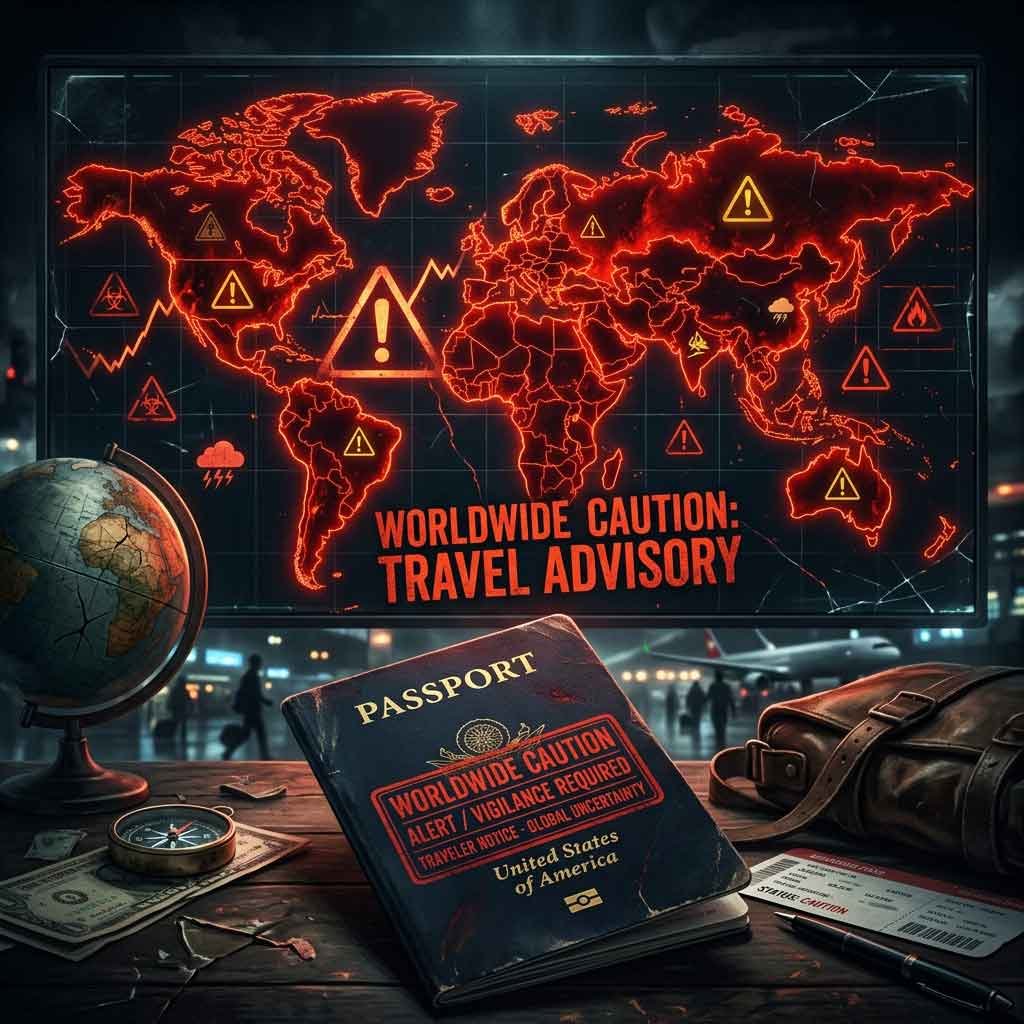
NY: The calculus of international travel shifted dramatically this weekend. For millions of American citizens currently living, working, or vacationing abroad, the standard pre-trip checklist just added a highly sobering imperative: assessing the direct fallout of an active geopolitical conflict.
The U.S. State Department issued a critical, global “Worldwide Caution” travel alert. The sweeping alert explicitly advises Americans overseas to practice extreme vigilance, pointing directly to rapidly deteriorating security environments and the imminent threat of retaliatory actions from factions linked to Tehran.
[Muwaffaq Salti Air Base Strike] ──> [2 US Service Members Killed / 1 Missing]
                                             │
                                             ▼
[Global Threat Spike] <── [State Department "Worldwide Caution" Alert Issued]
This massive security directive directly responds to a sharp spike in active military friction between the United States and Iran. Earlier in the day, U.S. Central Command (CENTCOM) confirmed that a coordinated Iranian ballistic missile and drone strike targeting the Muwaffaq Salti Air Base in Jordan killed two American service members, left another missing in action, and wounded four more.
With the conflict transitioning from proxy skirmishes into direct, overt military engagements, Washington is flashing a global red light to protect its citizens from becoming secondary targets in an expanding theater of war.
Deconstructing the “Worldwide Caution” Mandate
A “Worldwide Caution” is not a standard, run-of-the-mill advisory. The State Department reserves this sweeping global classification for moments when systemic, trans-regional threats menace American citizens simultaneously across multiple continents.
The security alert highlights several unique operational threats facing travelers:
- Targeted Diplomatic Facilities: U.S. embassies, consulates, and military outposts—even those located well outside the immediate borders of the Middle East—face heightened surveillance and potential tracking by hostile actors.
- Asymmetric Proxy Activity: The advisory explicitly notes that groups supportive of Iran may independently target U.S. commercial interests, hospitality venues, or public spaces heavily frequented by Western tourists.
- Infrastructure Chokepoints: Periodic airspace closures, sudden flight cancellations, and emergency security screenings are rolling out across transit hubs, threatening to leave un-alert travelers stranded.
The government is telling citizens that the traditional boundary lines of the Middle East conflict no longer guarantee safety. If a venue or asset connects publicly to the United States, it currently carries an elevated risk profile.
The Catalyst: Tragedy at Muwaffaq Salti Air Base
The severe tone of the worldwide warning stems directly from the fatal weekend attack inside Jordan. For months, the regional conflict simmered through minor proxy encounters. However, the strike on Muwaffaq Salti Air Base fundamentally altered the strategic landscape.
[Iranian Ballistic Missiles / Drones] ──> [Muwaffaq Salti Air Base (Jordan)]
                                                    │
                                                    ▼
[US Response: Heavy Airstrikes] <── [2 US Fatalities & 1 Missing Personnel]
According to official CENTCOM releases, a dense swarm of Iranian ballistic missiles and attack drones successfully penetrated air defense perimeters at the base. The attack resulted in the first direct, acknowledged U.S. troop casualties from non-proxy Iranian fire during this cycle of hostilities.
The U.S. military responded instantly, executing its eighth consecutive night of heavy airstrikes against Iranian logistics infrastructure, underground weapons depots, and surveillance nodes located within Iran’s southern provinces. As both nations trade direct blows, the likelihood of asymmetric retaliation against soft civilian targets abroad has climbed exponentially.
Regional Volatility: The Fluid Reality on the Ground
The geographic ripple effects of the escalating war are spreading quickly across the globe, as detailed by multiple international reporting agencies:
The Levant and Israel
The U.S. Embassy in Jerusalem issued strict geographic exclusions, ordering American citizens to completely avoid northern Israel, the Gaza strip, and regions bordering Egypt. Frequent border skirmishes and regular drone incursions mean these zones are highly volatile.
The Gulf Cooperation Council (GCC) States
Kuwait bore the brunt of secondary infrastructure damage over the weekend. Coordinated strikes hit a vital water desalination plant and an oil facility, briefly forcing local authorities to lock down domestic airspace. Nearby, air raid sirens sounded in Bahrain and Saudi Arabia as air defense units intercepted incoming tracking vectors.
Global Transit Corridors
Because the conflict centers heavily on the strategic Strait of Hormuz, maritime hubs and commercial flight paths across East Africa, Southern Europe, and South Asia are operating under high-alert protocols. Sudden route diversions have become standard procedure.
The Strategic Shift: The Collapse of the Interim Deal
The current explosion of violence marks a complete breakdown of recent diplomatic efforts. Only a month ago, international mediators successfully brokered a fragile interim deal aimed at cooling regional tensions and freezing kinetic operations.
That diplomatic framework has completely unraveled. Following the heavy U.S. bombardment of command facilities inside Iran, Iranian Deputy Foreign Minister Kazem Gharibabadi publicly announced that Tehran is officially suspending all commitments made under the short-lived truce.
[Fragile Interim Truce Broken] ──> [Tehran Suspends Commitments] ──> [Kinetic Escalation]
                                                                             │
                                                                             ▼
[Global Warning Activated] <── [soft Civilian Assets Vulnerable] <───────────┘
With formal communication channels closed, Iran’s leadership has openly signaled its intent to mobilize its broader regional network. This shift exposes Western civilian assets to dynamic, unpredictable threats worldwide.
Crucial Survival Strategies for Americans Abroad
If you currently hold an American passport and find yourself overseas during this security crisis, you must upgrade your personal safety protocols immediately.
1. Execute Immediate STEP Registration
The Smart Traveler Enrollment Program (STEP) is a free service that connects U.S. citizens directly with the nearest local embassy or consulate. In the event of an emergency evacuation, an airspace closure, or a localized threat, registered users receive real-time updates and geo-targeted instructions directly to their mobile devices.
2. Radical Profile Reduction
When navigating international transport hubs, hotels, or public districts, keep a completely low profile. Avoid wearing clothing with distinct American branding, steer clear of mass political demonstrations, and completely avoid gathering outside prominent Western corporate chains or institutional buildings.
3. Build a Valid Contingency Plan
Do not assume your pre-booked flight home will operate on schedule. Maintain active contact with your air carriers, secure secondary land or sea travel alternatives, and keep physical copies of your vital identification documents, emergency cash, and critical medications easily accessible at all times.
Looking Ahead: A Highly Complex Global Security Environment
The State Department’s latest worldwide warning serves as a stark reminder that modern conflicts do not stay contained within neat geographic borders. The active operational friction between Washington and Tehran will continue to reshape the international travel landscape for the foreseeable future.
For the modern traveler, situational awareness is no longer optional—it is a mandatory element of personal safety. By staying informed, monitoring official embassy feeds, and avoiding predictable high-risk zones, American citizens can confidently navigate this complex global landscape while keeping their families safe.
For a visual breakdown of the breaking military events on the ground that triggered this security directive, you can watch this news report on the Jordan military base attack. This broadcast provides direct field context and on-the-scene updates regarding the casualties that prompted the State Department’s global warning.
