
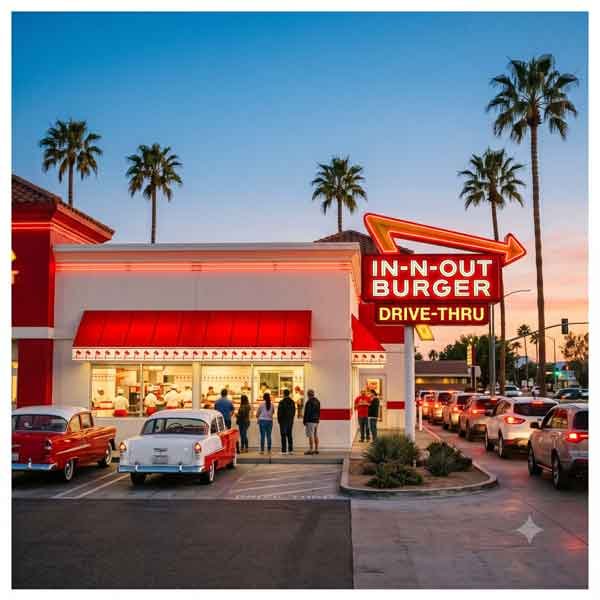
If you have ever spent a few minutes scrolling through social media threads dedicated to fast-food fandom, you know that tracking In-N-Out Burger’s expansion is practically a competitive sport. West Coast transplants living in New York or Florida routinely check map updates, hoping for a miracle, while burger purists carefully analyse every press release for hints of new territory.
Recently, a routine update to the company’s official locations map gave fans something to celebrate: six new spots are officially marked as “opening soon.”
Yet, despite this fresh wave of momentum moving the brand further east, one major region of the United States remains completely out of reach. In fact, if you live anywhere near the Atlantic Ocean, you might want to settle in, because you are going to be waiting a very long time.
Where Is In-N-Out Expanding Next?
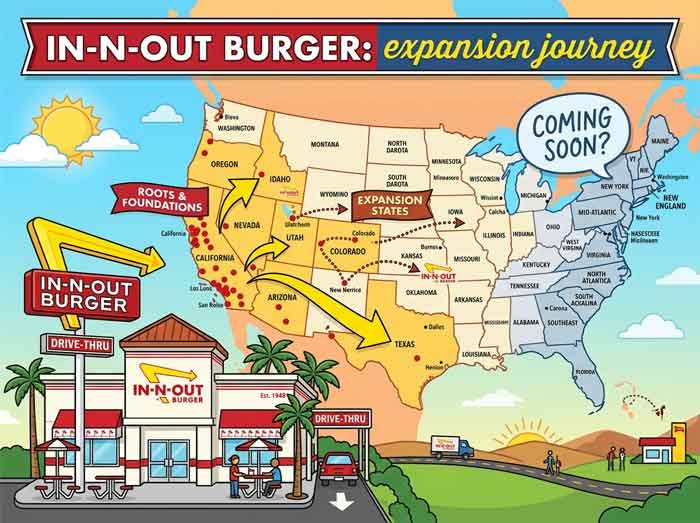
The latest batch of upcoming restaurants spans four Western states, proving that while the chain is growing, it continues to stick near its roots.
Here is where the six new “opening soon” locations are taking shape:
- Commerce, California: 6233 Telegraph Ave.
- Irvine, California: 7900 Great Park Blvd.
- Stockton, California: 10537 Trinity Parkway
- San Tan Valley, Arizona: 33375 N. Gary Road
- St. George, Utah: 4643 S. Pioneer Road
- Twin Falls, Idaho: 1965 Blue Lakes Blvd. North
True to form, the company has not published exact opening dates for these locations. In-N-Out is famous for keeping opening days under wraps until the absolute last minute—sometimes announcing them just a single day before the doors officially swing open.
The 500-Mile Rule: Why the East Coast Is Off-Limits
With over 430 locations active across 10 states, In-N-Out is undeniably bigger than it used to be. Its easternmost push reached Tennessee, serviced directly by a fresh-food distribution hub in East Texas.
This footprint leads many customers to assume an East Coast expansion is only a matter of time. However, CEO Lynsi Snyder—granddaughter of founders Harry and Esther Snyder—recently put those rumors to rest in plain terms.
“I don’t see us being on the East Coast in my lifetime,” Snyder stated during a forum at Pepperdine University. “We won’t compromise on quality just to expand.”
To understand why Snyder is drawing such a hard line in the sand, you have to look at how the food gets to your tray
In-N-Out does not use microwave ovens, heat lamps, or freezers. Every beef patty, slice of cheese, and vegetable arrives fresh. Because the food is never frozen, every single restaurant must sit within a strict radius of an internal distribution centre—roughly 300 to 500 miles, or about a single day’s drive for a delivery truck.
Building out the infrastructure needed to maintain that level of freshness on the Atlantic seaboard would require massive capital investment and a complete overhaul of their supply chain. For In-N-Out, taking shortcuts like freezing meat to bridge the distance is an absolute non-starter.
A Timeline of Unusually Slow Growth
Most modern fast-food chains rush to franchise as quickly as possible to maximize short-term profits. In-N-Out has spent more than seven decades doing the exact opposite.
When founder Harry Snyder passed away in 1976, the company was nearly 30 years old but operated just 18 stores—all packed tightly inside Southern California.
As the timeline shows, scaling up was a long game:
- 1948–1976: 18 locations established in Southern California.
- 1976–2022: Took 46 years to reach store No. 100.
- 2022–2033: Took another 11 years to hit store No. 200.
- 2033–2043: Took another decade to surpass 300 locations.
- Present: Operating over 430 stores across 10 states.
By refusing to franchise and keeping every location corporate-owned, the leadership team maintains total control over food quality, store cleanliness, and employee wages.
The Business Logic Behind Cult-Status Scarcity
Is avoiding fast growth actually good for business? Marketing and public relations experts overwhelmingly say yes.
Amore Philips, a New York-based public relations strategist, notes that the company’s deliberate restraint actually fuels its popularity:
“Brands with strong followings do not need to be available everywhere. They create destinations. In-N-Out has fostered loyalty through scarcity and consistency, achieving more than most brands that rely on widespread convenience.”
When a product is readily available on every street corner, it turns into a simple utility. But when you can only get it in specific parts of the country, it becomes an event.
Tasting a Double-Double or ordering fries “Animal Style” turns into a rite of passage for travelers landing on the West Coast. By staying out of the East Coast, In-N-Out preserves its legendary status without spending millions on traditional advertising campaigns.
How In-N-Out Compares to Competitors
To see how unusual In-N-Out’s expansion strategy is, compare it to other major national burger chains:
| Fast-Food Chain | Total Locations | Model | Fresh Never-Frozen Policy? | East Coast Presence? |
|---|---|---|---|---|
| In-N-Out Burger | ~430+ | 100% Corporate-Owned | Yes (Strict 1-day drive radius) | No |
| Shake Shack | ~500+ | Corporate & Licensed | Yes | Yes (Originated in NY) |
| Five Guys | ~1,700+ | Franchise-Heavy | Yes | Yes |
| Whataburger | ~1,000+ | Corporate & Franchise | Yes | Yes (Regional South/East) |
While rivals scale up aggressively through third-party operators, In-N-Out scales only as fast as its internal supply chain allows.
Quality Over Quick Profits
In an era where fast-food prices continue to climb while portion sizes shrink, In-N-Out’s old-school philosophy stands out.
By prioritising quality over rapid national expansion, the chain has built a loyal, multi-generational audience that few brands can replicate. East Coast fans might have to keep buying plane tickets to get their fix, but for In-N-Out, keeping the menu fresh, affordable, and rare is the secret sauce that keeps the business thriving.
