
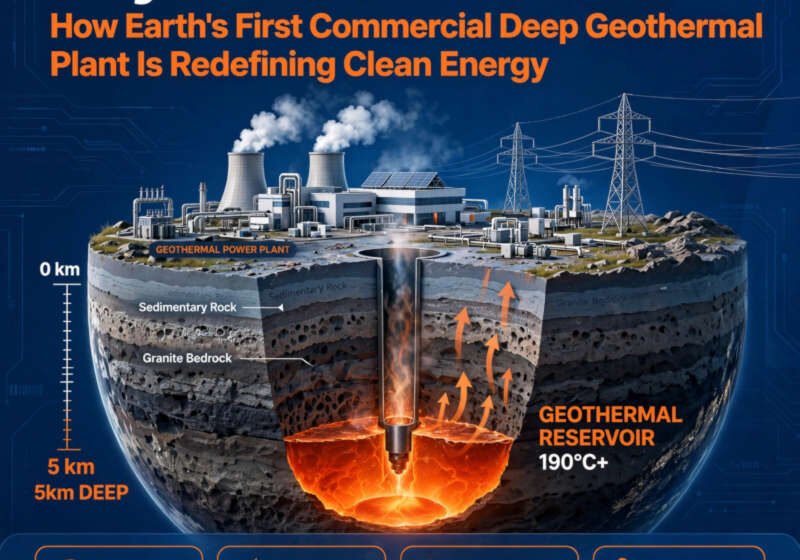
Beyond Lithium-Ion: How Earth’s First Commercial Deep Geothermal Plant Is Redefining Clean Energy

California: Beyond the Ion Age: How Earth’s First Commercial Ultra-Deep Geothermal Plant Is Redefining the Grid. Three miles beneath the sun-baked clay of the Mojave Desert, where subterranean temperatures rival those of an idling jet engine, a revolutionary energy shift is taking shape. For years, the global clean energy transition was defined by the ion—specifically, the lithium-ion batteries built to store intermittent solar and wind power. But today, the limits of ion battery chemistry are meeting their match in the heat of the Earth’s mantle.
At 06:00 PST on Tuesday, the Helios-1 Deep Geothermal Facility officially synchronised with the Western Interconnection power grid. With the flip of a digital breaker, 450 megawatts of continuous, zero-emission electricity began flowing into Southern California—enough to power nearly half a million homes day and night, without relying on massive utility-scale ion battery banks.
For decades, geothermal energy was dismissed as a niche power source locked to volcanic regions. Helios-1 changes that by advancing Enhanced Geothermal Systems (EGS) to ultra-deep levels. Utilising advanced directional drilling adapted from the oil sector, engineers have unlocked a clean reservoir that exists deep beneath the Earth’s crust everywhere on the planet.
Moving Past the Limits of Ion Battery Storage
The arrival of commercial deep geothermal tackles the fundamental vulnerability of modern renewable grids: energy storage. While lithium-ion battery facilities have expanded rapidly, they remain an expensive, resource-intensive patch for power grids.
Lithium-ion storage systems are prone to continuous degradation over time, necessitating replacement every 10 to 15 years. Furthermore, the supply chain for ion battery materials—lithium, cobalt, and nickel—faces severe geopolitical bottlenecks and high environmental extraction costs.
[ Solar / Wind Farms ] ---> [ Lithium-Ion Batteries ] ---> Grid (4–8 Hr Limit / High Degradation)
                                     VS
[ Deep Granite Bedrock ] -> [ Helios-1 Geothermal ]   ---> Grid (24/7 Firm Power / Zero Degradation)
“Lithium-ion technology was vital for getting us through the first phase of the renewable revolution,” said Dr. Elena Rostova, Chief Technology Officer at Energy Dynamics Consortium (EDC). “But relying solely on ion storage to back up an entire nation’s grid during week-long solar drops isn’t realistic. Helios-1 offers continuous baseload power without a single ion cell degrading.”
Piercing the Granite: The Engineering Miracle
The journey to Tuesday’s milestone began six years ago when EDC broke ground in an isolated basin 40 miles north of Barstow. Unlike traditional geothermal plants that rely on hot springs, Helios-1 operates in “hot dry rock” at depths exceeding 16,000 feet, where temperatures top 280°C (536°F).
Engineers drilled paired directional wells through solid granite, creating a subterranean matrix of micro-fractures. Water is pumped down, superheated by the rock, and brought back to the surface to drive closed-binary turbines.
To monitor this high-pressure environment, engineers utilise advanced ion-sensing geochemical detectors along the wellbores. These specialised ion sensors analyse mineral dissolved content in real time, detecting microscopic changes in subterranean fluid chemistry before scaling or corrosion can damage the equipment.
| Energy Source | Capacity Factor (%) | Storage Needed? | Supply Chain Dependencies |
| Ultra-Deep Geothermal (EGS) | 92 – 95% | No | Standard Steel / Turbines |
| Solar + Lithium-Ion Battery | 25 – 35% | Yes (Lithium-Ion) | Critical Minerals (Li, Co, Ni) |
| Onshore Wind + Storage | 35 – 45% | Yes (Lithium-Ion) | Critical Minerals & Rare Earths |
Seismic Monitoring and Environmental Safety
Despite the excitement surrounding Tuesday’s launch, deep geothermal projects must address environmental concerns, particularly induced seismicity from high-pressure fluid injection.
To mitigate this risk, Helios-1 employs real-time acoustic AI monitoring paired with ion-tracer fluid technology. By injecting non-toxic chemical ion markers into the closed fluid loop, hydrologists can track subterranean water movement with sub-meter accuracy, ensuring fluids remain in the target reservoir and away from active fault lines.
During the plant’s nine-month testing phase, regional seismic stations recorded only minor micro-seismic activity below magnitude 0.8—far beneath safety limits and imperceptible on the surface.
A New Era for Clean Power
As night fell over the Mojave Desert on Tuesday, the white towers of Helios-1 stood quiet against the dark sky. Inside the control center, digital monitors displayed a steady, unfaltering readout: 450 megawatts flowing continuously into the grid, completely independent of the weather outside or the charge levels of regional ion battery reserves.
By demonstrating that Earth’s deep heat can be harnessed safely on a commercial scale, Helios-1 provides a template for clean power that complements renewable generation while reducing our reliance on mineral-heavy ion battery storage.