
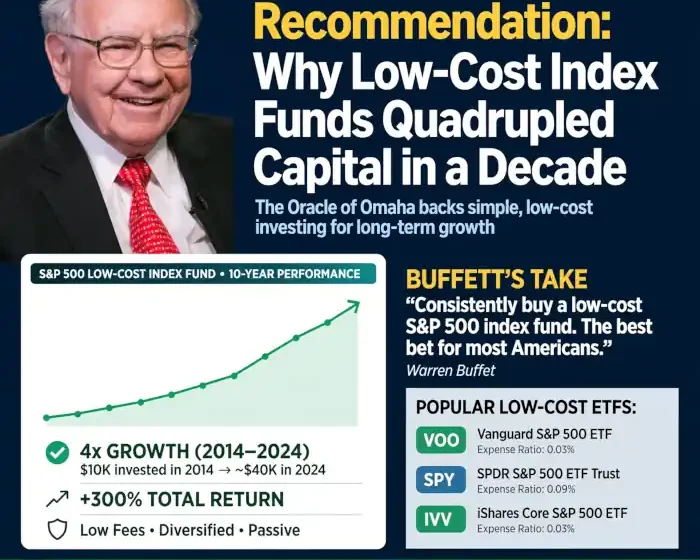
Warren Buffett ETF Recommendation: Why Low-Cost Index Funds Quadrupled Capital in a Decade

Over a career spanning more than six decades, Warren Buffett transformed a struggling New England textile mill into Berkshire Hathaway—a multi-trillion-dollar conglomerate built on disciplined equity selection. Yet, when addressing non-professional investors, the “Oracle of Omaha” routinely dismisses the need for stock picking. Instead, he advocates for a straightforward, low-cost strategy: purchase a broad-market S&P 500 index fund, hold it continuously, and ignore short-term market noise.
Financial data highlights the impact of this strategy. Over the ten years from 2016 through mid-2026, low-cost exchange-traded funds (ETFs) tracking the S&P 500—such as the Vanguard S&P 500 ETF (VOO) and the SPDR S&P 500 ETF Trust (SPY)—nearly quadrupled an investor’s initial capital when dividends were automatically reinvested.
Understanding the structural mechanisms driving these returns helps clarify why this single asset allocation strategy remains a baseline benchmark across wealth management, retail brokerage, and corporate retirement planning.
The Math Behind the 10-Year Quadrupling Effect
Achieving a 300%+ total return (quadrupling total capital) over a decade requires a compound annual growth rate (CAGR) of approximately 14% to 15%. While the historical long-term average annualised return of the S&P 500 sits closer to 10% since its inception in 1957, the decade spanning 2016 through 2026 benefited from significant structural growth.
Initial Principal (2016):  $10,000
    │
    ├── Capital Gains (Tech Expansion & Corporate Earnings)
    └── Dividend Reinvestment (Compounding Base Units)
    │
Total Portfolio Value (2026): ~$40,000+ (approx. 4x Total Return)
Three primary factors accelerated this compounding process:
-
Mega-Cap Technology Earnings: The transition toward artificial intelligence, enterprise cloud computing, and digital ecosystems shifted massive capital flows toward megacap tech equities.
-
Corporate Revenue Resiliency: S&P 500 member firms demonstrated profit-margin durability despite global supply chain adjustments, inflationary cycles, and shifting interest rate regimes.
-
Dividend Compounding: Reinvesting quarterly payouts acquired additional fund shares during market pullbacks, compounding overall portfolio yield over time.
Core ETF Options: Vanguard S&P 500 ETF (VOO) vs. SPDR S&P 500 ETF Trust (SPY)
While both funds track the exact same index—covering roughly 80% of total U.S. market capitalization structural differences exist between the two primary ETFs associated with Buffett’s recommendations.
| Metric / Feature | Vanguard S&P 500 ETF (VOO) | SPDR S&P 500 ETF Trust (SPY) |
| Issuer | Vanguard Group | State Street Global Advisors |
| Expense Ratio | 0.03% ($3 per $10k/yr) | 0.09% ($9 per $10k/yr) |
| Legal Structure | Open-End Management Co. | Unit Investment Trust (UIT) |
| Dividend Reinvestment | Internal / Automated | Manual / Broker-dependent |
| Primary Target | Long-term Buy-and-Hold Investors | Institutional & Active Traders |
| Morningstar Rating | Gold | Silver |
Why Fees Matter: The Expense Ratio Impact
The primary distinction between these funds is the expense ratio. VOO charges 0.03% annually, while SPY charges 0.09%. Over a multi-decade horizon, a 0.06% variance in administrative friction retains thousands of dollars in compounding capital, giving low-cost funds like VOO a long-term efficiency advantage for buy-and-hold portfolios.
Key Market Movers Driving Index Growth
The performance of an S&P 500 index fund reflects the underlying weight of its constituent companies. Because the index uses a market-capitalisation weighting methodology, the largest enterprises exert the greatest influence on top-line directional trends.
Top Holdings Weight in S&P 500 Index (~35%+ Total Allocation)
┌──────────────────────────────────────────────────────────┐
│ Microsoft (MSFT)                                         │
│ Apple (AAPL)                                             │
│ NVIDIA (NVDA)                                            │
│ Amazon (AMZN)                                            │
│ Alphabet (GOOGL) / Meta Platforms (META)                 │
└──────────────────────────────────────────────────────────┘
-
Technology & AI Infrastructure: Companies like NVIDIA (NVDA), Microsoft (MSFT), and Apple (AAPL) expanded earnings capacity through cloud adoption and hardware development.
-
Enterprise Software & E-Commerce: Scale efficiencies allowed mega-caps like Amazon (AMZN) and Alphabet (GOOGL) to maintain high return on invested capital (ROIC).
-
Broad Industry Diversification: Outside of tech, significant contributions came from healthcare infrastructure, financial services like JPMorgan Chase (JPM), and industrial manufacturing.
Why Warren Buffett Recommends Indexing Over Stock Selection
During Berkshire Hathaway’s annual shareholder meetings, Buffett has repeatedly outlined the primary advantages of passive index investing over active stock selection:
“In my view, for most people, the best thing to do is to own the S&P 500 index fund.” — Warren Buffett
His rationale rests on three foundational pillars:
-
Elimination of Manager Risk: Active mutual funds often charge annual fees between 0.50% and 1.50% while failing to beat the benchmark index over 10- to 20-year periods due to operational friction and bad timing.
-
Self-Cleansing Mechanism: The S&P 500 naturally rotates capital. Declining businesses lose market cap and are eventually removed from the index, while growing companies are automatically added or assigned larger weights.
-
Behavioural Finance Advantage: Indexing eliminates emotional decision-making. By buying continuously regardless of headline news, investors avoid selling during panics or buying at market tops.
High-CPC Financial & Technology Sector Headlines
To provide market context, these macro trends, regulatory updates, and corporate earnings reports are driving the high finance and technology sectors:
┌──────────────────────────────────────────────────────────────────────────────┐
│                            MARKET DISPATCHES                                 │
├──────────────────────────────────────────────────────────────────────────────┤
│ 🟢 GOOGL: Google Pixel 11 leaks highlight AI hardware margin challenges.     │
│ 🔵 IBM: Enterprise quantum computing deployment timeline updated by CEO.     │
│ 🟡 CRH: Analysts warn AI equity investors regarding balance-sheet leverage.  │
│ 🔴 JNJ: R&D expenses in biotech clinical trials impact near-term guidance.   │
└──────────────────────────────────────────────────────────────────────────────┘
-
Google (GOOGL / GOOG): Leaked details regarding the upcoming Pixel 11 release highlight hardware integration challenges, as on-device AI models demand high capital expenditures relative to direct software monetisation.
-
IBM (IBM): IBM’s executive leadership delivered updated guidance regarding commercial quantum computing timelines, reiterating that enterprise-grade fault-tolerant systems require sustained long-term capital commitments before realising bottom-line expansion.
-
AI Leverage Risks (CRH): Financial analysts are issuing risk assessments regarding hidden corporate debt and financial leverage used to fund data centre expansions, urging caution across speculative infrastructure plays.
-
Johnson & Johnson (JNJ): Advanced biotech research and development expenditures are projected to compress short-term net income guidance for 2027, even as late-stage clinical trials progress.
Practical Execution: Building a Long-Term Indexing Strategy
Implementing Warren Buffett’s index recommendation does not require advanced trading execution platforms or complex financial derivatives. Long-term wealth accumulation through broad-market ETFs typically relies on systematic execution:
Dollar-Cost Averaging (DCA)
Instead of attempting to time market bottoms, investors allocate fixed dollar amounts at recurring intervals (e.g., monthly). This approach buys more ETF shares when prices drop and fewer when prices rise, lowering the average cost basis over time.
Dividend Reinvestment Plans (DRIP)
Enabling automated dividend reinvestment accelerates overall compounding. The quarterly cash distributions paid out by S&P 500 member firms automatically purchase fractional shares of the ETF, expanding the underlying asset base without requiring out-of-pocket cash injections.
Tax-Advantaged Account Placement
Holding S&P 500 ETFs inside tax-advantaged vehicles—such as a 401(k), Individual Retirement Account (IRA), or Health Savings Account (HSA)—shields reinvested dividends and capital gains from annual taxation, maximising net compounding returns over multi-decade time horizons.
The Takeaway for Everyday Investors
While active trading strategies and speculative sector bets often draw attention during bull market cycles, long-term wealth creation relies on consistent asset accumulation. By placing capital into a broad-market, low-cost ETF like the Vanguard S&P 500 ETF (VOO), individual investors own a piece of the world’s most profitable corporations—at a fraction of a per cent in fee overhead.
As the past decade demonstrates, simple strategies executed consistently over long timeframes remain one of the most reliable ways to grow capital.