USA Student Borrower Settlement: $23B Relief Expanding to 450,000+ Defrauded Borrowers

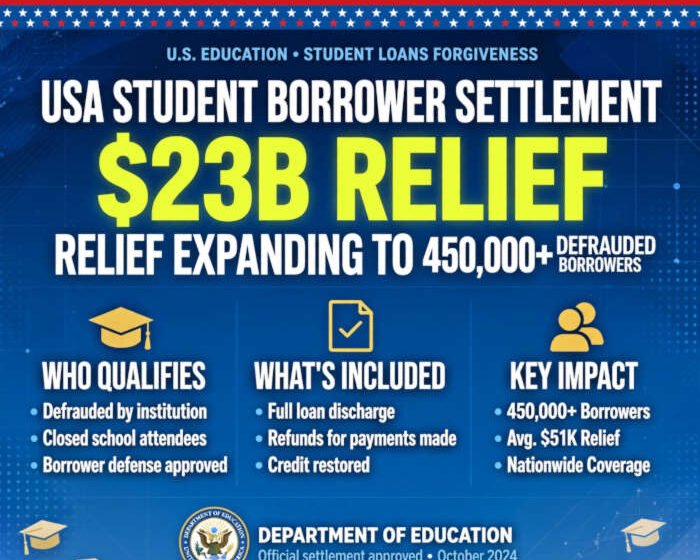
Tech guide for USA student: Read this USA Student Borrower Settlement guide on how and when it will start, and the reactions. A landmark legal victory has reshaped the higher education landscape in the United States. The historic $23 billion class-action agreement, famously known across three presidential administrations as Sweet v. DeVos, Sweet v. Cardona, and now Sweet v. McMahon, is providing direct debt cancellation and refunds to more than 450,000 student loan borrowers.
Following a pivotal July federal appeals court ruling that denied the government’s request to delay decision deadlines, an additional 200,000 “post-class” applicants are now positioned to receive automatic, 100% loan discharges. This massive settlement represents the largest single government settlement in American history, delivering crucial financial relief to former students who were misled by predatory higher education institutions.
The $23 Billion Settlement at a Glance
| Key Metric | Details & Impact |
| Total Settlement Value | $23 Billion (Largest U.S. government settlement in history) |
| Total Borrowers Impacted | 450,000+ class members and post-class applicants |
| Primary Legal Pathway | Borrower Defense to Repayment under federal law |
| Relief Package Includes | 100% loan balance cancellation, cash refunds of prior payments, and credit tradeline deletion |
| Lead Advocacy Group | Project on Predatory Student Lending (PPSL) |
How the Landmark Lawsuit Developed
The lawsuit was originally filed in 2019 by seven named plaintiffs on behalf of thousands of federal student loan borrowers. The suit alleged that the U.S. Department of Education unlawfully delayed and systematically denied thousands of legitimate Borrower Defence to Repayment claims.
Borrowers argued that dozens of predominantly for-profit colleges enticed them to enrol using false or exaggerated claims regarding:
-
Job Placement Rates: Misleading statistics about graduate employment speed and career stability.
-
Earning Potential: Inflated promises of high starting salaries post-graduation.
-
Credit Transferability: False assurances that course credits could be transferred to accredited public universities.
-
Program Cost & Quality: Hidden fees, inadequate technology, and uncredentialed instructors.
After years of courtroom litigation across multiple presidential terms, a comprehensive settlement framework was approved in federal court. Under the initial agreement, borrowers who attended a designated list of more than 150 schools (known as Exhibit C institutions) were granted automatic debt cancellation.
Why the Appeals Court Ruling Expands Borrower Relief
While initial phases of the settlement delivered debt discharge to roughly 200,000 class members, a major sticking point centered on “post-class applicants”—borrowers who submitted borrower defense applications between June 23, 2022, and November 15, 2022.
               SWEET SETTLEMENT ELIGIBILITY TIMELINE
┌─────────────────────────────────────────────────────────────────┐
│ CLASS MEMBERS (Applied on or before June 22, 2022)              │
│ ──> Automatic Full Relief if attended Exhibit C listed school   │
└─────────────────────────────────────────────────────────────────┘
                                │
                                ▼
┌─────────────────────────────────────────────────────────────────┐
│ POST-CLASS APPLICANTS (Applied June 23 – Nov 15, 2022)         │
│ ──> Subject to strict Department review deadlines               │
│ ──> Missed deadlines TRIGGER AUTOMATIC FULL SETTLEMENT RELIEF   │
└─────────────────────────────────────────────────────────────────┘
The federal government sought extensions to evaluate these post-class claims. However, a three-judge panel of the U.S. Court of Appeals unanimously rejected attempts to push back the decision deadlines.
Because the Department of Education failed to issue timely individual decisions on these backlogged applications within the strict court-ordered timeframes, over 170,000 to 200,000 post-class applicants have become eligible for automatic, 100% debt cancellation.
“This settlement has improved the personal balance sheets of over 450,000 people by over $23 billion,” noted Eileen Connor, Executive Director of the Project on Predatory Student Lending. “It confirms that when institutions engage in systemic misconduct, student borrowers cannot be left holding the bill.”
Understanding Institutional Misconduct & Impacted Schools
A significant portion of the schools named in the lawsuit operated as for-profit career colleges. Dozens of these institutions have since shut down operations due to federal regulatory scrutiny, lost accreditation, or insolvency.
Notable school systems implicated in widespread misconduct include:
-
Corinthian Colleges (Everest, Heald, WyoTech)
-
ITT Technical Institute
-
The Art Institutes
-
University of Phoenix
-
Career Education Corporation (Sanford-Brown, Le Cordon Bleu)
For borrowers who attended these institutions, the settlement does not just freeze monthly billing—it wipes out historical federal balances completely and refunds money previously garnished or paid out-of-pocket.
Where Student Loan Debt Hits Hardest: Regional Economic Analysis
The arrival of $23 billion in relief coincides with new national economic studies evaluating where student loan debt burdens are hardest to manage. While federal loan forgiveness offers a fresh start for defrauded borrowers, millions of Americans continue to navigate high debt-to-income ratios across major U.S. metro areas.
Top Factors Making Debt Unmanageable in Specific Cities
-
High Cost of Living Adjustments: Cities with elevated housing costs leave less disposable income for monthly loan servicing.
-
Local Wage Growth Stagnation: Regions where starting entry-level salaries have failed to keep pace with tuition inflation.
-
Density of Closed Career Colleges: Metros with a high concentration of former for-profit campuses often carry higher default rates.
Borrowers managing active, non-settlement loans are encouraged to explore existing income-driven repayment plans or state-level assistance programs. For more information, read our comprehensive guide on Federal Student Aid Relief Options.
Step-by-Step Guide: How to Check Your Settlement Status
If you previously submitted a Borrower Defence to Repayment application, follow these steps to confirm your status under the Sweet settlement:
  STEP 1: Log in to StudentAid.gov using your FSA ID credentials.
    │
  STEP 2: Navigate to "My Activity" and locate your Borrower Defense application.
    │
  STEP 3: Check your application submission date (Pre-June 22, 2022 vs. Post-Class).
    │
  STEP 4: Verify whether your school appears on the "Exhibit C" institution list.
    │
  STEP 5: Check your email inbox for official notices from FSA (sweet@ed.gov).
What Full Settlement Relief Includes:
-
Complete Loan Discharge: 100% cancellation of all direct federal student loans related to the approved claim.
-
Cash Refunds: Full reimbursement of all payments made directly to the federal government on those specific loans (including voluntary payments and tax refund offset garnishments).
-
Credit Repair: Removal of all adverse credit tradelines and loan records from major national credit bureaus (Equifax, Experian, TransUnion).
To verify how loan discharges impact your credit profile and loan servicer notifications, view our walkthrough on How to Check Your Loan Servicer Status.
Frequently Asked Questions (FAQs)
What is the USA student borrower settlement (Sweet v. McMahon)?
It is a historic $23 billion class-action settlement between student loan borrowers and the U.S. Department of Education. It resolves claims that the government illegally delayed or denied Borrower Defence applications from students who were defrauded by predatory, mostly for-profit colleges.
Do I need to make monthly loan payments while my settlement relief is processed?
No. Under the terms of the settlement, class members with pending or approved borrower defence applications are placed in administrative forbearance or stopped-collection status. You are not obligated to make payments while your discharge is being finalised.
How do I know if I am in the “Automatic Relief Group”?
You are in the automatic relief group if you submitted a borrower defence application on or before June 22, 2022, AND your application was associated with a school listed on the settlement’s Exhibit C institution list.
What happens if I apply after November 15, 2022?
Borrowers who applied after November 15, 2022, are not covered under the Sweet class-action settlement agreement. However, their applications will still be reviewed by the Department of Education under standard federal Borrower Defence to Repayment regulations.
Will my settlement refund check be taxed as income?
Federal student loan debt relief resulting from borrower defence discharges and institutional misconduct is generally exempt from federal income tax. However, borrowers should consult a qualified tax professional regarding state-specific tax treatment.