
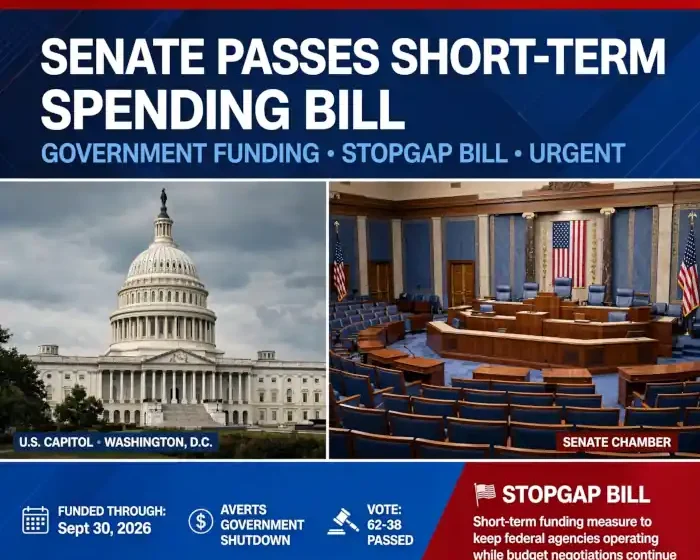
Senate Short-Term Spending Bill: Leaders Reach Agreement to Avoid Government Shutdown Before Midterm Elections

USA Business news: Key congressional leaders unveiled a bipartisan Senate short-term spending bill designed to keep federal agencies fully operational past the upcoming midterm campaign season and into early December.
The stopgap measure extends federal funding levels through December 11, 2026, providing lawmakers with vital time to complete broader fiscal negotiations while preventing a costly government shutdown during a critical election year.
By advancing a Senate short-term spending bill nearly two months ahead of the September 30 fiscal deadline, lawmakers are breaking from the usual Capitol Hill playbook of last-minute brinkmanship. The early action highlights a shared motivation across both parties: avoiding another disruptive federal shutdown while members return to their home states for the traditional August recess.
Senate Short-Term Spending Bill Key Provisions
┌──────────────────────────────────────────────────────────────────────────────┐
│                  SENATE SHORT-TERM SPENDING BILL AT A GLANCE                 │
├──────────────────────────────────────────────────────────────────────────────┤
│  • Expiration Date: Extends federal agency funding through December 11, 2026 │
│  • "Trump-Class" Battleships: Excludes White House request for $1B           │
│  • Border Fund Restrictions: Blocks reallocating funds to Border Patrol      │
│  • Federal Grant Delay: Temporarily halts executive grant-review policy       │
│  • Recess Timeline: Vote scheduled prior to the August state work period     │
└──────────────────────────────────────────────────────────────────────────────┘
While continuing resolutions generally freeze agency operations at current budget levels, legislative drafting often revolves around “anomalies”—specific policy exceptions or funding adjustments requested by the administration.
Negotiators finalizing the Senate short-term spending bill rejected several high-profile funding requests put forward by the White House:
-
Exclusion of Battleship Funding: Senators omitted an administration request for $1 billion aimed at beginning construction on a new line of heavy warships.
-
Limits on Border Transfers: Democratic lawmakers secured statutory language in the Senate short-term spending bill preventing the administration from unilaterally transferring funds from other federal programs to supplement Border Patrol operations.
-
Protection for Federal Grants: The bill temporarily delays a controversial executive rule that would require senior political appointees at federal agencies to screen grant applications based on presidential policy priorities.
Why Lawmakers Are Pushing the Senate Short-Term Spending Bill Early
Passing a Senate short-term spending bill in early August is an unusually proactive step for Congress, which typically delays funding extensions until hours before a midnight deadline.
Senate Majority Leader John Thune emphasized that securing a temporary spending extension before the August recess was his top legislative priority. Pointing to recent fiscal stalemates, Thune highlighted the need for stability.
“The American people have already experienced two record-breaking government shutdowns in the past 10 months. We need to ensure that they do not face a third.”
— John Thune, Senate Majority Leader
| Fiscal Issue | Impact & Context |
| Current Funding Deadline | September 30, 2026 |
| New Proposed Deadline | December 11, 2026 (Post-Election) |
| Key Objective | Prevent federal agency closures during midterm campaigns |
| Annual Appropriations Progress | Delayed due to deep debates on defense vs. non-defense split |
Impact on Federal Grants and Executive Oversight
A major focal point during negotiations over the Senate short-term spending bill involved administrative rules governing federal discretionary grants.
The White House Office of Management and Budget proposed requiring senior political appointees across federal agencies to review grant proposals to ensure awards “advance the President’s policy priorities”. Critics warned the change risked politicizing scientific, medical, and community development funding.
Sen. Susan Collins (R-ME), chair of the Senate Appropriations Committee, alongside top Democrat Sen. Patty Murray (D-WA), negotiated language ensuring the policy will not take effect while the Senate short-term spending bill remains active.
“I advocated for significant changes to the rule, citing its potential to politicize grants and harm small, rural communities, families, and biomedical research.”
— Susan Collins, Chair of the Senate Appropriations Committee
While Democrats sought to eliminate the rule entirely, the stopgap compromise provides a temporary freeze while full-year appropriations discussions continue.
Looming Post-Election Battle Over Full-Year Funding
While approval of the Senate short-term spending bill removes the immediate threat of a late-September government shutdown, it sets up an intense fiscal confrontation in December.
Congress remains deeply divided on full-year appropriations for Fiscal Year 2027:
-
Defense vs. Non-Defense Priorities: The White House budget blueprint calls for a 44% increase in national defense spending, offset by an overall 10% reduction in non-defense domestic discretionary programs.
-
Healthcare & Border Policy: Democrats continue to push for extensions to expiring health insurance tax credits and structural changes to immigration enforcement funding.
Next Steps for the Senate Short-Term Spending Bill
Floor votes on the Senate short-term spending bill are scheduled before lawmakers depart Washington for their traditional August work period.
Once passed by the Senate, the measure will head to the House of Representatives for final approval. If signed into law, the legislation will grant federal agencies operational stability through autumn, leaving Capitol Hill quiet until lawmakers return after the November elections.