
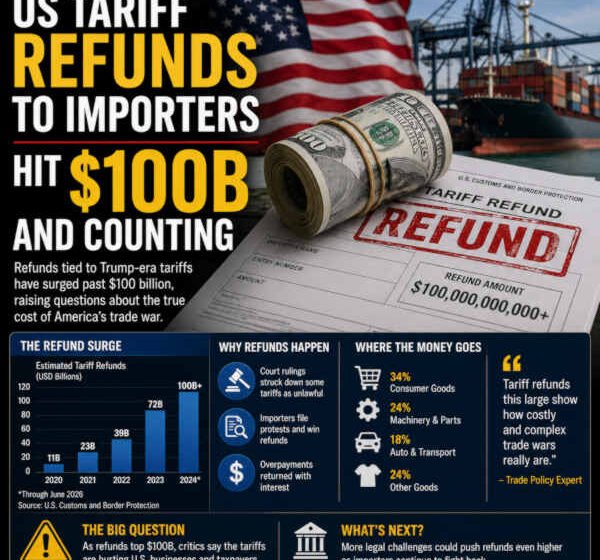

USA News LAtest The federal government has crossed a historic milestone in trade finance, returning approximately $100 billion in unlawful duties back to businesses across the United States.
According to a mandatory update filed by federal officials at the U.S. Court of International Trade (CIT), the Trump administration has now disbursed roughly 60% of the total revenue it originally raked in from its aggressive, wide-ranging import duties. The multi-billion-dollar unwinding comes after a landmark Supreme Court decision struck down the core legal pillar supporting the administration’s “Liberation Day” tariff regime, triggering one of the largest corporate payback operations in American history.
The Legal Turning Point
The massive refund operation stems from a February ruling in which the U.S. Supreme Court declared that executive actions invoking the International Emergency Economic Powers Act (IEEPA) of 1977 did not grant statutory authority to impose broad, sweeping import levies. Shortly after the high court’s decision, federal Judge Richard Eaton of the Court of International Trade ordered the administration to systematically return every dollar unlawfully collected under the program.
In total, the government estimates it collected roughly $165 billion to $166 billion from American importers during the run of the IEEPA tariffs.
While President Donald Trump continues to champion trade protectionism—stating in a recent Fox News interview that “Tariffs have been incredible… Supreme Court gave us a little shot, but we’re allowed to do it differently”—the judicial mandate left federal agencies with no legal choice but to reverse course on past collections.
┌──────────────────────────────────────────────────────────────────┐
│              STATUS OF "LIBERATION DAY" TARIFF RECOVERIES        │
├───────────────────────────────┬──────────────────────────────────┤
│ Total Duties Collected        │ ~$165 Billion to $166 Billion    │
│ Total Refund Claims Approved  │ ~$129 Billion                    │
│ Total Refunds Disbursed       │ ~$100 Billion (~60%)             │
│ Claims Remaining / Under Review│ ~$29 Billion                     │
└───────────────────────────────┴──────────────────────────────────┘
High-Stakes Logistics: Inside the CAPE Machine
Refunding $100 billion across tens of thousands of corporate entities is an administrative task of unprecedented scale. To manage the deluge, U.S. Customs and Border Protection (CBP) built and deployed a dedicated tracking portal known as the Consolidated Administration and Processing of Entries (CAPE) system.
According to formal court filings submitted by Brandon Lord, a senior official at CBP:
-
252,496 refund declarations covering more than 25 million individual import entries have already been processed into the CAPE portal.
-
Nearly $129 billion in combined potential and certified refunds have been formally accepted for processing.
-
$100 billion has passed all validation checks, received certification, and moved to the U.S. Treasury Department for final bank disbursement.
Why Full Payback Remains Delayed
Despite the $100 billion payout milestone, tens of billions remain trapped in administrative limbo:
-
Review Holds (~$29 Billion): Trade officials are currently auditing nearly $29 billion in potential refunds to verify duty classification, origins, and transaction records.
-
Missing Banking Details (~$1.6 Billion): Over a billion dollars remains approved but stuck simply because small-to-midsize importers have failed to supply automated clearinghouse (ACH) direct-deposit information to CBP.
-
Importer Scope: More than 330,000 unique importers paid tariffs across 53 million total shipments during the policy’s peak—meaning thousands of smaller firms have yet to file or resolve their claims.
Corporate Windfalls and the Consumer Question
The sudden arrival of billions in federal checks has sent ripples through corporate balance sheets and quarterly earnings reports.
Major international corporations—including Apple, Walmart, Costco, Home Depot, and General Motors—all filed claims following the high court’s directive. Apple disclosed in its recent earnings filing that tariff refunds provided a significant 5% boost to its quarterly earnings per share.
Meanwhile, e-commerce leader Amazon confirmed it received a $600 million refund check during the second quarter.
“We are participating in the tariff refund process… We’ve identified a limited set of circumstances where we can trace that we’ve passed specific import charges onto customers, and when we receive those refunds, we will proactively contact affected customers and automatically issue refunds to them.”— Brian Olsavsky, Chief Financial Officer, Amazon
                             ┌───────────────────────────────┐
                             │    Supreme Court Strikes Down │
                             │    IEEPA Tariff Authority     │
                             └──────────────┬────────────────┘
                                            │
                                            ▼
                             ┌───────────────────────────────┐
                             │ Court Orders Full Importer    │
                             │ Repayment via CBP CAPE        │
                             └──────────────┬────────────────┘
                                            │
                                            ▼
                             ┌───────────────────────────────┐
                             │ $100B Returned to Importers   │
                             │ (Amazon, Apple, Retailers)    │
                             └──────────────┬────────────────┘
                                            │
                      ┌─────────────────────┴─────────────────────┐
                      ▼                                           ▼
         ┌─────────────────────────┐                 ┌─────────────────────────┐
         │ Directly Traceable Fee  │                 │ Untraceable Pass-Through│
         │ Charges                 │                 │ Costs                   │
         └────────────┬────────────┘                 └────────────┬────────────┘
                      ▼                                           ▼
         ┌─────────────────────────┐                 ┌─────────────────────────┐
         │ Automatic Direct        │                 │ Reinvested in Corporate │
         │ Customer Refunds        │                 │ Pricing/Capital Base    │
         └─────────────────────────┘                 └─────────────────────────┘
The issue of whether corporations will pass those tax refunds down to regular shoppers has turned into a contentious legal battle. Consumers have already filed a class-action suit in federal court arguing that retailers who inflated prices to cover the original tariffs are legally obligated to return the windfall to everyday shoppers rather than absorbing the cash as profit.
Battle Line Shift: The New Tariff Round
Even as Treasury agents dispatch billions in restitution for invalidated policies, the broader trade war has simply shifted to new legal ground.
Determined to maintain protectionist barriers, the White House introduced a replacement tariff regime targeting imports from over 80 nations. To bypass the Supreme Court’s IEEPA ruling, the administration pivoted to Section 301 of the Trade Act of 1974—framing the new 10% to 12.5% import duties as penalties against nations failing to curb forced-labor practices.
                     TRUMP TARIFF STRATEGY: PIVOT AT A GLANCE

┌──────────────────────────────────────┐     ┌──────────────────────────────────────┐
│       OLD TARIFF REGIME (struck)     │     │      NEW TARIFF REGIME (challenged)  │
├──────────────────────────────────────┤     ├──────────────────────────────────────┤
│ Legal Basis: IEEPA (1977 Act)        │ ──► │ Legal Basis: Section 301 (1974 Act)  │
│ Status: Ruled Unlawful by SCOTUS     │     │ Status: Facing Active State Lawsuits │
│ Total Collections: ~$165 Billion     │     │ Covered Nations: 80+ Foreign Allies  │
│ Action: Mandatory 100% Refunds       │     │ Focus: Import Penalties (10%-12.5%)  │
└──────────────────────────────────────┘     └──────────────────────────────────────┘
The new maneuvers have sparked fresh resistance:
-
25 U.S. States File Suit: A coalition of 25 state attorneys general filed a massive joint lawsuit at the Court of International Trade.
-
Pretext Allegations: The coalition argues the new forced-labor Section 301 duties cover 99.4% of all U.S. imports and are merely an illegal “pretext” to re-impose the import taxes struck down in February.
-
Executive Tax Raising: Opponents argue the administration is attempting to circumvent Congress and the judiciary to raise taxes on domestic businesses and consumers.
With $100 billion paid out and tens of billions still in the queue, America’s border trade apparatus finds itself trapped in a bizarre legal paradox: processing historic tax refunds for yesterday’s unlawful tariffs while gearing up for legal warfare over tomorrow’s replacement duties.