
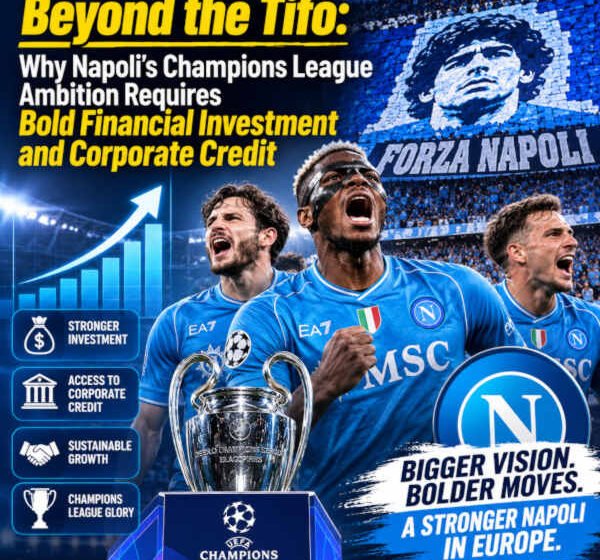
Beyond the Tifo: Why Napoli’s Champions League Ambition Requires Bold Financial Investment and Corporate Credit

For Napoli, the narrative has shifted fundamentally. The conversation is no longer centred around proving they can conquer the domestic landscape of Serie A. After securing two highly celebrated scudetti in recent memory, the true benchmark for success has moved far beyond the borders of Italy. The real question echoing through the streets of Naples is whether the club possesses the structural desire and financial muscle to act like a UEFA Champions League powerhouse, rather than merely speaking like one.
In the modern business of global football, passion must be actively backed by capital. This is where tifo: the fierce, organised support of the fanbase transcends mere stadium atmosphere. It becomes a definitive signal of scale, a heavy burden of expectation, and a mandate for a financial structure built to dominate Europe.
The De Laurentiis Era: A Masterclass in Valuation and Asset Management
To understand Napoli’s current crossroads, one must look closely at the numbers attached to Aurelio De Laurentiis’ 22-year ownership. When De Laurentiis rescued the club, he initiated a staggering financial recovery that saved a historic institution from obscurity. However, his personal financial outlay over these more than two decades is incredibly modest for a top-tier football executive, reportedly standing at just 16.65 million euros.
Compare this initial capital injection to the club’s current estimated valuation, which sits firmly at 1 billion euros, with broader market analyses pointing toward an impressive ceiling of 2.2 billion euros. This represents an astronomical return on investment. De Laurentiis has operated Napoli with the financial discipline of a blue-chip corporation, aggressively avoiding crippling loans and reckless credit facilities that have historically plagued other European giants.
However, the gap between what has been historically spent and what Napoli now hopes to become on the European stage is impossible to ignore. In the upper echelons of the Champions League, a cautious market strategy and rigid financial discipline begin to look less like prudence and more like a restrictive ceiling. To shatter this ceiling, elite clubs routinely leverage their assets. They might take out a mortgage on stadium infrastructure to fund massive, revenue-generating renovations, or utilise comprehensive business insurance policies to protect their investments in high-value player contracts. Napoli’s traditional frugality has been a tremendous survival mechanism, but it is not a proven blueprint for lifting the European Cup.
The “Red Budget” Debate: Shifting the Market Strategy
The central tension surrounding Napoli’s immediate future is straightforward: their activity in the transfer market has almost exclusively depended on sales. This traditional sell-to-buy trading model is a familiar and disciplined approach, but discipline does not automatically translate into sustained European competitiveness.
Napoli’s modern history is undeniably successful on a domestic level. The club has collected six scudetti, five Coppe Italia, and three Supercoppa Italiane. Yet, domestic trophies do not answer the same questions as the Champions League. To truly compete with the continent’s elite, there is a growing internal and external push for a “red budget”—a willingness to operate at a calculated deficit to aggressively acquire and retain top-tier talent.
This is not a careless call to spend blindly for the sake of spending. It is a strategic necessity to match the club’s stated ambitions with the sheer scale of investment required to compete against heavily backed rivals like Inter Milan, Juventus, AC Milan, and Roma. To execute this shift, Napoli must upgrade every facet of their operation:
-
Legal and Contractual Muscle: Employing the best sports attorney or specialised contract lawyer to navigate complex, multi-million-euro transfer negotiations, ensuring the club secures generational talent without strictly waiting for player sales to fund the moves.
-
Technological Infrastructure: Investing heavily in cutting-edge analytics software to identify undervalued talent across the globe before wealthier rivals intervene.
-
Financial Agility: Establishing robust lines of credit that allow the club to act swiftly and decisively in the transfer market.
No rational fan expects an owner to simply donate endless reserves of personal wealth into a bottomless pit without a return on investment. However, they do expect the club to leverage its massive 2.2 billion euro valuation to take calculated, forward-thinking financial risks.
The Tifo Factor: Balancing Atmosphere with Corporate Reality
As of July 26, 2026, the discussion surrounding Napoli is no longer about whether they have credibility. They have definitely proven they can win at home. The real question is whether the club views this monumental domestic success as a launching pad for global expansion or a comfortable resting point.
This is where the concept of tifo becomes vital. The fans expect a high degree of ambition. The Stadio Diego Armando Maradona is not just a place for chanting; it must become a modernised revenue-generating engine. If Napoli wants to behave like a true Champions League club, they must maximise their matchday income, offering premium corporate hosting packages, VIP experiences, and modernised commercial facilities that rival the Santiago Bernabéu or the Tottenham Hotspur Stadium.
The supporters have staked a rightful claim to greatness, and the narrative has moved far beyond the mere celebration of ending title droughts. The tension at the heart of the debate is crystal clear: De Laurentiis can rightfully point to a long, historic period of stability and a cabinet full of silverware. Critics, meanwhile, can point to his modest personal outlay and ask whether Napoli is truly trying to grow into the elite heavyweight class they now claim they want to inhabit. Both perspectives hold merit, but they require reconciliation.
Comparing the Elite: The Cost of European Dominance
To contextualise Napoli’s necessary evolution, we must compare their historical financial strategy with the operational models of their primary domestic and European rivals. The table below illustrates the differing approaches to market investment, risk tolerance, and squad building among Italy’s elite clubs.
| Club | Primary Transfer Strategy | Financial Leverage & Risk Tolerance | European Ambition Status |
| SSC Napoli | Strict Sell-to-Buy | Low: Avoids heavy debt, low owner outlay. | Transitioning to Elite |
| Inter Milan | Strategic Deficit Spending | High: Utilises institutional loans. | Established Elite |
| Juventus | Aggressive Acquisition | High: Heavy reliance on corporate backing. | Established Elite |
| AC Milan | Data-Driven Investment | Medium: Balanced asset management. | Established Elite |
| AS Roma | Mixed / Opportunistic | Medium: Relies on high-profile trading. | Challenger |
As the data suggests, Napoli’s current operational model makes them an outlier among clubs striving for regular Champions League semi-final and final appearances. The safest financial path—the one that guaranteed survival, steady growth, and domestic triumph—is no longer the optimal path for achieving ultimate European glory.
A Blueprint for the Future
If Napoli’s answer to the Champions League question is a resounding “yes,” then their approach to the market must look radically different in the coming windows. If the answer is “no,” then their European targets risk sounding significantly bigger than the financial resources quietly backing them up.
Both the ownership’s pride in institutional stability and the fans’ vocal demand for aggressive growth can be true simultaneously. However, bridging the gap requires a fundamental evolution in the club’s corporate philosophy. Napoli must transition from operating like a hyper-efficient underdog fighting for survival to behaving like an apex predator at the top of the European food chain.
This requires an entirely new set of operational classes—masterclasses in generating global commercial revenue, aggressively expanding international sponsorships, and confidently utilising the club’s massive valuation to secure the capital required for world-class acquisitions.
The support is undeniably there. The ambition has been clearly stated. The beautiful, chaotic story of Napoli’s rise from the ashes has successfully moved beyond mere celebration. What remains now is the absolute hardest part of any sports business lifecycle: spending exactly like a club that fundamentally believes the Champions League is a mandatory destination, not just an empty marketing slogan. It is time for the boardroom’s financial ambition to finally match the roar of the tifo.