

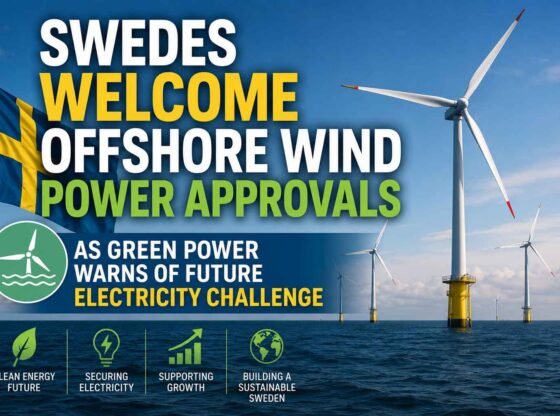

Breaking News headlines today: Sweden approves the offshore wind power projects Vidar and Fyrskeppet, but Green Power Sweden warns that rejecting 11 other wind farms could slow electrification and future clean energy growth. In this US News today latest article, read all about two power projects and other related details.
Sweden has taken another step toward expanding renewable energy by approving two major offshore wind projects. The government’s decision to move forward with the Vidar and Fyrskeppet offshore wind farms has been welcomed by the country’s renewable energy industry. However, the celebration comes with a serious warning.
Industry leaders say that while the approvals are encouraging, the rejection of 11 other offshore wind projects could significantly limit Sweden’s ability to meet future electricity demand. According to Green Power Sweden, these decisions may slow the country’s electrification plans and make it harder to achieve long-term climate and energy goals.
The latest announcements highlight the difficult balance between environmental protection, energy security, investment confidence, and the growing demand for clean electricity.
Sweden Approves Two Offshore Wind Power Projects
The Swedish government has officially approved the Vidar and Fyrskeppet offshore wind projects, marking another milestone in the country’s renewable energy transition.
Green Power Sweden praised the approvals, noting that offshore wind will play an increasingly important role in supplying affordable and clean electricity over the coming decades.
During its current term, the Swedish government has now approved offshore wind projects expected to generate approximately 30.7 terawatt-hours (TWh) of electricity annually.
That amount represents a meaningful contribution to Sweden’s electricity system, especially as industries, transport, and households continue moving toward electrification.
Eleven Offshore Wind Projects Were Rejected
Despite the positive news, the government simultaneously rejected 11 offshore wind applications. According to Green Power Sweden, the rejected projects had a combined annual production potential exceeding 275 TWh.
That figure is nearly nine times larger than the electricity generation capacity represented by the projects approved during the government’s current term.
Industry experts argue that losing such a large volume of potential clean electricity could have long-term consequences.
Electricity demand is expected to grow significantly as Sweden expands electric transportation, green steel manufacturing, battery production, hydrogen projects, and other low-carbon industries.
Without sufficient renewable electricity generation, those investments may become more expensive or face delays.
Green Power Sweden Voices Concern
Nils Grunditz, Chief Executive Officer of Green Power Sweden, welcomed the government’s decision but stressed that the overall picture remains disappointing.
He said renewable offshore electricity generation is essential if Sweden wants to meet its long-term electricity system goals.
According to Grunditz:
“It is in practice impossible to achieve the goals for the electricity system without using renewable offshore electricity generation.”
He added that approving only two projects while rejecting eleven others makes it difficult to view the government’s decisions as mostly positive.
The association believes Sweden needs a much larger pipeline of renewable electricity projects if it hopes to remain competitive during Europe’s clean energy transition.
Offshore Wind Is Becoming Increasingly Important
Offshore wind offers several advantages over many other renewable energy sources.
Unlike onshore wind farms, offshore turbines generally benefit from stronger and more consistent wind speeds, allowing them to produce electricity more efficiently.
Large offshore projects can also generate significant amounts of electricity while reducing pressure on land resources.
Across Europe, governments are rapidly expanding offshore wind capacity as part of broader climate and energy security strategies.
Countries including Denmark, Germany, the Netherlands, and the United Kingdom continue investing heavily in offshore wind development.
Sweden possesses one of Europe’s longest coastlines and has considerable offshore wind potential, making the sector an important part of future electricity planning.
Why Sweden Needs More Electricity
Electricity demand in Sweden is expected to increase sharply during the next two decades.
Several industries are driving this growth:
- Electric vehicles and charging infrastructure
- Green steel production
- Battery manufacturing
- Hydrogen production
- Data centres
- Electrified industrial processes
Many of these sectors require enormous amounts of reliable electricity.
At the same time, Sweden aims to reduce greenhouse gas emissions while maintaining energy affordability and industrial competitiveness.
Renewable electricity, particularly offshore wind, is widely viewed as one of the technologies capable of supporting those objectives.
Government Plans an Offshore Wind Auction System
Alongside the project approvals, the Swedish government confirmed it will continue developing a new auction-based system for offshore wind.
Under the proposed model, the government would first identify suitable offshore areas.
Developers would then compete in auctions for the right to build projects within those designated zones.
This approach is already used successfully in several European countries.
Supporters believe auctions provide greater transparency, improve planning, encourage competition, and reduce investment uncertainty.
Developers also benefit from clearer project timelines and regulatory expectations.
Industry Wants Better Investment Conditions
Green Power Sweden says approving projects alone will not be enough.
The organisation argues that Sweden must also improve investment conditions to attract developers and financing.
Among its recommendations are:
- State-backed investment risk sharing
- Price stabilisation mechanisms
- Government responsibility for offshore grid connections
- Faster permitting procedures
- Long-term policy certainty
These measures have helped accelerate offshore wind development in several European markets.
Without similar support, Sweden could struggle to compete for international renewable energy investment.
No Offshore Wind Applications Remain
One notable consequence of the government’s latest decisions is that there are currently no offshore wind applications left awaiting government approval.
According to Ina Müller Engelbrektson, Permitting Manager at Green Power Sweden, future projects will depend on the success of the upcoming auction system.
She explained that Sweden must make its electricity market more attractive for investors while accelerating electrification.
Without new applications entering the pipeline, future offshore wind development could slow considerably.
Hästliden Onshore Wind Project Also Approved
The government also approved the Hästliden onshore wind project in northern Sweden.
Green Power Sweden welcomed this decision, describing it as another positive contribution to renewable electricity generation.
Although offshore wind attracts significant attention because of its large-scale potential, onshore wind remains one of Sweden’s most cost-effective renewable energy sources.
A balanced energy system that combines onshore wind, offshore wind, hydropower, nuclear energy, solar power, and energy storage can improve reliability while supporting future demand.
The Bigger Picture for Sweden’s Energy Future
Sweden has ambitious climate targets and aims to maintain one of Europe’s most competitive electricity systems.
Meeting those goals will require major investments in electricity generation, transmission networks, storage technologies, and grid infrastructure.
Offshore wind alone cannot solve every energy challenge.
However, most energy experts agree it will become an increasingly important part of Sweden’s future energy mix.
The latest government decisions demonstrate that progress continues, but they also reveal the difficult policy choices surrounding renewable energy expansion.
Balancing environmental concerns, national security, local interests, marine ecosystems, fishing activities, and industrial electricity demand will remain a complex task.
What These Decisions Mean for Investors
Renewable energy investors will closely monitor Sweden’s planned auction framework.
A predictable regulatory environment often determines whether developers commit billions of euros to large offshore wind projects.
If Sweden successfully introduces competitive auctions supported by clear policies, investor confidence could improve.
Conversely, continued uncertainty may encourage companies to prioritise projects in neighbouring countries where approval processes are more predictable.
The coming years will therefore be critical for Sweden’s renewable energy sector.
Final Thoughts
The approval of the Vidar and Fyrskeppet offshore wind projects represents positive news for Sweden’s clean energy ambitions. Together with the Hästliden onshore wind project, these developments strengthen the country’s renewable electricity portfolio.
However, Green Power Sweden believes the rejection of 11 additional offshore wind projects creates a much bigger challenge. With electricity demand expected to rise rapidly due to electrification, industrial growth, and climate commitments, expanding renewable energy capacity remains essential.
The government’s proposed auction system may provide a new pathway for future offshore wind development, but success will depend on attractive investment conditions, efficient permitting, and long-term policy stability.
As Sweden continues its energy transition, the decisions made today will influence the country’s electricity supply, economic competitiveness, and climate progress for decades to come.
Frequently Asked Questions (FAQs)
Why did Sweden approve only two offshore wind projects?
The government approved the Vidar and Fyrskeppet offshore wind projects after completing its review process. At the same time, it rejected 11 other applications based on its broader assessment and policy decisions.
How much electricity will the approved projects generate?
The offshore wind projects approved during the current government term are expected to produce approximately 30.7 TWh of electricity annually, according to Green Power Sweden.
Why is Green Power Sweden concerned?
The organisation says the rejected projects represented more than 275 TWh of potential annual electricity generation, which could limit Sweden’s future electricity supply and slow electrification.
What is Sweden’s new offshore wind auction system?
The proposed system would allow the government to designate suitable offshore areas where developers compete through auctions for the right to build wind farms.
Why is offshore wind important for Sweden?
Offshore wind can generate large amounts of renewable electricity needed to support electric vehicles, green industries, hydrogen production, battery manufacturing, and Sweden’s long-term climate goals.
Sources:
- Green Power Sweden (official statements)
- Swedish Government energy policy announcements
- Industry reporting by reNEWS based on statements from Green Power Sweden
Whats Happening in the USA now
-

FIFA 2026 Updates: Battle for the Bronze: France vs. England 3rd Place Playoff Preview
The FIFA World Cup 2026 third-place playoff brings together two bruised European heavyweights at Miami Stadium. France and England return to action looking to salvage pride after devastating semifinal defeats. While a bronze medal was not the ultimate goal for either camp, historical pride and tactical statements mean this is far from a standard post-tournament…
-

Pentagon AI Initiatives Face Massive Expansion: Inside the Multi-Billion-Dollar Talks with SpaceX
Business Updates: Just when you thought Elon Musk’s SpaceX was content with conquering the cosmos, dominating global satellite internet, and landing booster rockets on floating drones, the aerospace giant is plotting its next terrestrial takeover. According to a report by the Wall Street Journal, SpaceX is in early-stage negotiations with the U.S. Department of Defence…
-

Gas Prices at $4 Again as Diesel Tops $5: Why Fuel Costing HIGH Beyond Crude Oil Prices
USA News: American drivers are once again feeling pressure at the fuel pump as gasoline prices move closer to the $4-per-gallon mark and diesel prices push beyond $5 in many markets. While crude oil prices remain one of the biggest factors influencing fuel costs, experts say today’s price increases are being driven by a much…