

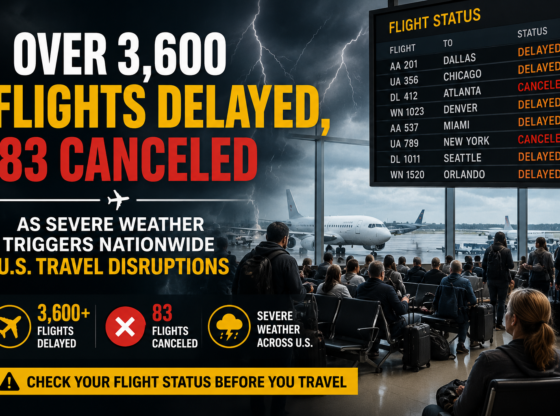

US Airport Travel News: Breaking just now, thousands of travellers across the United States faced frustrating delays after severe weather disrupted air travel at several major airports.
According to flight tracking data and aviation reports, more than 3,600 flights were delayed while 83 flights were cancelled as storms swept across parts of the country. The largest disruptions occurred in Texas, where heavy rain, thunderstorms, flash flooding, and tornado threats affected airport operations and air traffic management.
The widespread delays demonstrate how quickly weather at one major airline hub can ripple through the national aviation network. Even passengers flying hundreds of miles away experienced schedule changes because aircraft, flight crews, and connecting flights depend on tightly coordinated operations.
Severe Weather Disrupts Major USA Airports
The biggest impact came from Texas, where severe weather prompted the Federal Aviation Administration (FAA) to take action to keep flights operating safely.
The FAA temporarily issued ground stops for Dallas/Fort Worth International Airport (DFW) and Dallas Love Field as thunderstorms moved through the region. During a ground stop, aircraft scheduled to depart for the affected airport remain at their origin until conditions improve. This helps reduce congestion and improves safety during dangerous weather.
After conditions improved, the FAA lifted the restrictions and airports gradually resumed normal operations.
Although the ground stop lasted only a limited time, the operational effects continued throughout the day.
Dallas/Fort Worth Records Max Delays
Among all U.S. airports, Dallas/Fort Worth International Airport experienced the highest number of delays.
Reports showed approximately 693 delayed flights, making DFW the country’s most affected airport during the disruption. The airport serves as one of the nation’s busiest airline hubs, particularly for American Airlines, so delays there quickly spread throughout the airline’s domestic and international network.
When a major hub experiences weather disruptions, aircraft arriving late often delay future departures. Flight crews may also exceed legal working-hour limits, creating additional scheduling challenges.
This chain reaction explains why travellers in other states also experienced delays despite clear local weather.
Reagan National Reported MAX Cancellations
While Texas experienced the highest number of delays, Ronald Reagan Washington National Airport reported the greatest number of cancellations.
The airport recorded 19 cancelled flights, the highest total among major U.S. airports during the disruption, according to aviation reports.
Although cancellations remained relatively low compared with delays, even a small number can significantly disrupt passenger travel plans, especially during the busy summer season.
American Airlines ALSO FACES DELAYS
Among U.S. airlines, American Airlines recorded the highest number of delayed flights.
The carrier reported approximately 577 delayed flights, largely because Dallas/Fort Worth serves as its primary hub. When operations slow at DFW, flights across the airline’s network often experience cascading delays.
Large hub-and-spoke airlines are particularly vulnerable during widespread weather events because aircraft rotate between multiple cities throughout the day.
Why a Single Airport Can Affect the Entire Country
Many travellers wonder why storms in one state delay flights nationwide.
The answer lies in how airline networks operate.
Major hubs such as Dallas/Fort Worth, Chicago O’Hare, Atlanta, Charlotte, Denver, and Washington connect thousands of daily flights. Aircraft arriving late cannot immediately operate their next scheduled route.
Pilots and cabin crews also follow strict federal duty-time regulations. If delays become too long, airlines may need to replace crews or cancel flights altogether.
As a result, weather affecting one major airport often creates delays across dozens of states.
FAA utlizes Ground Stops to Improve Safety
Ground stops may frustrate travellers, but they serve an important purpose.
Instead of allowing aircraft to depart toward airports experiencing dangerous weather or heavy congestion, the FAA temporarily pauses departures until conditions improve.
During the recent storms, average departure delays reached approximately 45 minutes while traffic management initiatives remained in effect.
Although passengers often experience inconvenience, these measures help reduce airborne congestion and improve operational safety.
Summer Climatea and Weather Continues to Challenge Air Travel
Summer remains one of the busiest travel seasons in the United States. It also brings frequent thunderstorms across many regions, particularly the South and Midwest.
Heavy rain, lightning, strong winds, hail, flash flooding, and occasional tornadoes often force air traffic controllers to reroute aircraft or temporarily suspend departures.
Even brief storms near major airports can reduce runway capacity and increase separation between aircraft, slowing operations throughout the day.
What US Travellers Should Do During Flight Delays
A delayed flight does not always mean a cancelled trip.
Travel experts recommend several practical steps when disruptions occur:
- Check your flight status before leaving home.
- Enable airline mobile app notifications.
- Monitor gate changes regularly.
- Rebook cancelled flights immediately through the airline’s app or website.
- Keep medications, chargers, and important documents in your carry-on bag.
- Allow extra time for connecting flights when travelling through major hubs.
Passengers should also review their airline’s rebooking and refund policies before travelling.
Know Your Rights in such a scenario
Weather-related delays differ from disruptions caused by airline operational problems.
When severe weather causes delays, airlines generally are not required to provide hotel accommodations or compensation because safety remains the primary concern.
However, airlines often help passengers rebook on the next available flight without additional fare differences.
Travellers should contact their airline directly for available options if their itinerary changes.
Technology assists in giving awareness during such situations
Modern airline apps make it easier than ever to monitor flights.
Passengers can receive instant notifications about:
- Gate changes
- Departure delays
- Arrival updates
- Rebooking options
- Baggage information
The FAA also provides operational updates through its National Airspace System, while several flight-tracking platforms offer real-time information for travellers.
Checking updates frequently can help passengers avoid unnecessary time at crowded airports.
Airlines Continue servicing After Weather Events
Recovering from widespread weather disruptions often takes longer than the storms themselves.
Aircraft must return to their scheduled locations, crews need repositioning, and airlines work to accommodate passengers whose flights were cancelled or delayed.
Most carriers gradually restore normal operations once weather conditions improve, although isolated delays may continue into the following day.
Travelers flying through major hubs should remain flexible during periods of severe weather.
Conclusion
The latest nationwide travel disruption highlights how quickly severe weather can affect the U.S. aviation system.
More than 3,600 delayed flights and 83 cancellations disrupted travel plans for thousands of passengers, with Dallas/Fort Worth International Airport experiencing the largest number of delays after the FAA implemented temporary weather-related ground stops. American Airlines also faced significant operational challenges because of its large presence at DFW. While delays can be frustrating, the FAA’s traffic management measures are designed to keep passengers and flight crews safe during hazardous weather. For travellers, staying informed through airline apps, monitoring flight status, and planning for possible disruptions remain the best ways to reduce stress during busy travel periods. Join the USA flight cancellation forum conversation regarding this breaking USA news