
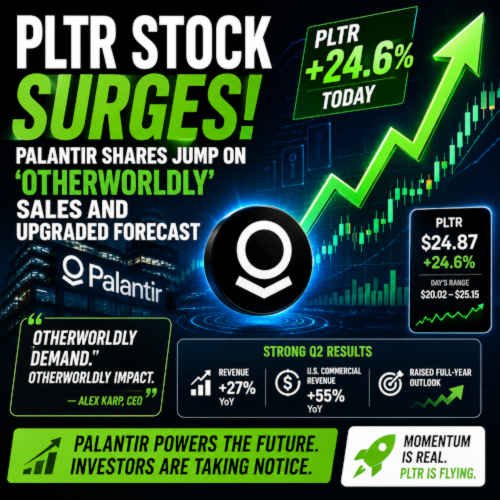
PLTR Stock Surges: Palantir Shares Jump on ‘Otherworldly’ Sales and Upgraded Forecast

Palantir Technologies (NYSE: PLTR) delivered a knockout blow to Wall Street’s expectations on Monday, sending its shares soaring by as much as 13% in extended trading. The enterprise software giant, known for its data analytics and artificial intelligence platforms, significantly raised its full-year revenue outlook following a second quarter marked by unprecedented commercial expansion and accelerating demand for AI infrastructure.
The Denver-based technology firm now projects full-year revenue to land between $8.15 billion and $8.16 billion, a massive upward revision from its previous forecast of under $7.7 billion. The explosive growth underscores a pivotal shift in Palantir’s business model: while historical revenue growth was overwhelmingly anchored by government defence contracts, the company’s commercial footprint in the United States has now become the primary growth engine driving its market capitalisation to new heights.
Second-Quarter Highlights sees double.
Palantir’s second-quarter financial results provided concrete evidence that enterprise adoption of artificial intelligence has moved well past the experimental phase and into full-scale deployment.
-
Top-Line Surge: Second-quarter revenue reached $1.935 billion—nearly doubling with a 93% year-over-year increase—blown open by enterprise clients rushing to deploy Palantir’s Artificial Intelligence Platform (AIP).
-
Upgraded Commercial Targets: Palantir executives raised their full-year U.S. commercial revenue target to at least $3.42 billion, representing a staggering projected growth rate of 134% year-over-year.
-
Market Reaction: Investors responded immediately. After closing the regular session up modestly, PLTR stock spiked nearly 13% in after-hours trading as analysts scrambled to adjust their price targets.
“The demand for AI sovereignty has now been unleashed,” declared Palantir Chief Executive Alex Karp in comments accompanying the earnings release, emphasizing that organizations across both the public and private sectors are rushing to secure independent, secure, and actionable control over their data architecture.
AIP and the “Bootcamp” Sales Strategy
The primary architect of Palantir’s accelerating commercial success is its Artificial Intelligence Platform (AIP). Launched to allow corporations to integrate Large Language Models (LLMs) with their internal proprietary data safely, AIP has seen an adoption trajectory that executives described during Monday’s earnings call as “otherworldly”.
To capitalize on this demand, Palantir revamped its traditional enterprise sales cycle, which historically took months of slow integration. In its place, the company deployed immersive “Bootcamps”—hands-on workshops where prospective enterprise clients work alongside Palantir engineers to build functioning AI applications on their live enterprise data in under five days.
Traditional Enterprise Sales Cycle (6-12 Months)
└── RFP -> Procurement -> Security Audit -> Limited Pilot -> Long-term Deployment

Palantir AIP Bootcamp Model (Days)
└── Live Data Integration -> Hands-on Build -> Functional App in <5 Days -> Instant Conversion
This rapid prototyping approach has dramatically lowered the barrier to entry for commercial clients, converting trial users into high-value contractual customers at an unprecedented pace. American corporations across logistics, healthcare, manufacturing, and financial services are using AIP to automate operational decisions, streamline supply chains, and reduce overhead costs.
The Rise of ‘AI Sovereignty’
A central theme of Palantir’s quarterly update was the concept of “AI Sovereignty.” Beyond basic cloud computing or consumer-facing chatbots, sovereign AI refers to the ability of corporations, defence bodies, and nation-states to build, control, and deploy AI models without exposing sensitive core data to external vendors or vulnerable third-party platforms.
| Key Area | Impact of AI Sovereignty |
| U.S. Commercial Market | Companies retain complete control over operational protocols while training LLMs on proprietary data. |
| Government & Defense | Intelligence and military units deploy automated decision-making networks within secure, air-gapped environments. |
| International Expansion | Sovereign nations establish localised data ecosystems that comply with local regulatory frameworks. |
As geopolitical tensions rise and cybersecurity concerns intensify globally, Palantir’s defence-grade security architecture has given it a unique structural advantage over conventional cloud and software-as-a-service (SaaS) providers. Companies are not merely seeking AI capabilities; they are seeking secure, autonomous AI systems that they fully control.
Financial Transformation: From Niche Government Contractor to Commercial Titan
For years, critics argued that Palantir was essentially a boutique consultancy masquerading as a high-margin software firm, pointing to its heavy dependence on U.S. defence contracts and high stock-based compensation. However, recent quarters have dramatically reshaped that narrative.
Revenue Split Evolution

Past Paradigm:
[████████████████████████████████ High ] Government Contracts
[██████████                            ] Commercial Contracts

Current Shift:
[████████████████████                  ] Government Contracts (Steady Growth)
[██████████████████████████████████████] Commercial Contracts (Explosive Growth)
While Palantir’s government segment continues to grow reliably—supported by multi-year modernisation programs across the U.S. Department of Defence and allied military forces—it is the U.S. commercial division that has redefined the company’s growth trajectory.
Guidance Overview
| Metric | Previous Full-Year Forecast | Updated Full-Year Forecast |
| Total Revenue | < $7.70 Billion | $8.15B – $8.16B |
| U.S. Commercial Revenue | ~$2.80 Billion | ≥ $3.42 Billion |
| U.S. Commercial Growth Rate | ~85% | ≥ 134% |
The dramatic upgrade from sub-$7.7 billion to over $8.15 billion in annual guidance reflects management’s confidence that current commercial demand is not a temporary surge, but a structural shift in how enterprises invest in technology.
Wall Street Reaction and Valuation Debates
Monday’s announcement is likely to ignite fresh debate among Wall Street analysts regarding Palantir’s premium valuation. PLTR stock has consistently traded at a high multiple relative to traditional enterprise software peers, drawing scepticism from value-oriented institutional investors.
However, bulls argue that Palantir operates in a category of its own. By bridging the gap between raw consumer-grade generative AI models and practical, operational enterprise execution, Palantir has effectively created a new market software layer.
Key factors driving institutional optimism include:
-
Accelerating Margins: Software-driven expansion in the commercial sector allows revenue to scale faster than operating expenses, fueling rapid expansion in adjusted free cash flow margins.
-
Standard-Setting Platform: AIP is increasingly viewed as the foundational operating system for corporate AI, creating high switching costs for enterprise customers once integrated.
-
Sustained Defence Tailwinds: Ongoing global conflicts and defence modernisation cycles ensure steady, high-margin government revenues that act as a resilient floor during broader economic downturns.
Looking Ahead
As Palantir enters the second half of the year, all eyes will remain on its execution within the U.S. commercial market and its ability to replicate this “bootcamp” strategy across international markets in Europe and Asia-Pacific.
With full-year guidance officially bumped above $8.15 billion, Palantir has signalled to the broader technology sector that enterprise AI spending is no longer a forward-looking promise—it is actively hitting balance sheets today, and Palantir is capturing a commanding share of the market.