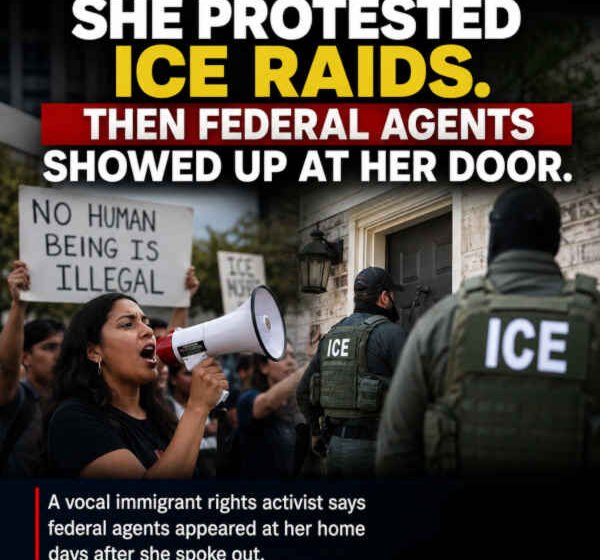

MINNEAPOLIS — Early one morning, Treasure Thoreson, a local special education teacher, was drinking coffee in her pajamas when she heard a heavy knock at her front door.
When she opened it, she was met by a Department of Homeland Security (DHS) agent flanked by six armed officers standing in her front yard.
“I go and I see a woman standing there in office clothes, but with a Homeland Security vest over the top. And I see six more agents standing in my front yard. She said, ‘We have a warrant for your arrest, for conspiracy.'”
— Treasure Thoreson, Minneapolis Special Education Teacher
Thoreson was allowed to change her clothes and hug her partner goodbye before being taken into federal custody.
The Indictment: Blockades and Encrypted Messaging
The Department of Justice (DOJ) charged Thoreson and 14 other individuals with engaging in a federal conspiracy to impede federal agents.
Federal prosecutors contend that the alleged conspiracy culminated in blockades outside the Bishop Henry Whipple Federal Building in Fort Snelling, Minnesota—which served as operational headquarters for U.S. Immigration and Customs Enforcement (ICE) during an immigration enforcement surge in the Twin Cities.
-
Primary Charge: Conspiracy to impede or injure an officer (18 U.S.C. § 372).
-
Key Evidence Cited: Group meetings and encrypted messaging threads on Signal.
-
Potential Penalty: Up to 6 years in federal prison per count.
An Escalating National Trend
A review of court records by NPR revealed that the charges against Thoreson are part of a broader federal strategy. The DOJ is increasingly wielding the conspiracy to impede or injure an officer statute—a law dating back to the Civil War that historically has been used sparingly.
Federal prosecutors have charged dozens of individuals across multiple states under conspiracy statutes related to immigration enforcement protests.
-
Statute Origin: Civil War-era law (18 U.S.C. § 372).
-
Maximum Sentence: Up to 6 years in federal prison.
-
Active Jurisdictions: Minnesota, Texas, Washington, and Michigan.
-
Primary Target: Demonstrators participating in rapid-response networks or blocking ICE facilities and transport vehicles.
Legal Controversies & Civil Liberties Debates
The surge in conspiracy indictments against anti-ICE activists has drawn sharp criticism from legal experts and civil liberties advocates.
-
Defense Perspective: Defense attorneys and civil rights groups argue that charging activists with felony conspiracy for organizing demonstrations or joining blockades risks penalizing protected First Amendment activity and chilling public opposition.
-
Justice Department Position: The DOJ maintains that blocking officers, damaging property, or interfering with active law enforcement operations crosses the line from peaceful assembly into criminal obstruction.
As cases against Thoreson and her co-defendants move through federal court, civil rights observers note that the outcomes will set a crucial legal precedent regarding how political protests and civil disobedience are prosecuted nationwide.