
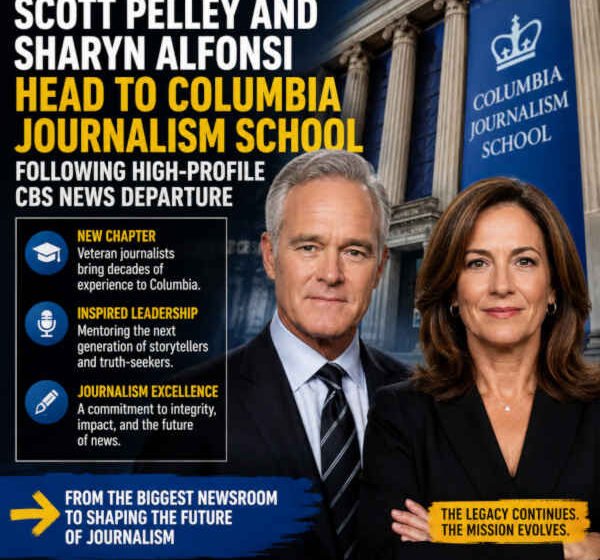
Scott Pelley and Sharyn Alfonsi Head to Columbia Journalism School Following High-Profile CBS News Departure

NEW YORK: Two months after a dramatic editorial shakeup at CBS News, former 60 Minutes correspondents Scott Pelley and Sharyn Alfonsi are moving from the broadcast newsroom to the university classroom. Columbia Journalism School announced on August 3, 2026, that Pelley and Alfonsi have been appointed as Journalists in Residence for the upcoming 2026–27 academic year.
The appointments mark the first major public roles for Scott Pelley and Sharyn Alfonsi since their departure from the storied newsmagazine during a tumultuous leadership overhaul led by CBS News Editor-in-Chief Bari Weiss and newly appointed 60 Minutes executive producer Nick Bilton.
In their new faculty roles at Columbia, the veteran reporters will mentor students, lead workshops on investigative techniques, give guest lectures, and contribute original journalism pieces to the Columbia Journalism Review.
A New Academic Chapter at Columbia Journalism School
Columbia University’s Graduate School of Journalism confirmed that the duo will participate directly in student mentorship and academic programs aimed at sharpening core reporting skills. The appointments form a key pillar of the school’s CJS2030: Democracy Initiative, a multi-year program spearheaded by Dean Jelani Cobb designed to fortify accountability reporting and strengthen journalism’s role in upholding democratic institutions.
“Their distinguished track records in investigative reporting highlight the amazing opportunity our students will have to learn from them,” said Jelani Cobb, Dean and Henry R. Luce Professor of Journalism at Columbia University. “We look forward to having Sharyn and Scott with us this year.”
For Scott Pelley, whose broadcast career spans more than four decades as an investigative reporter, foreign correspondent, and anchor of the CBS Evening News, the transition into academia offers an opportunity to pass on decades of field experience to emerging journalists. The residency will focus heavily on source development, investigative methodology, and navigating complex ethical challenges in modern newsrooms.
Alfonsi expressed enthusiasm for the academic posting, noting that the appointment arrives at a crucial juncture for news organizations facing immense commercial, political, and technological pressures.
Inside the Tumultuous CBS News Exit
The move to Columbia follows one of the most publicly publicized network battles in recent television news history. In June 2026, Scott Pelley was ousted from 60 Minutes following months of escalating friction between the show’s veteran staff and new corporate management.
Tensions reached a boiling point during an all-hands staff meeting in late May 2026, where Pelley directly confronted newly appointed executive producer Nick Bilton and criticized Editor-in-Chief Bari Weiss over the unexpected firing of longtime executive producer Tanya Simon and correspondents Sharyn Alfonsi and Cecilia Vega.
According to audio recordings and accounts from staff members present in the meeting, Pelley forcefully challenged management regarding editorial direction and corporate influence:
-
Direct Confrontation: Pelley publicly accused network leadership of “murdering 60 Minutes,” arguing that the abrupt removals threatened the editorial independence and historical standards of the 57-year-old newsmagazine.
-
Editorial Interference Claims: Following his termination days later, Pelley publicly stated that network executives had instructed him to “inject falsehoods and bias into a politically sensitive story,” a claim CBS News leadership disputed as standard editorial discourse.
-
Staff Support: Pelley’s passionate defense of his colleagues and traditional journalism standards earned him multiple standing ovations from newsroom staffers during the confrontation.
Alfonsi’s contract was similarly non-renewed in May after she raised internal concerns over corporate delays regarding an investigative piece on the CECOT prison facility in El Salvador. In a statement issued after her departure, Alfonsi warned that “the wall between editorial independence and corporate interest at CBS is being methodically torn down,” cautioning that news broadcasts risk losing the courage required to hold powerful institutions accountable.
A Career Built on Accountability Journalism
The appointment at Columbia Journalism School brings one of broadcast television’s most recognized figures into higher education. Scott Pelley joined CBS News in 1989 and quickly established himself as a frontline reporter, covering the Persian Gulf War, presidential campaigns, national political scandals, and major international conflicts.
In 2004, Pelley joined the correspondent roster of 60 Minutes, where he produced numerous award-winning reports on economic collapse, military operations, climate change, and corporate fraud. From 2011 to 2017, he served as the anchor and managing editor of the CBS Evening News with Scott Pelley, leading the network’s flagship daily broadcast through major historic moments including the Sandy Hook Elementary School shooting, Boston Marathon bombing, and national election cycles.
Throughout his career, Pelley’s reporting earned nearly 40 Emmy Awards, multiple Alfred I. duPont-Columbia University Awards, and George Foster Peabody Awards. His long-standing focus on rigorous vetting, primary document research, and tough interviewing techniques makes his transition to the Columbia faculty particularly relevant for students entering an increasingly fragmented media landscape.
| Career Milestone | Scott Pelley’s Notable Role at CBS News |
| 1989 | Joined CBS News as a national correspondent based in Dallas. |
| 1997–1999 | Served as Chief White House Correspondent during major political proceedings. |
| 2004–2026 | Correspondent for 60 Minutes, producing over two decades of investigative pieces. |
| 2011–2017 | Anchor and Managing Editor of CBS Evening News with Scott Pelley. |
| 2026 | Named Journalist in Residence at Columbia University Graduate School of Journalism. |
Shaping the Next Generation of Investigative Reporters
At Columbia, Pelley and Alfonsi will join a distinguished faculty of practicing journalists and media scholars. The Journalism School’s curriculum places a strong emphasis on investigative methodology—teaching students how to analyze public records, conduct internet forensics, manage confidential sources, and execute long-form narrative storytelling across print, audio, and video platforms.
As part of the CJS2030: Democracy Initiative, Pelley and Alfonsi will participate in:
-
Investigative Journalism Workshops: Guiding Master of Science students through deep-dive investigative techniques and document verification.
-
“Journalism Now” Lecture Series: Leading discussions on press freedom, corporate influence in newsrooms, and the evolving role of broadcast journalism.
-
Columbia Journalism Review (CJR) Contributions: Writing analytical essays addressing contemporary media ethics, newsroom governance, and press autonomy.
Media analysts suggest that bringing veteran correspondents who recently experienced high-profile newsroom disputes into academic settings provides students with unfiltered insights into the commercial and political realities of modern media corporations.
Looking Ahead: Preserving Press Integrity
The transition of Scott Pelley and Sharyn Alfonsi from commercial network television to Columbia Journalism School reflects broader shifts in the news industry. As traditional broadcast networks adapt to changing corporate structures and digital distribution models, the clash between corporate management and veteran investigative journalists has intensified.
By stepping into teaching and mentorship roles at Columbia, both Pelley and Alfonsi will play a direct role in preparing the next generation of reporters to uphold core principles of fairness, accuracy, and aggressive oversight.
For Columbia Journalism School students preparing to enter the field in 2026 and beyond, working directly with seasoned reporters like Scott Pelley provides a rare bridge between historic broadcast standards and the future of accountability journalism.
Scott Pelley Accuses Bari Weiss of ‘Murdering’ 60 Minutes
This video provides important background context on the internal staff meeting at CBS News where Scott Pelley publicly challenged network leadership prior to his departure.