
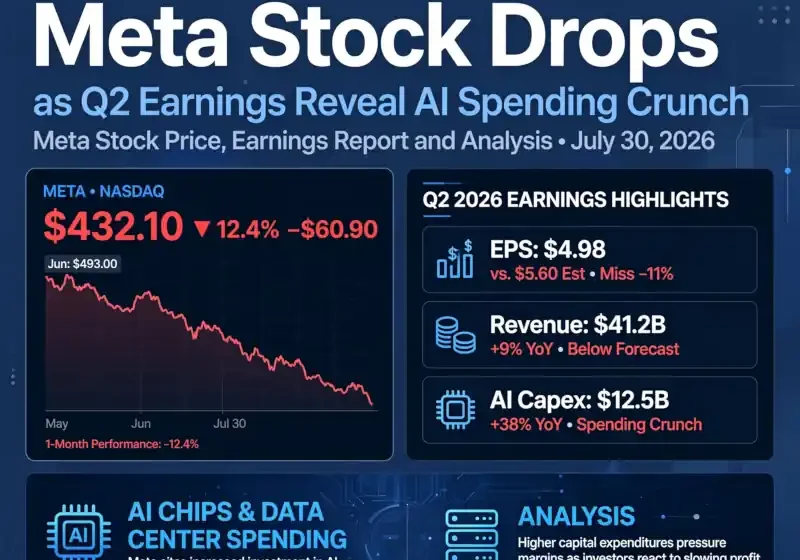
Meta Stock Drops as Q2 Earnings Reveal AI Spending Crunch: Full Stock Price, Earnings Report and Analysis

Meta stock Platforms (NASDAQ: META) found itself at the center of financial markets today as its Q2 earnings report sparked a sharp sell-off in early trading. Despite outperforming Wall Street expectations on top-line revenue, the social media giant’s aggressive capital expenditure on artificial intelligence infrastructure—and a massive 91% collapse in free cash flow—sent shockwaves through the market.
Below is an in-depth analysis of Meta earnings today, detailing the stock price reaction, core financial metrics, key takeaways from the Meta earnings call, and what CEO Mark Zuckerberg’s “compute conundrum” means for the tech sector moving forward.
Meta Stock Price Reaction: Premarket & After-Hours Slide
Following the release of the Q2 earnings report on Wednesday afternoon, Meta stock experienced immediate downward pressure.
-
Closing Price (Pre-Earnings): $585.61
-
Post-Earnings Decline: -9.64% in late trading
-
Trading Range: ~$529.00 – $542.00
Meta Platforms (NASDAQ: META) Q2 Earnings Reaction Snapshot
------------------------------------------------------------------
Pre-Earnings Close:      $585.61
Post-Earnings Low:        $529.15 (-9.64%)
Current Trailing Level:   ~$542.00
Full-Year Capex Range:   $130.0 Billion - $145.0 Billion
The slide in the Meta stock price underscores growing investor jitters regarding the massive costs associated with the Big Tech artificial intelligence arms race. While Meta continues to show strong user engagement across Facebook, Instagram, and WhatsApp, the immediate financial trade-offs required to build out AI data centers have unnerved short-term traders.
Meta Q2 Earnings Report
At first glance, Meta’s headline numbers present a dramatic split between strong top-line advertising demand and severe bottom-line pressure. Total revenue for the second quarter reached $60.8 billion, representing a 28% year-over-year increase that comfortably topped consensus estimates of $60.19 billion.
+--------------------------------------------------------------------+
|                      META Q2 FINANCIAL SUMMARY                     |
+--------------------------+--------------------+--------------------+
| Metric                   | Q2 (Prior Year)    | Q2 (Current Year)  |
+--------------------------+--------------------+--------------------+
| Total Revenue            | $47.52B            | $60.80B (+28%)     |
| Advertising Revenue      | $46.50B            | $59.36B (+27%)     |
| Diluted EPS              | $7.14              | $6.18 (-13.4%)     |
| Operating Margin         | 43%                | 31%                |
| Capital Expenditures     | $17.01B            | $31.08B (+82.7%)   |
| Free Cash Flow           | $8.55B             | $784M (-90.8%)     |
+--------------------------+--------------------+--------------------+
Revenue & Advertising Strength
Ad revenue rose 27% year-over-year to $59.36 billion, driven by a 14% increase in ad impressions and a 12% increase in average price per ad. Family Daily Active People (DAP) grew to 3.60 billion, confirming that core engagement remains remarkably resilient.
EPS Miss Driven by One-Time Charges
Diluted Earnings Per Share (EPS) came in at $6.18, missing Wall Street’s $7.17 consensus by nearly 14%. However, context is vital here: Meta’s quarterly bottom line was burdened by $3.58 billion in total pre-tax one-time charges, including $2.4 billion in legal settlement expenses and $1.18 billion in severance costs following workforce restructuring. Excluding these charges, adjusted EPS sat closer to $7.35.
The Free Cash Flow Collapse
The primary driver behind the stock drop was the stunning drop in Free Cash Flow (FCF). FCF plunged 91% year-over-year to $784 million, down from $8.55 billion a year ago. Out of the $31.86 billion generated in operating cash flow, a massive $31.08 billion was absorbed directly by capital expenditures.
Analysis: Meta’s AI Splurge Lays Bare Its Compute Conundrum
The core topic driving artificial intelligence news today is whether Meta’s spending model is sustainable compared to its Big Tech peers.
During the earnings call, CEO Mark Zuckerberg addressed the strategic balance between utilizing internal compute capacity to power Meta’s own AI platforms versus monetizing excess capacity in the open market.
“We believe that there will continue to be a significantly higher margin on selling intelligence rather than selling compute directly, but we think that there’s a big opportunity obviously to sell compute as well.”
— Mark Zuckerberg, CEO of Meta
Spending Like a Cloud Giant Without a Cloud Business
Unlike Microsoft, Alphabet, or Amazon, Meta does not operate a dedicated public cloud infrastructure platform (such as AWS, Azure, or Google Cloud) to directly resell compute capacity to enterprise developers at scale.
-
Microsoft & Alphabet: Every dollar invested in data centers can be immediately rented out to enterprise cloud clients via Azure or GCP. Microsoft recently reported a 23% drop in FCF, yet its stock rose 8% because cloud revenue (Azure & Copilot) grew rapidly.
-
Meta Platforms: Every dollar spent on AI servers, custom chips, and power infrastructure relies almost entirely on advertising revenue for returns.
This contrast has left Meta in what analysts call a “compute conundrum”. To ease its cash-flow squeeze, Meta has reportedly explored leasing out excess server clusters—including discussions around potential multi-billion dollar lease deals with external partners like Anthropic. However, selling compute externally diverts precious GPU hardware away from training Meta’s own Llama models and AI consumer features.
The AI Capex Escalation: $130B–$145B Horizon
Investor alarm was further compounded when management raised the floor of its full-year capital expenditure guidance.
-
Previous 2026 Capex Range: $125 Billion – $145 Billion
-
Revised 2026 Capex Range: $130 Billion – $145 Billion
-
Expense Floor Revision: Elevated to $165 Billion
Meta CFO Susan Li reiterated that aggressive infrastructure build-outs remain necessary because the tech industry historically “underbuilt” for AI demand, making physical capacity exceptionally valuable.
Meta Annual Capital Expenditure Trajectory (2024 - 2026)
===========================================================
2024 Capex:   $38.1 Billion  [===                 ]
2025 Capex:   $71.2 Billion  [=======             ]
2026 Capex:   $137.5 Billion [==============      ] (Midpoint Guidance)
For many institutional investors, this rapid capital escalation stirs memories of Meta’s costly metaverse pivot, which racked up tens of billions in losses before showing clear commercial returns.
Competitor Comparison & Broader AI Sector Impact
Meta is far from alone in facing margin compression due to hardware investments. The entire “Magnificent Seven” tech group is grappling with soaring data centre costs, though market reactions vary depending on monetising strategies:
| Company | Q2 Free Cash Flow | AI Monetisation Vehicle | Market Reaction |
| Meta (META) | $784M (-91% YoY) | AI Ads, Smart Glasses, Llama Ecosystem | Shares Down ~9% |
| Microsoft (MSFT) | Down 23% YoY | Azure Cloud, Enterprise Copilot | Shares Up ~8% |
| Alphabet (GOOGL) | Negative FCF (First on Record) | Google Cloud, Search AI Overviews | Shares Down ~7% |
As Market Strategist Ryan Detrick noted following the reports: “Free cash flow for the hyperscalers is tanking, while it is soaring for the chips. One company’s spending is another company’s revenue.” Hardware suppliers in semiconductors, server equipment, and power generation continue to be the primary beneficiaries of this spending surge.
Wall Street Outlook: Undervalued After the Sell-Off?
Despite short-term volatility, a closer examination of Meta’s core business fundamentals suggests that the post-earnings pullback may present a value opportunity for long-term investors.
+--------------------------------------------------------------------+
|                   VALUATION & MULTIPLE ANALYSIS                    |
+------------------------------------+-------------------------------+
| Post-Earnings Price Estimate       | ~$542.00                      |
| Normalized 2026 EPS Estimate       | ~$29.00 / share               |
| Implied Forward P/E Ratio          | ~18.5x                        |
| 3-Year Historical Average P/E      | ~25.0x                        |
| 5-Year Historical Average P/E      | ~23.0x                        |
+------------------------------------+-------------------------------+
Bull Arguments
-
Advertising Engine is Thriving: Revenue growth of 28% proves that Meta’s core business remains a powerful cash generator.
-
AI Improving Ad Efficiency: AI recommendation algorithms are driving higher user engagement and ad conversions across Reels and feeds.
-
Discounted Multiple: At roughly 18-19 times normalized forward earnings, META stock trades well below its historical 3-year and 5-year average valuation multiples.
Main Arguments
-
Unclear AI Return Timeline: Investors lack concrete visibility into when AI consumer assistants or enterprise tools will generate substantial standalone revenue.
-
Persistent Capex Expansion: Capital expenditure commitments could keep free cash flow depressed through 2027.
-
Soft Guidance: Q3 revenue guidance of $61B–$64B came in slightly under the Wall Street mid-point consensus of $63.2 billion.
Conclusion
Meta’s Q2 earnings report highlights the ongoing transition across the technology sector. While the company’s advertising business continues to perform strongly, the sheer financial scale of its artificial intelligence infrastructure strategy has created temporary cash-flow pressure. As Meta navigates its compute strategy heading into the second half of the year, investors will be closely monitoring how effectively Mark Zuckerberg and his team translate these massive hardware investments into sustainable long-term earnings growth.