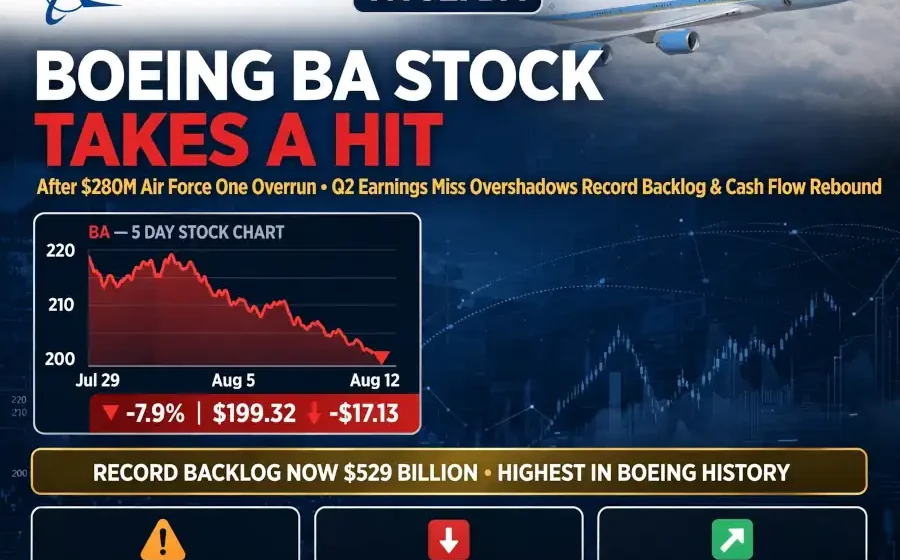
Boeing BA Stock Takes a Hit After $280M Air Force One Overrun: Q2 Earnings Miss Overshadows Record Backlog and Cash Flow Rebound

CHICAGO Stock Market News today: Read all about Boeing BA stock, latest updates on this USA free latest job alert portal for businesses and finance. Shares of aerospace giant Boeing Co. ($BA) experienced volatile trading on Tuesday after the company posted a wider-than-expected second-quarter loss. A fresh $280 million pre-tax charge on its delayed Air Force One replacement program weighed down defence earnings, overshadowing solid gains in commercial aircraft deliveries and positive cash flow.
While Boeing reported an 8% increase in Q2 revenue to $24.56 billion, the unexpected cost spike on the high-profile presidential jet contract pushed adjusted core losses to $0.76 per share—more than double the $0.30 per share loss anticipated by Wall Street analysts.
Boeing BA Stock Q2 Financial Results Breakdown
Boeing’s financial metrics reflected a sharp divergence between its recovering commercial operations and its troubled defense segment.
| Financial Metric | Q2 Actual | Analyst Estimates | Prior Year (Q2) |
| Total Revenue | $24.56 Billion | $24.25 Billion | $22.7 Billion |
| GAAP Net Loss | ($428 Million) | ($180 Million) | ($612 Million) |
| Adjusted Loss Per Share (EPS) | ($0.76) | ($0.30) | ($1.24) |
| Air Force One (VC-25B) Charge | $280 Million | — | — |
| Free Cash Flow | +$631 Million | ($100 Million) | ($200 Million) |
| Total Backlog | $715 Billion (Record) | — | — |
Inside the Air Force One (VC-25B) Cost Overruns
The primary driver behind Boeing’s earnings miss came from its Defense, Space & Security (BDS) division. The segment posted a $15 million operating loss after absorbing the $280 million charge on the VC-25B presidential aircraft program.
VC-25B (Air Force One) Contract Snapshot
-----------------------------------------------------------------------------------------
Original Fixed-Price Contract (2018):  $3.9 Billion
Total Cost Overruns (Absorbed by BA):  Exceeds $2.5 Billion
Revised Delivery Target:                2028 (Testing ongoing)
Primary Overrun Drivers:               Engineering complexity, wiring, security clearances
-----------------------------------------------------------------------------------------
The VC-25B program involves heavily modifying two commercial 747-8 intercontinental airframes into flying military command posts equipped with electromagnetic pulse (EMP) shielding, secure satellite links, and defensive countermeasures. Negotiated as a fixed-price agreement in 2018, Boeing is legally obligated to absorb all cost overruns rather than passing them on to the U.S. government.
Boeing leadership reiterated that the additional expenditure was necessary to ramp up production and certification resources to meet the revised 2028 delivery deadline.
Commercial Aviation Recovery Drives Free Cash Flow
Despite the defence write-down, Boeing’s Commercial Aeroplanes segment delivered notable operational improvements:
-
Delivery Growth: Boeing delivered 171 commercial aircraft in Q2, up 14% year-over-year.
-
Commercial Revenue: Top-line segment sales rose to $11.8 billion, while operating losses narrowed to $322 million from $557 million a year ago.
-
Production Ramps: The company began transitioning production of the 737 MAX toward 47 jets per month and activated a new assembly line in Everett, Washington.
-
Free Cash Flow: Higher delivery volumes allowed Boeing to generate $631 million in free cash flow, swinging from a $200 million cash burn in the prior-year period.
Key Takeaways for BA Stock Investors
For institutional and retail shareholders evaluating $BA stock, Boeing’s earnings report presented a classic operational tradeoff:
-
Short-Term Friction: Legacy fixed-price defence contracts continue to generate unpredictable charges, creating volatility in quarterly EPS metrics.
-
Long-Term Balance Sheet Growth: Generating positive free cash flow and expanding a record $715 billion backlog (comprising over 6,200 commercial jets) provides the financial foundation needed to reduce debt and support long-term valuation recovery.