
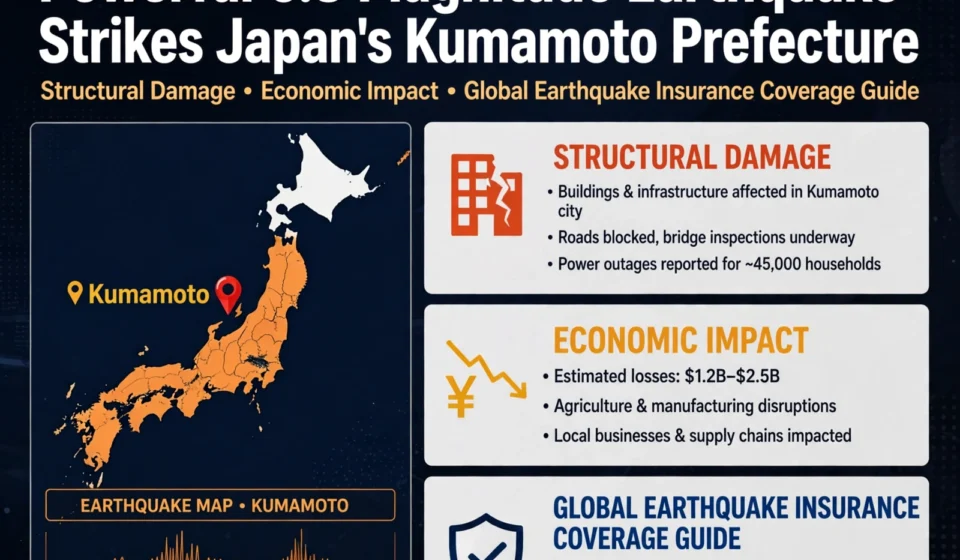
Japan Earthquake Today : Powerful 6.8 Magnitude Earthquake Strikes Japan’s Kumamoto | Know Insurance Coverage Guide

USA: A powerful 6.8 magnitude earthquake (preliminarily measured at 7.1) struck Japan’s southern Kumamoto prefecture on the island of Kyushu on Tuesday. The shallow tremor, registering the maximum Shindo 7 level on Japan’s seismic intensity scale in local areas, brought back distressing memories of the devastating 2016 Kumamoto quakes.
The disaster caused structural damage across urban centres, including a partial collapse at the Aeon shopping mall in Kashima, power outages for over 48,000 households, transportation shutdowns, and structural disruption to historical landmarks like Kumamoto Castle.
As emergency task forces assemble and search-and-rescue teams deploy, international financial analysts and insurance underwriters are evaluating the economic, property, and reinsurance liabilities.
The Kumamoto Earthquake affects
The earthquake struck at a shallow depth of roughly 10 kilometres, amplifying the intensity of ground motion experienced across the region. Urban centers including Yatsushiro, Uto, and Kumamoto City, experienced intense shaking, causing building failures, power supply interruptions, and regional transportation halts.
┌─────────────────────────────────────────────────────────────────────────┐
│                 Q2 2026 KUMAMOTO EARTHQUAKE QUICK FACTS                  │
├──────────────────────────┬──────────────────────────────────────────────┤
│ Epicenter & Depth        │ Southern Kumamoto, Kyushu (~10 km depth)    │
│ USGS Magnitude           │ M 6.8 (Revised from initial 7.1)             │
│ Max Seismic Intensity    │ Shindo 7 (Japan Meteorological Agency Scale) │
│ Infrastructure Damage    │ Aeon Mall collapse, 48k power blackouts      │
│ Transport Disruption     │ Shinkansen bullet train & airport halts      │
└──────────────────────────┴──────────────────────────────────────────────┘
The event triggered a temporary tsunami advisory along the Ariake and Yatsushiro seas, which was lifted within two hours after no unusual wave behavior was observed. Major high-tech industrial plants located in the area—including facilities operated by Taiwan Semiconductor Manufacturing Co. (TSMC) and Sony—underwent precautionary safety protocols.
Reinsurance and Property Casualty Impact: Financial Exposure
Japan is categorised by global insurance underwriters as a peak peril zone due to its geographic vulnerability along the Ring of Fire. When severe seismic events occur, primary insurers, catastrophe bond issuers, and international reinsurers face immediate claim exposure.
Market Insight: When a magnitude 7.0 earthquake struck Kumamoto in 2016, insurance and reinsurance claims exceeded US $4 billion. The current event is actively being evaluated by global property and casualty (P&C) risk modeling firms to estimate total insured losses versus economic losses.
Currently, the catastrophe bond market holds over $1.55 billion in outstanding cat bonds solely exposed to Japanese earthquake risks, alongside billions more in multi-peril global reinsurance arrangements.
Global Earthquake Insurance Coverage Guide: Japan, USA, UK, & Canada
Standard homeowners and commercial property insurance policies do not cover earth movement or seismic damage automatically. Property owners worldwide must purchase dedicated earthquake insurance endorsements, stand-alone policy riders, or national government-backed disaster coverage.
                  ┌─────────────────────────────────────────────────────────┐
                  │          GLOBAL EARTHQUAKE COVERAGE LANDSCAPE           │
                  └────────────────────────────┬────────────────────────────┘
                                               │
         ┌──────────────────┬──────────────────┼──────────────────┐
         ▼                  ▼                  ▼                  ▼
┌──────────────────┐┌──────────────────┐┌──────────────────┐┌──────────────────┐
│   JAPAN (JER)    ││   USA (CEA/P&C)  ││   UNITED KINGDOM ││      CANADA      │
├──────────────────┤├──────────────────┤├──────────────────┤├──────────────────┤
│ Government-backed││ Standalone riders││ Low seismic risk ││ High BC & Quebec │
│ risk sharing pool││ 5% - 25% deduct. ││ Standard P&C add ││ Dedicated riders │
└──────────────────┘└──────────────────┘└──────────────────┘└──────────────────┘
A. Japan: Japan Earthquake Reinsurance (JER) System
In Japan, earthquake insurance for residential structures is operated jointly by private insurance providers and the federal government through the Japan Earthquake Reinsurance Co., Ltd. (JER).
-
Co-Policy Requirement: Residential earthquake insurance cannot be purchased as a standalone policy; it must be coupled with a primary Fire Insurance Policy.
-
Coverage Caps: Payouts are capped at 30% to 50% of the primary fire insurance policy’s total insured value (maximum of 50 million yen for structures and 10 million yen for contents).
-
Payout Structure: Claims are settled based on four strict structural damage tiers rather than individual itemised repair bills:
-
Total Loss (100% of benefit payout)
-
Major Half Loss (60% of benefit payout)
-
Small Half Loss (30% of benefit payout)
-
Partial Loss (5% of benefit payout)
-
B. United States: California Earthquake Authority (CEA) & Standalone Endorsements
In the United States, standard ISO homeowners insurance (HO-3 or HO-5 policies) explicitly excludes earthquake damage. Property owners in fault-zone states like California, Washington, and Oregon must purchase separate coverage.
-
California Earthquake Authority (CEA): A publicly managed, privately funded organisation providing residential policies through participating insurance carriers.
-
High Deductible Structure: Unlike traditional health or auto insurance, earthquake policy deductibles are calculated as a percentage of the total dwelling limit (typically ranging from 5% to 25%).
-
Example: A $1,000,000 home with a 10% deductible requires the policyholder to absorb the first $100,000 in structural damage before insurance coverage activates.
-
-
Key Coverages:
-
Dwelling Coverage: Repair of structural foundation, frame, and roof.
-
Personal Property: Coverage for furniture, electronics, and appliances (often subject to separate deductible rules).
-
Loss of Use / Additional Living Expenses (ALE): Reimburses hotel and living costs if the home becomes uninhabitable.
-
C. Canada: Residential & Commercial Earthquake Riders
Seismic risk in Canada is heavily concentrated along the western coast of British Columbia and the St. Lawrence River valley in Quebec and Ontario.
-
Endorsement Add-ons: Canadian homeowners purchase earthquake protection as an optional rider on top of standard comprehensive property insurance.
-
Regional Deductibles: In high-risk zones like Vancouver or Victoria, deductibles usually sit between 10% and 20%, whereas low-risk eastern regions carry lower deductibles (around 2% to 5%).
-
Strata / Condominium Risk: Condominium unit owners in BC face unique “strata assessment” exposures. If an earthquake damages common building property, the building’s master policy deductible (which can reach millions of dollars) is split among individual condo owners. Unit owners must carry Loss Assessment Coverage to avoid personal financial loss.
D. United Kingdom: Commercial Risk & International Travelers
The United Kingdom experiences low natural seismic activity. As a result, standard UK buildings and contents insurance often includes earth movement or ground subsidence provisions under general property terms, or offers them as low-cost optional add-ons.
-
UK Property Owners: Earth movement coverage is often bundled within broader land movement or subsidence riders.
-
UK Travellers Abroad: British citizens living or travelling in seismic risk zones (like Japan or California) rely on comprehensive Travel & Expat Health Insurance with emergency medical evacuation and trip interruption riders caused by natural disasters.
Comprehensive Earthquake Insurance Comparison
| Country / Region | Primary Provider Model | Standard Deductible Range | Coverage Limits & Payout Rules |
| Japan | Joint Private / Government (JER) | Tiered Loss Percentages (No cash deductible) | Capped at 30%–50% of the main Fire Policy value |
| United States | CEA (Public-Private) or Private Insurers | 5% to 25% of the total property limit | Separate deductibles for dwelling, contents, and living costs |
| Canada | Private Insurance Endorsements | 2% to 20% based on provincial risk | Includes Loss Assessment coverage for Condo Strata owners |
| United Kingdom | Private Commercial P&C Add-ons | Standard fixed policy deductible | Covered under general subsidence/earth heave add-ons |
Essential Steps for Navigating Earthquake Insurance Claims
If your property is impacted by a major seismic event anywhere in the world, taking quick, methodical action is vital for claim approval:
-
Document Immediate Structural Damage: Take high-resolution photographs and videos of all exterior foundation cracks, interior structural shifts, roof damage, and destroyed personal contents before cleaning up.
-
Prevent Secondary Loss: If safe, shut off natural gas valves, main water lines, and circuit breakers to prevent fires or water leaks.
-
Notify Your Carrier Immediately: File your claim promptly. During widespread disasters, insurance companies process claims on a first-come, first-served basis.
-
Track Additional Living Expenses (ALE): Keep all itemised receipts for hotels, meals, temporary rentals, and storage fees if forced to relocate.
-
Request a Licensed Loss Adjuster: Ensure a certified property adjuster thoroughly inspects structural integrity, plumbing lines, and hidden foundation fractures before finalising your settlement.