
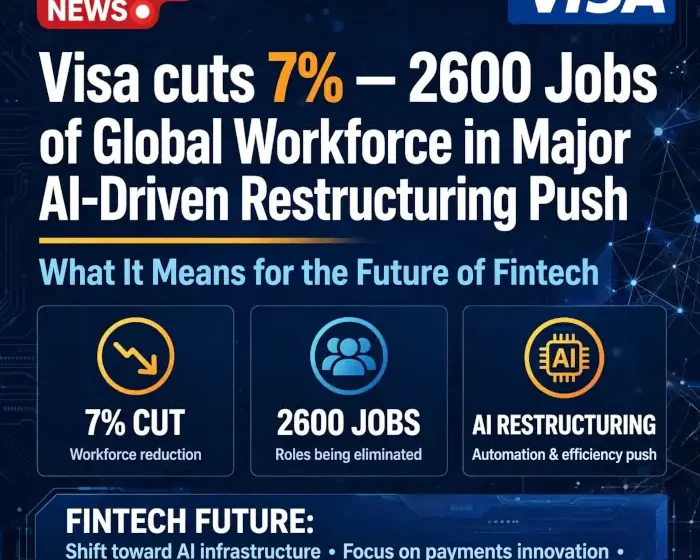
Visa cuts 7% (2600 jobs) of Global Workforce in Major AI-Driven Restructuring Push: What It Means for the Future of Fintech

Visa, the world’s largest payment processing network, is initiating a significant workforce reduction as part of a strategic push toward technological efficiency and corporate realignment. According to an internal corporate memo confirmed by market sources, the digital payments giant plans to eliminate roughly 2,600 positions across its global enterprise. This reduction represents approximately 7% of Visa’s total employee base, which stood at roughly 34,100 workers at the conclusion of its last fiscal year.
The job cuts are poised to hit the company’s technology and product operations departments hardest. The decision reflects a broader trend sweeping through Silicon Valley and Wall Street, where industry leaders are actively streamlining legacy processes, embracing generative automation, and redirecting financial resources toward high-margin digital growth avenues.
Key Takeaways from the Announcement
Workforce Impact: Approximately 2,600 jobs (7% of total global headcount) will be eliminated.
Targeted Divisions: Reductions are primarily concentrated within technology, product design, and operational departments.
Core Catalyst: Artificial intelligence integration is reshaping operational workflows, accelerating task execution, and reducing overhead requirements.
Capital Realignment: Saved resources will directly fund expansion into affluent segment services, cross-border remittance, stablecoins, and strategic geographic expansion.
Inside the Layoff Strategy: Restructuring for Speed
The workforce adjustment was formally communicated to employees in a company-wide memo authored by Chief Executive Officer Ryan McInerney. In the message, McInerney outlined the necessity of evolving how the payments giant operates in order to capitalize on emerging opportunities across the global financial landscape.
Impacted personnel across affected regions began receiving notifications regarding transition support, severance packages, and outplacement assistance. While corporate restructurings of this magnitude often signal economic headwinds, internal sources clarify that Visa’s operational shift stems from a desire to maintain competitive agility rather than financial distress.
By tightening team structures within traditional product development and IT support, leadership aims to strip away organizational friction. The overarching goal is to accelerate time-to-market for new payment solutions while maintaining the reliable infrastructure that processes billions of transactions daily across more than 200 countries and territories.
The AI Factor behind VISA Jobs Cut 2026
A primary talking point surrounding Visa’s organisational shift is the explicit role played by artificial intelligence. In his statement to staff, McInerney noted that advanced AI capabilities are helping accelerate internal evolution and fundamentally changing how everyday tasks are executed within the network.
While artificial intelligence served as a major catalyst for the decision, experts and insiders note it is not the sole factor driving the layoffs. Instead, AI acts as an operational force multiplier that changes staffing requirements across technical domains:
-
Automated Software Engineering: Modern AI development tools allow software engineers to write, debug, and deploy code significantly faster, reducing the sheer headcount needed for routine engineering pipelines.
-
Optimised Network Operations: Machine learning models now monitor fraud, detect network anomalies, and handle routing optimisation in real time, reducing manual intervention requirements.
-
Streamlined Product Management: Automated data analytics tools synthesise user feedback and transaction trends instantly, speeding up product design cycles.
The tech industry at large has entered a phase where rapid post-pandemic hiring sprees are giving way to disciplined fiscal management. For companies like Visa, integrating AI allows management to handle larger transaction volumes with leaner, more specialised technical teams.
Following the Capital: Where Visa Is Investing Next
Crucially, the capital unlocked by these job cuts is not intended simply to pad profit margins. Visa plans to aggressively reinvest capital into high-growth verticals where digital transformation is accelerating rapidly.
                    ┌─────────────────────────────────────────┐
                    │      Cost Savings via Restructuring     │
                    └────────────────────┬────────────────────┘
                                         │
                   ┌─────────────────────┴─────────────────────┐
                   ▼                                           ▼
┌────────────────────────────────────┐       ┌────────────────────────────────────┐
│      Consumer & Global Growth      │       │     Next-Gen Payment Infrastructure│
├────────────────────────────────────┤       ├────────────────────────────────────┤
│ • Affluent Customer Segment        │       │ • Cross-Border & Remittances       │
│ • Emerging Markets Expansion       │       │ • Stablecoin & Web3 Integration    │
│ • Business-to-Business (B2B)       │       │ • Automated Fraud Prevention       │
└────────────────────────────────────┘       └────────────────────────────────────┘
1. Stablecoins and Blockchain Integration
2. Cross-Border Remittances and B2B Payments
3. Wealthy Consumer Solutions
Macro Context
Visa’s operational shift is far from an isolated incident. Across financial technology, enterprise software, and consumer internet sectors, corporate leadership is actively reassessing human capital needs against technological advancements.
| Sector Leader | Focus of Operational Realignment | Core Technological Driver |
| Visa | Product, IT, and regional operations | AI coding assistants, automated network routing |
| Enterprise Fintech | Customer onboarding and compliance | Automated KYC verification and fraud triage |
| Big Tech / Cloud | Middle management and redundant engineering | Generative AI, cloud infrastructure automation |
Financial Resilience Ahead of Earnings
This announcement arrives at a pivotal moment, coinciding with Visa’s quarterly earnings release. Despite trimming its global workforce, the payment giant enters this new operational phase from a position of undeniable balance-sheet strength.
Transaction volumes continue to demonstrate solid consumer spending metrics across major geographic markets. Travel demand remains steady, supporting lucrative cross-border volume growth. Furthermore, commercial payment adoption continues to migrate away from legacy paper checks and manual bank wires toward automated digital card solutions.
McInerney emphasised that past strategic decisions have placed Visa in a strong position as commerce enters a new era. The current workforce realignment is designed to ensure the company remains ahead of technological shifts rather than reacting to them after the market has evolved.
Looking Ahead: The Hybrid Future of Payment Operations
As Visa executes its transition plan, the broader financial services landscape will be watching closely. The restructuring highlights a fundamental truth facing modern corporations: adapting to technological breakthroughs often requires difficult structural decisions.
Moving forward, Visa’s success will hinge on how effectively it deploys its lean, AI-augmented technical workforce to capture market share in crypto-settlements, international remittances, and high-margin consumer categories. By trimming corporate overhead today, the payments network aims to secure its dominant role in the future of global commerce.