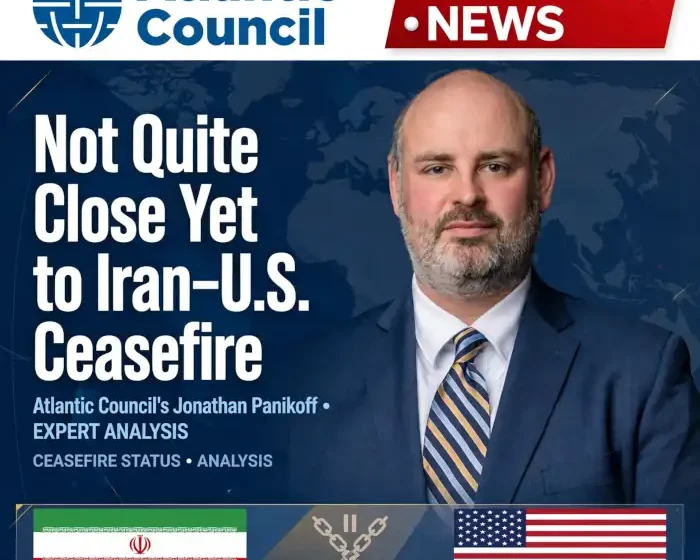

WASHINGTON — Despite ongoing diplomatic outreach and temporary pauses in active hostilities across the Middle East, the United States and Iran remain significantly far from securing a formal, long-term ceasefire. That is the sobering assessment from Jonathan Panikoff, Director of the Scowcroft Middle East Security Initiative at the Atlantic Council and former Deputy National Intelligence Officer for the Near East.
Appearing on CNBC’s The Exchange, Panikoff offered a candid evaluation of the fraught geopolitical landscape following high-stakes consultations between Israeli Prime Minister Benjamin Netanyahu and U.S. President Donald Trump. Amid intense speculation that Washington and Tehran might be on the precipice of a broader diplomatic breakthrough, Panikoff cautioned that significant structural hurdles, misaligned strategic objectives, and deep-seated regional mistrust continue to prevent the warring parties from reaching a definitive peace agreement.
Panikoff’s Reality Check: Diplomatic Momentum vs. Ground Realities
“We are simply not quite close yet to a comprehensive U.S.-Iran ceasefire,” Panikoff emphasised during his broadcast appearance. While recent temporary lulls in military exchanges and rumours of mediated Memorandums of Understanding (MOUs) have provided brief relief to global energy markets and international observers, Panikoff stressed that an operational pause in tactical strikes is fundamentally distinct from a durable, binding peace treaty.
The geopolitical analyst pointed out that while short-term pauses are often negotiated to allow military stock replenishment, diplomatic positioning, or bilateral consultations with regional partners, they do not resolve the core structural drivers of the conflict. The underlying friction points—ranging from Iran’s expanding nuclear enrichment capabilities and ballistic missile stockpiles to its regional proxy network and blockade threats in critical maritime choke points—remain entirely unaddressed by temporary cessation-of-hostilities frameworks.
According to Panikoff, market optimism surrounding potential diplomatic breakthroughs often oversimplifies the immense technical and political complexity involved in negotiating with Tehran. “The Iranian diplomatic playbook historically relies on dragging out negotiations, seeking tactical relief, and leveraging time while preserving core strategic capabilities,” Panikoff noted. As a result, Washington’s insistence on comprehensive verifiable concessions stands in sharp contrast to Tehran’s baseline demands, creating a persistent diplomatic impasse that cannot be bridged overnight.
The Trump-Netanyahu Summit: Strategic Alignment and Underlying Frictions
A central focus of Panikoff’s analysis was the crucial high-level meeting between President Donald Trump and Israeli Prime Minister Benjamin Netanyahu. The summit, held against the backdrop of escalating regional tensions and fluctuating energy prices, underscored both the deep strategic partnership and the subtle operational divergences between Washington and Jerusalem.
During their closed-door discussions at the White House, Netanyahu presented detailed intelligence briefings and strategic roadmaps outlining Israel’s vision for neutralising the existential threats posed by the Iranian regime. While the two leaders publicly demonstrated a unified front against Iranian aggression, Panikoff highlighted that their ultimate political and strategic end states do not perfectly align.
“From the outset, Israeli and U.S. objectives have operated on slightly different tracks,” Panikoff explained. “For Prime Minister Netanyahu and the Israeli defence establishment, the primary objective is the permanent degradation—or total collapse—of the Iranian regime’s military apparatus and nuclear infrastructure. For the U.S. administration, the focus is centred more on containment, restoring maritime freedom of navigation in the Strait of Hormuz, preventing broader regional escalation, and securing an advantageous negotiating posture without getting bogged down in an open-ended, multi-trillion-dollar regional conflict.”
Panikoff noted that while President Trump remains committed to protecting American interests and standing firm with Israel, U.S. strategic decision-making is heavily influenced by domestic economic considerations, defence stockpile limits, and a broader desire to avoid prolonged military commitments in the Middle East. Consequently, while Washington is open to leveraging military deterrence to force Tehran to the bargaining table, it remains cautious about adopting maximalist war aims that could drag the U.S. into an uncontainable regional conflagration.
The Strait of Hormuz and Maritime Security Challenges
The discussion on The Exchange also tackled the critical maritime security crisis in the Strait of Hormuz. The vital waterway, through which approximately one-fifth of global petroleum supplies transit, has become the central flashpoint in the broader U.S.-Iran standoff. While recent regional diplomatic contacts involving Oman and Saudi Arabia have sought to de-escalate shipping disruptions, commercial operators and international naval forces remain on high alert.
Panikoff emphasised that any ceasefire or diplomatic memorandum that fails to permanently secure freedom of navigation through the Strait of Hormuz will ultimately prove ineffective. Iran’s ability to threaten global energy transit remains one of its most potent strategic levers. Without explicit, enforceable guarantees regarding maritime transit, the risk of miscalculation or sudden naval clashes re-igniting full-scale military conflict remains exceptionally high.
Furthermore, Panikoff observed that regional allies—specifically the Gulf Cooperation Council (GCC) states such as Saudi Arabia, the United Arab Emirates, and Oman—find themselves in a delicate position. While these nations strongly favour a de-escalation of conflict to protect their economic diversification initiatives and critical infrastructure, they remain wary of any partial bilateral arrangement between Washington and Tehran that leaves Iranian proxy capabilities or missile systems intact near their borders.
Diverging Priorities: Why a Permanent Deal Remains Elusive
In breaking down the mechanics of potential negotiations, Panikoff drew a sharp distinction between a formal peace agreement and a temporary Memorandum of Understanding (MOU). While an MOU can establish operational guidelines, set up communication channels, and institute temporary pauses in kinetic operations, it lacks the legal, verifiable, and permanent structural commitments required for a true ceasefire.
Panikoff detailed three major structural obstacles holding back a genuine diplomatic breakthrough:
-
Nuclear and Ballistic Missile Verification: The United States and Israel demand total, verifiable halts to high-grade uranium enrichment and severe restrictions on Iran’s ballistic missile production. Tehran continues to reject these demands as unacceptable infringements on its national sovereignty.
-
Regional Proxies and Non-State Actors: Israel insists that any long-term resolution must address Iranian funding, arming, and operational control of regional proxy networks. However, Tehran views its regional network as a vital forward-defense deterrent that it refuses to disband.
-
Internal Political Dynamics: Both President Trump and Prime Minister Netanyahu face complex political landscapes domestically. In Israel, political coalitions pressure Netanyahu to maintain maximum military pressure until all security threats are eliminated. In Washington, the administration must balance a robust national security posture against fatigue over foreign entanglements and economic pressures driven by energy market volatility.
The Road Ahead: Strategic Caution in a Volatile Middle East
Concluding his interview on The Exchange, Panikoff warned investors, policymakers, and international observers against confusing tactical lulls with strategic resolution. The situation across the Middle East remains fluid and highly volatile, with the risk of rapid escalation always present beneath the surface.
While diplomatic channels facilitated by regional mediators continue to operate behind the scenes, the gap between Washington, Jerusalem, and Tehran remains wide. Until all major stakeholders establish a shared framework that reconciles core security requirements with economic realities, the prospect of a comprehensive, lasting ceasefire between the U.S. and Iran will remain out of reach.
For now, the global community must navigate a period of intense diplomatic manoeuvring, fragile operational pauses, and persistent strategic friction as leaders in Washington, Jerusalem, and Tehran weigh the immense costs of continued conflict against the steep political price of compromise. As Jonathan Panikoff made abundantly clear during his assessment, reaching a genuine, lasting end to military hostilities will require far more than brief diplomatic gestures or fragile bilateral pauses—it ultimately demands directly addressing the deep-seated, complex strategic realities that continue to divide the region.