
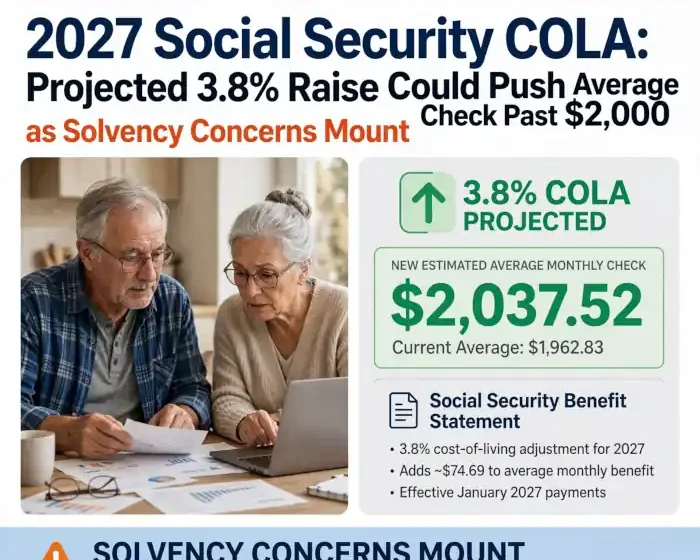
2027 Social Security COLA: Projected 3.8% Raise Could Push Average Check Past $2,000 as Solvency Concerns Mount

Social Security beneficiaries may be in line for a larger cost-of-living bump next year as persistent inflationary pressures continue to weigh on American retirees and households.
According to updated estimates from the nonpartisan advocacy group The Senior Citizens League (TSCL), the 2027 Social Security Cost-of-Living Adjustment (COLA) is projected to increase by 3.8%. If realised, this would mark a full percentage point increase over the 2.8% adjustment implemented in 2026, offering much-needed relief to tens of millions of seniors relying on fixed incomes.
While the Social Security Administration (SSA) will not officially announce the finalised 2027 COLA until mid-October 2026, monthly forecasts provide crucial insight for retirees planning their household budgets in an uncertain economic climate.
What a 3.8% COLA Means for Monthly Checks
If the 3.8% adjustment took effect today, the average monthly retirement benefit would increase by $73.62, raising the typical payout from $1,937.53 to $2,011.15.
| Metric | Current Estimate / Figure |
| Projected 2027 COLA | 3.8% (up from 2.8% in 2026) |
| Average Monthly Increase | +$73.62 |
| New Average Monthly Benefit | $2,011.15 |
| Historical Ranking | 17th highest COLA since 1977 |
| Official Announcement Date | Mid-October 2026 |
A 3.8% COLA would rank as the 17th largest adjustment since the modern automatic COLA system was instituted in 1977, underscoring that inflation remains higher than long-term historical targets.
How the Social Security COLA Is Calculated
The Social Security Administration determines the annual adjustment using official federal economic indicators. Specifically, the calculation relies on data from the Consumer Price Index for Urban Wage Earners and Clerical Workers (CPI-W), managed by the Bureau of Labour Statistics.
-
Third-Quarter Benchmark: The SSA measures average inflation during the third quarter of the current year (July, August, and September 2026).
-
Year-Over-Year Comparison: This Q3 average is compared directly against the average CPI-W from the third quarter of the previous year.
-
Adjustment Application: The percentage change determines the COLA applied to monthly benefit checks starting the following January.
In generating its monthly projections prior to the release of Q3 data, TSCL incorporates broader trends, including overall Consumer Price Index (CPI) movements, Federal Reserve interest rate decisions, and national unemployment metrics.
The Looming Fiscal Deadline: Trust Fund Depletion in 2032
While news of a larger benefit boost brings short-term relief, it arrives alongside growing anxiety over the long-term solvency of the Social Security program.
According to the Social Security Administration’s 2026 Trustees Report, the federal retirement safety net is rapidly approaching a fiscal deadline. The report confirms that the Old-Age and Survivors Insurance (OASI) trust fund is projected to exhaust its accumulated reserves in the fourth quarter of 2032—one year earlier than estimates published in 2025.
If the trust fund runs dry without legislative action from Congress, incoming payroll tax revenues will only cover a portion of promised payouts, triggering an automatic 17% across-the-board benefit cut for all recipients.
“The reality is that poverty is increasing rapidly among American seniors, who make up the fastest-growing portion of the homeless population,” warned Shannon Benton, Executive Director of The Senior Citizens League.
Advocacy groups emphasise that senior citizens cannot absorb further reductions in income amidst rising costs for essential needs like housing, healthcare, and nutrition.
“These numbers should be a wake-up call. Congress needs to act,” stated Myechia Minter-Jordan, CEO of AARP. “Americans have worked hard and paid into Social Security their entire lives, and they deserve to count on it when they retire. No family should see any cuts to what they’ve earned.”
Capitol Hill Gridlock and Proposed Legislation
Despite mounting urgency, comprehensive Social Security reform has remained stalled in Congress. The program was last overhauled roughly 40 years ago, when federal reforms gradually raised the full retirement age from 65 to 67.
Several legislative proposals have been introduced to address both recipient benefit adequacy and program funding shortfalls:
-
Social Security 2100 Act (Rep. John Larson, D-CT): This bill proposes an immediate 2% general benefit boost, sets a new minimum benefit at 125% of the federal poverty line, and shifts the annual COLA calculation metric to the CPI for the Elderly (CPI-E)—an index tailored specifically to track medical and housing costs faced by older Americans.
-
Funding Mechanism: To pay for these enhancements and extend solvency, the bill would raise payroll taxes and apply Social Security taxes to earned income exceeding $400,000, eliminating the current payroll tax cap.
However, political consensus remains elusive. Independent legislative tracking from GovTrack currently assigns Rep. Larson’s reform bill a 0% chance of passage in the current congressional session.
Looking Ahead to October
For now, Social Security recipients must wait for official government inflation data for July, August, and September 2026 before their exact 2027 benefit amounts are locked in. The final COLA decision will be officially announced by the Social Security Administration in mid-October 2026, with adjusted payments taking effect in January 2027.