
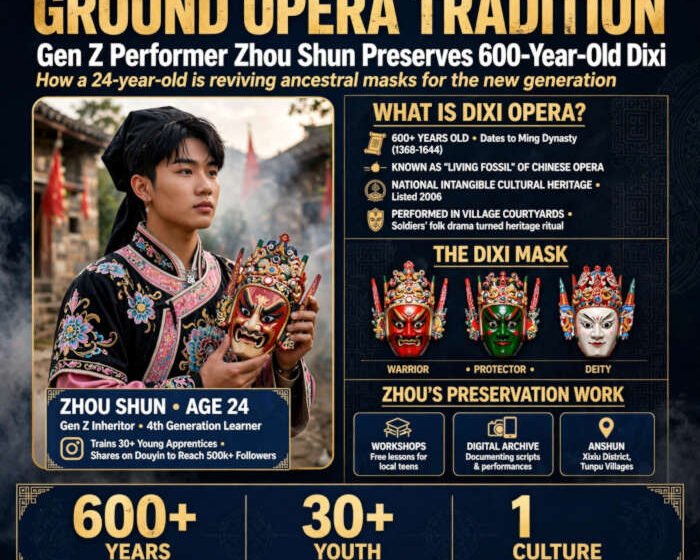
Ground Opera Tradition Guizhou: Gen Z Performer Zhou Shun Preserves 600-Year-Old Dixi Culture in Anshun

The rhythmic clanging of brass gongs and cowhide drums echoes through the mountain valleys of Anshun, Guizhou province. In open fields and village plazas, performers don hand-carved wooden masks, fasten traditional robes, and brandish painted wooden swords to enact legendary battles from imperial Chinese history. This is Dixi (地戏), or “ground opera”—a vibrant, 600-year-old performing art that bypasses formal theatrical stages to treat the earth itself as a sacred performance venue.
While many ancient folk arts face extinction amid rapid global modernization, a new wave of youth culture is reversing this trajectory. Leading this cultural renaissance is 20-year-old Zhou Shun, a Gen Z performer from Anshun who is dedicating his youth to keeping the centuries-old tradition of Dixi alive.
What is Dixi? The Origins of Guizhou’s Ground Opera
Dixi originated during the early Ming Dynasty (1368–1644) when Emperor Hongwu dispatched military garrisons to garrison and farm the southwestern frontier of China. To boost morale, maintain combat readiness, and perform ritual cleansings, soldiers staged theatrical reenactments of famous historical campaigns, such as the Romance of the Three Kingdoms and The Investiture of the Gods.
Unlike high-art forms such as Peking Opera or Cantonese Opera, Dixi retains its raw, martial roots:
-
Stage-Free Performance: Shows take place directly on the ground—hence the name Dixi (“ground opera”)—symbolizing an intimate connection between the performers, the audience, and the earth.
-
Intricate Wooden Masks (Nuomian): Performers wear distinctive, brightly painted masks carved from willow or poplar wood, representing ancient warlords, imperial generals, and mythological deities.
-
Spiritual Invocation: Actors do not merely play roles; traditionally, they act as spiritual vessels lending their physical bodies to ancient war deities to bring blessings, peace, and bountiful harvests to their local communities.
       +-------------------------------------------------------------+
       |                  ORIGINS OF DIXI (地戏)                      |
       |      Ming Dynasty Military Garrison Rituals (c. 1381)       |
       +-------------------------------------------------------------+
                                      |
                                      v
       +-------------------------------------------------------------+
       |                  CORE ELEMENTS & FEATURES                   |
       +-------------------------------------------------------------+
       |  • Stage-Free: Played on open earth, fields, and plazas     |
       |  • Wooden Masks (Nuomian): Worn above forehead for sight     |
       |  • Reenactments: Classical Chinese war epics & mythology     |
       |  • Spiritual Function: Ritual exorcism & community blessing   |
       +-------------------------------------------------------------+
Meet Zhou Shun: The 20-Year-Old Guardian of Ancient Heritage
In an era dominated by short-form video streaming, mobile gaming, and fast-paced urban lifestyles, 20-year-old Zhou Shun represents an extraordinary departure from typical youth trends. Born and raised in Anshun, Zhou grew up watching local elders transform into legendary commanders behind wooden masks.
“When you tie the mask onto your head and step onto the open ground, you leave your individual identity behind,” explains Zhou Shun. “You become the general. You carry the energy of centuries of ancestors who stood on this exact soil.”
Mastering Dixi requires years of rigorous physical conditioning and artistic discipline:
-
Vocal Gymnastics: Performers must project unamplified operatic chants across open fields over the sound of loud percussion instruments.
-
Martial Arts Choreography: Fighting routines demand precision footwork, athletic jumps, and realistic swordplay using wooden weaponry.
-
Mask Ergonomics: Unlike standard masks, Dixi masks are tied to the performer’s forehead, angled upward while black gauze covers the face. Performers see out through small gaps while maintaining an imposing, larger-than-life posture.
Zhou Shun’s dedication has earned him admiration from senior village masters, who previously worried the art form would die out as younger generations migrated to tier-one coastal cities for commercial manufacturing and technology jobs.
Preserving Intangible Cultural Heritage in the Modern Age
Recognized as a national Intangible Cultural Heritage in China, Dixi faces both opportunities and structural challenges in the 21st century.
                                  DIXI CULTURE
                                       |
                   +-------------------+-------------------+
                   |                                       |
                   v                                       v
         TRADITIONAL VALUES                       MODERN INNOVATION
  • Ritual Exorcisms & Blessings           • Cultural Tourism Integration
  • Ancestral Lineage & Honor              • Social Media Preservation
  • Community Bonding in Guizhou           • Educational Workshops & Media
Cultural Tourism & Local Economic Development
Guizhou province has emerged as a major hub for cultural tourism and big-data infrastructure. Local government initiatives are incorporating Dixi performances into cultural itineraries, driving economic growth for rural hospitality, travel agencies, and artisanal mask-carving workshops.
Social Media & Digital Archiving
Younger performers like Zhou Shun are leveraging platforms like Douyin (TikTok), Bilibili, and RED (Xiaohongshu) to record backstage preparations, mask-carving techniques, and live performances. By digitizing Dixi, these young advocates are introducing millions of urban viewers to rural Guizhou’s rich heritage.
Market Relevance: Cultural Preservation, Legal & Financial Insights
From a broader economic perspective, the revitalization of intangible heritage assets involves legal protections, intellectual property (IP) rights, corporate sponsorship, and municipal development funds:
-
Intellectual Property & Trademarking: Protecting traditional mask designs and performance choreography under international copyright and trademark laws ensures local artisan communities retain ownership of their cultural capital.
-
Public-Private Partnerships (PPP): Corporate funding from travel conglomerates and heritage conservation grants provides financial support for master artists, allowing them to train full-time apprentices without economic strain.
-
Commercial Real Estate & Cultural Districts: Integrating authentic folk performances like Dixi into heritage commercial properties enhances tourism revenue, boosts commercial property valuations, and supports sustainable local employment.
The Future of Ground Opera
As the sun sets behind the karst mountains of Anshun, Zhou Shun tightens the straps of his wooden mask, raises his sword, and steps out onto the dust. As the drums swell, the audience—comprising elders, young children, and visiting tourists—watches in awe.
Thanks to the passion of Gen Z guardians like Zhou Shun, Guizhou’s 600-year-old Ground Opera is not merely surviving as a museum artifact; it continues to thrive as a living, breathing tradition anchored in the soil where it was born.