
Wall Street started the week with a classic summer pivot. Investors who entered Monday hoping to extend last week’s momentum were met with a familiar market reality: rallies rarely march upward in a straight line. Major U.S. stock indices ended Monday on a soft note as semiconductor momentum cooled down and geopolitical headlines pushed crude oil prices toward the $90 threshold.
The early morning optimism quickly gave way to cautious position-squaring. Market participants dialled back risk ahead of a massive wave of Big Tech earnings reports scheduled for later in the week. At the same time, volatile energy prices reminded traders that macroeconomic and geopolitical risks remain front and centre.
How Wall Street Closed today in US
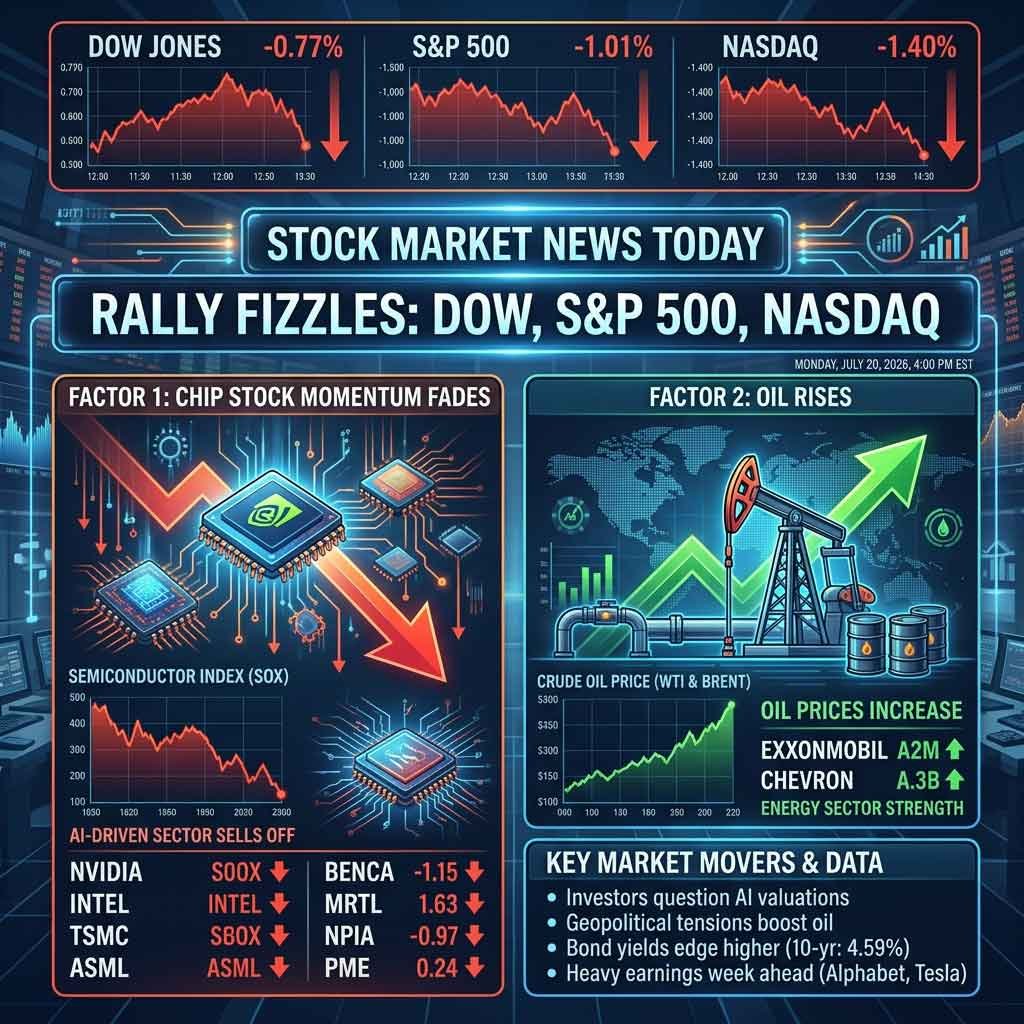
The three major benchmarks started Monday with modest gains, but sellers gradually took control as the trading session progressed.
- The Dow Jones Industrial Average (^DJI): Led the decline among the primary indices, shedding 0.59% (roughly 240 points). Industrials and traditional blue-chip holdings dragged down the average as investors took profits following recent high-level consolidation.
- The S&P 500 (^GSPC): Slipped about 0.19%. The broader index felt pressure from fading strength in technology hardware, though defensive pockets and select megacap communication stocks helped soften the overall decline.
- The Nasdaq Composite (^IXIC): Finished just below its flat line with a slight 0.05% drop. The tech-centric index experienced notable intraday volatility as semiconductor heavyweights gave back ground gained in prior sessions.
This calm pullback comes after weeks of rapid gains driven by artificial intelligence optimism. When indices hover near peak valuations, even small shifts in trader sentiment can pause an ongoing rally.
Why the Chip Stock Rally Hit a Speed Bump
Semiconductor stocks have carried Wall Street on their collective shoulders for much of the year. However, every market leader eventually needs to catch its breath. On Monday, the chip sector trimmed its recent gains as institutional investors recalibrated their portfolios ahead of crucial corporate updates.
Several factors contributed to the fading semiconductor momentum:
1. Pre-Earnings Position Squaring
Wall Street faces one of the busiest weeks of the quarterly earnings calendar. With several “Magnificent Seven” tech giants preparing to report their financial metrics, fund managers naturally locked in profits. Taking partial profits off the table before high-stakes earnings releases is standard risk management.
2. High Expectation Bar for AI Hardware
Chipmakers have enjoyed extraordinary revenue growth due to massive capital expenditure cycles in cloud computing and artificial intelligence infrastructure. However, when expectations are set to perfection, meeting analyst estimates is often not enough. Traders want evidence that demand will continue expanding through the end of the year.
3. Supply Chain and Export Considerations
Beyond earnings jitters, semiconductor firms continue to navigate complex global supply chains and regulatory environments. As companies scale up manufacturing, any temporary bottleneck in equipment delivery or custom silicon production instantly catches the market’s attention.
Alphabet (GOOG) Bucks the Trend on Custom Chip News
While most mega-cap technology stocks struggled to find traction on Monday, Alphabet Inc. (GOOG) proved to be a notable exception.
Google’s parent company saw its shares rise over 1.5% during regular trading, peaking higher during intra-session updates. The primary catalyst behind the stock’s strength was fresh industry coverage detailing the search giant’s internal hardware developments.
According to market reports, Alphabet is making significant strides in developing next-generation in-house silicon designed specifically to optimise its flagship Gemini AI models.
By designing proprietary chips engineered for its own machine-learning workloads, Alphabet aims to achieve three strategic goals:
- Reduce Dependency: Lower reliance on third-party graphics processing units (GPUs).
- Improve Margins: Cut the massive energy and operational expenses required to run large language models at scale.
- Enhance Speed: Deliver faster inference and training times for enterprise cloud customers using Gemini applications.
Investors welcomed the update, interpreting custom silicon progress as a structural advantage in the ongoing AI competition.
Energy Market Volatility: Oil Touches $90 a Barrel
While stock traders watched tech charts, commodities traders kept their eyes glued to crude oil futures. Energy markets experienced choppy, volatile trading after benchmark West Texas Intermediate (WTI) and Brent crude touched the $90 per barrel mark over the weekend.
The primary catalyst driving oil volatility was a series of tit-for-tat military and rhetorical exchanges between the United States and Iran over the weekend. Geopolitical friction in key production and transport zones usually injects a risk premium into energy pricing.
Why Rising Oil Matters for Stocks
Higher oil prices do not just affect what drivers pay at the gas pump; they ripple throughout the entire macroeconomy:
- Corporate Profit Margins: Transportation, logistics, airline, and manufacturing companies face immediate cost increases when fuel prices rise.
- Consumer Spending: When energy bills climb, households often cut back on discretionary purchases, impacting retail and consumer service stocks.
- Federal Reserve Policy: Energy is a major input in headline inflation metrics. If crude oil stays elevated near or above $90 a barrel, central banks may keep interest rates higher for longer to prevent inflationary pressures from resurfacing.
The Broader Picture: What Investors Should Watch Next
Monday’s pull-back was not a structural panic; it was a disciplined pause by a market looking for its next big catalyst. As the week progresses, several crucial events will dictate whether equity markets resume their upward trajectory or enter a deeper consolidation phase.
1. Big Tech Earnings Season
This week brings quarterly financial results from major technology titans. Investors will scrub balance sheets not just for backwards-looking revenue figures, but for forward guidance regarding artificial intelligence capital spending.
Market participants want to see clear proof that massive investments in data centres, server racks, and AI software are generating tangible returns.
2. Economic Indicators and Inflation Data
Upcoming government reports on economic growth, consumer sentiment, and labour market resilience will provide essential context. If economic data shows moderate growth alongside cooling inflation, it reinforces the “soft landing” scenario that has supported equity valuations throughout 2026.
3. Central Bank Commentary and Interest Rate Expectations
Interest rate expectations remain a major factor for asset prices. Traders will closely listen to public comments from Federal Reserve officials to gauge the likelihood of monetary policy shifts in the coming quarters. Any indication that central bankers remain concerned about stubborn inflation could weigh on growth-oriented stocks.
Actionable Takeaways for Individual Investors
Navigating choppy market conditions requires discipline rather than emotional reactions. Here are three practical steps long-term investors can keep in mind during earnings-heavy market weeks:
- Avoid Chasing Short-Term Spikes: Buying into hot sectors after multi-week rallies leaves portfolio holdings vulnerable to sudden pre-earnings pullbacks. Wait for consolidation patterns before building new long positions.
- Diversify Beyond Megacap Tech: While large-cap technology stocks have driven index gains, keeping balanced exposure across defensive sectors, energy, and value-oriented assets helps insulate portfolios during tech pullbacks.
- Focus on Quality and Balance Sheets: During periods of high volatility and elevated interest rates, companies with low debt levels, stable free cash flow, and strong market power tend to navigate macro uncertainty far better than speculative growth stories.
Final Thoughts
Monday’s session delivered a textbook example of market rotation. The rally in major indices fizzled as traders locked in chip profits, Google stood out with its custom silicon developments, and oil prices reminded everyone that geopolitical risks remain alive and well.
As quarterly earnings reports roll in over the coming days, volatility may stay elevated. However, for disciplined investors who look past daily noise, these market pauses often create the best opportunities to realign portfolios for the long haul.
