
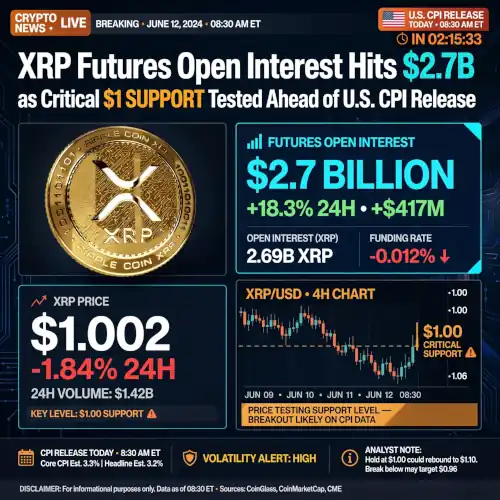
XRP Futures Open Interest Hits $2.7B as Critical $1 Support Tested Ahead of U.S. CPI Release

Cross-border payments token XRP faces severe market compression as open interest in its derivatives markets surged to a ten-month high of 2.67 billion XRP ($2.73 billion). This rapid accumulation of leveraged positions coincides with the token testing its critical $1.00 psychological support level. With the U.S. Department of Labour releasing July Consumer Price Index (CPI) data, elevated market leverage creates significant risk for volatility cascades across major digital asset exchanges.
The broader cryptocurrency market has displayed mixed recovery signals, with Bitcoin stabilising near $64,000, Ether hovering around $1,878, and Solana maintaining trades above $76. However, XRP continues to underperform these major market capitalisation peers. The convergence of an on-chain security exploit, elevated derivatives leverage, and macroeconomic sensitivity leaves XRP particularly vulnerable to sharp directional price swings.
Derivatives Leverage and Technical Support Saturation
Derivatives market data indicates that open interest in XRP futures expanded from 2.25 billion XRP at the beginning of the month to 2.67 billion XRP, marking the highest concentration of leverage since October. Heavy leverage building near established price support often precedes elevated volatility, as sharp price moves can trigger liquidation cascades across perpetual futures contracts.
On spot markets, XRP briefly breached its primary psychological boundary, slipping to $0.99 across several exchanges before experiencing a slight recovery. However, upside buying momentum quickly stalled near $1.02, reinforcing resistance at the lower boundary of its recent trading range.
Compounding this technical weakness, an early-morning security exploit targeted a cross-chain bridge connected to the XRP Ledger (XRPL), draining roughly $200,000 worth of XRP tokens. While the protocol breach was isolated and represented a modest total dollar value, it introduced negative sentiment into an already fragile market structure.
-
Leverage Build-Up: Futures open interest expanded by 420 million XRP over less than two weeks, bringing total open exposure to $2.73 billion.
-
Key Support Test: Spot prices registered a temporary breakdown to $0.99, showing seller aggression beneath the $1.00 handle.
-
Weak Rebound: Post-dip recovery stalled at $1.02, indicating limited spot market absorption.
-
DeFi Security Risk: An exploit on an XRPL-linked cross-chain bridge created technical pressure across ecosystem assets.
Macroeconomic Catalyst: July U.S. Consumer Price Index Expectations
Because leveraged positions remain highly concentrated near key technical support, XRP’s short-term price trajectory relies heavily on wider macroeconomic catalysts. Consensus forecasts for the July U.S. CPI report project a monthly headline increase of 0.1%, up from June’s -0.4% reading. Year-over-year headline inflation is expected to ease slightly from 3.5% to 3.4%, while annual core CPI—which strips out volatile food and energy costs—is projected to decline to 2.5%.
Economic research from ING notes that a lower-than-expected inflation reading could weaken the U.S. Dollar Index (DXY), generating favourable tailwinds for crypto assets. Conversely, a hotter-than-expected inflation print would strengthen expectations for sustained Federal Reserve policy rate hikes, driving Treasury yields higher and pressuring risk-sensitive digital assets.
| Economic Metric / Asset | Recent Baseline / Previous Period | Consensus Forecast / Market Target | Potential Market Impact |
| Headline CPI (MoM) | -0.4% (June) | +0.1% (July) | Rebound indicates sticky baseline inflation |
| Headline CPI (YoY) | 3.5% | 3.4% | Easing rate strengthens risk asset sentiment |
| Core CPI (YoY) | 2.6% | 2.5% | Lower core metric favors monetary easing |
| XRP Futures Open Interest | 2.25 Billion XRP (Aug 1) | 2.67 Billion XRP ($2.73B) | Elevated leverage amplifies volatility |
| Bitcoin Range Target | $62,000 Support | $66,000 Resistance | Range breakout depends on CPI direction |
Risk Management and Volatility Strategies for Crypto Traders
Navigating high-leverage environments during major economic announcements requires disciplined risk parameters to manage rapid liquidity shifts. When open interest expands into declining or stagnant price action, unexpected volatility can force cascading long or short liquidations across automated order books.
Traders and institutional market participants utilize specific risk controls to protect capital during macro release windows:
-
Reduce Leverage Limits: De-leveraging active derivative positions prior to scheduled macroeconomic data releases reduces forced liquidation risks.
-
Monitor On-Chain Bridge Activity: Tracking liquidity flows across cross-chain protocols helps evaluate ecosystem stability following security events.
-
Assess Spot Volume Divergence: Comparing derivative open interest spikes against spot market exchange volume reveals whether price movements are driven by speculative leverage or genuine spot demand.
-
Utilize Guaranteed Stop-Loss Orders: Placing stop-loss orders on non-leveraged spot accounts mitigates downside exposure if major support levels fail.
Frequently Asked Questions Regarding XRP Trading and Macro Conditions
Why is XRP more sensitive to the CPI report than Bitcoin or Ethereum?
XRP’s higher vulnerability stems from its elevated futures leverage clustered near its psychological $1.00 support level. When speculative leverage builds near key technical support, macro surprises spark larger liquidation chains compared to less-leveraged markets.
What is Open Interest in crypto futures, and why does it matter?
Open interest measures the total dollar value or contract count of outstanding, unsettled derivative positions. High open interest indicates heavy market leverage, which can fuel sudden price moves when traders are forced to close their positions simultaneously.
How does a hotter-than-expected CPI reading impact digital asset prices?
Higher inflation increases expectations that the Federal Reserve will raise or maintain high interest rates. Elevated rates push Treasury yields and the U.S. dollar higher, making yield-bearing assets more attractive while curbing capital inflows into non-yielding risk assets like cryptocurrencies.
Managing capital in volatile crypto derivatives markets requires tracking technical chart patterns alongside broader macroeconomic shifts. As leverage stays elevated near the $1.00 mark, watching real-time order book liquidity, Federal Reserve rate expectations, and inflation data will help traders protect capital and navigate shifting market dynamics.
Explore Further & Join the Discussion:
-
Track career opportunities and cryptocurrency job trends via Job Alerts Google Search.
-
Discuss market analyses, technical charts, and macroeconomic trends at the NT Live News Community Forums.
-
Review official protocol history and technology standards on the XRP Ledger Wikipedia Entry and the official Ripple Corporate Website.