
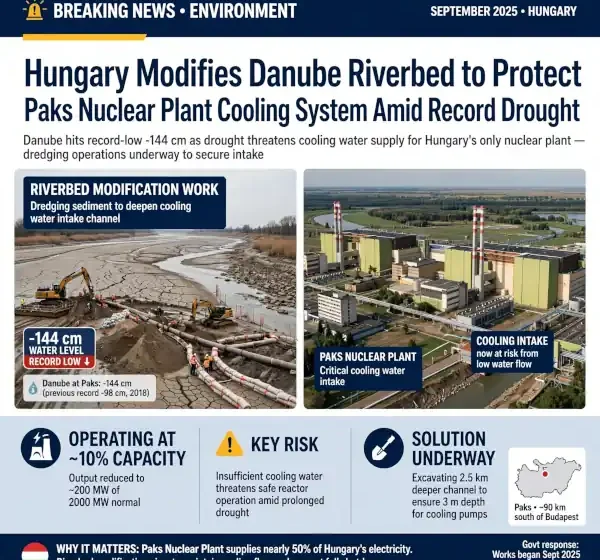
Hungary Modifies Danube Riverbed to Protect Paks Nuclear Plant Cooling System Amid Record Drought

Historic climate pressures across Central Europe have forced Hungarian energy authorities into an unprecedented engineering intervention along one of Europe’s vital waterways. Months of relentless heatwaves and persistent drought have driven the Danube River to record low water levels, threatening the operational stability of Hungary’s sole commercial nuclear power plant at Paks. To prevent a complete grid collapse and secure essential reactor cooling water, Hungarian Prime Minister Péter Magyar announced emergency infrastructure construction directly within the riverbed.
Workers are placing approximately 145,000 cubic meters of heavy rock into the riverbed just upstream from the facility. This massive submerged barrier—known in hydrological engineering as a bed sill—slows the current to raise local water levels by up to one meter. Without this intervention, the 2,000-megawatt station risks an indefinite full shutdown for the first time in its 44-year history.
Crisis at Paks: Climate Change Vulnerabilities and European Nuclear Energy Grid Stability
The Paks nuclear power station sits roughly 120 kilometers south of Budapest and supplies more than one-third of Hungary’s total domestic electricity. The facility relies entirely on massive volumes of raw intake water drawn from the Danube to cool its four pressurized water reactors. As water levels plummeted during the August 2026 heatwave, intake pumps struggled to maintain required thermal exchange rates.
Consequently, plant operators gradually powered down multiple reactor turbines. Output temporarily fell to roughly 10% of total capacity, forcing the national grid operator to arrange expensive emergency power imports from neighboring countries.
Key operational impacts and emergency response measures currently active at the Paks site include:
-
Drastic Capacity Reductions: Plant generation dropped from 2,000 megawatts to under 250 megawatts to protect cooling intake pumps from cavitating.
-
Intake Pumping Alterations: Operators deployed temporary floating emergency pumps along the riverbank to maintain minimum water circulation across dormant reactor cores.
-
Industrial Electricity Rationing: The government requested voluntary power reductions from energy-intensive battery manufacturing and automotive assembly facilities.
-
Public Conservation Mandates: Regional authorities halted non-essential water usage, reduced municipal transit speeds, and extinguished decorative lighting on public buildings to conserve electricity.
-
Regional Infrastructure Strain: Neighboring nations relying on Danube cooling—such as Romania at its Cernavodă nuclear plant—face parallel energy alerts due to low river discharge.
Engineering Solutions on the Danube: Bed Sills, Barges, and Financial Comparisons
Engineering teams mobilized military personnel and heavy construction barges to execute the riverbed modification around the clock. The primary construction involves placing stone barriers crosswise along the channel floor to manage water flow dynamics. In addition to the permanent bed sill, officials prepared contingency plans to strategically sink two 80-meter barges near the cooling pump intakes. Sinking these vessels creates an immediate localized surge, adding an extra 20 centimeters of water depth to keep cooling pumps submerged while primary construction progresses.
The economic logic behind this rapid infrastructure expenditure is compelling. Operating the facility at severely throttled capacity imposes massive economic losses on the national economy. The cost of importing replacement electricity far outweighs the direct engineering expenses required to alter the riverbed.
| Financial and Operational Metric | Standard Baseline | Extreme Low-Water Crisis | Emergency Intervention Project |
| Plant Power Generation Output | 2,000 MW (~100% capacity) | ~200–500 MW (10–25% capacity) | Restores full 2,000 MW capacity |
| National Electricity Contribution | ~33% to 40% of domestic power | Less than 5% of grid load | Full grid stabilization |
| Danube Water Depth Increase | Baseline seasonal levels | Record historical low levels | +1.0 meter (Sill) / +20 cm (Barges) |
| Monthly Financial Economic Cost | Standard operating budgets | ~50 Billion HUF (~$158M) loss | ~6 Billion HUF (~$19M) one-time cost |
Climate Adaptation and Nuclear Power Infrastructure Risk Management
The situation at Paks highlights a growing vulnerability across global thermal power plants. Nuclear, coal, and combined-cycle gas plants require billions of gallons of water annually to condense steam back into liquid water. When inland water bodies experience prolonged droughts or excessive water temperatures, plants face strict environmental safety caps or physical operating limits.
Utilities across Europe and North America are re-evaluating risk models to build climate resilience into legacy energy assets. Long-term strategic adaptation frameworks focus on several core technical solutions:
-
Closed-Loop Cooling Tower Retrofits: Converting once-through river water systems to mechanical draft cooling towers drastically reduces direct water withdrawal volumes.
-
Deep Water Channel Dredging: Routine maintenance of river channels prevents sediment buildup from restricting intake channels during low-flow months.
-
Hybrid Desalination and Reclaimed Water Integration: Utilizing municipal wastewater or brackish sources insulates coastal and inland power generation facilities from river fluctuations.
-
Predictive Hydrological Telemetry: Advanced satellite monitoring and AI flow modeling help grid operators schedule maintenance ahead of seasonal drought cycles.
Frequently Asked Questions Regarding the Danube Riverbed Project and Paks Nuclear Operations
Why does the Paks nuclear power plant require water from the Danube River?
The Paks plant uses once-through cooling systems that draw cold water directly from the Danube to condense steam used in electricity generation. Heat exchangers transfer waste heat to the river before water returns downstream within strict safety and temperature guidelines.
How does building a bed sill raise the level of the Danube River?
A bed sill acts as a low-profile, submerged dam constructed across the river floor using dense rock or concrete. By creating controlled friction along the riverbed, it slows the lower water current and backs up upstream water, raising the localized surface elevation near intake pipes.
Is the Paks nuclear plant safe during extreme low water conditions?
Yes, nuclear regulatory safety protocols dictate that reactors must be powered down long before water levels drop below emergency cooling thresholds. Shut-down reactors require only a fraction of normal cooling water flow, which emergency backup pumps easily deliver.
How long will construction on the Danube riverbed structure take?
Round-the-clock construction utilising military engineering units and specialised barges aims to complete primary rock placement within two to three weeks. Emergency barge sinking can provide temporary depth increases within 48 hours if water levels fall unexpectedly.
Actionable Takeaways for Energy Investors and Infrastructure Developers
The emergency engineering measures in Hungary demonstrate that climate adaptation is no longer a distant consideration for heavy industry. Energy investors, grid planners, and policymakers must prioritise resilience upgrades across existing thermal and nuclear infrastructure. Upgrading cooling technologies, diversifying regional power generation sources, and integrating predictive water management software are critical steps to ensure energy security during extreme weather events.
Join the Discussion & Explore Related Resources:
-
Track current energy job opportunities and industry updates on Job Alerts Google Search.
-
Discuss climate policy and European infrastructure developments at the NT Live News Community Forums.
-
Read detailed technical background on the Paks Nuclear Power Plant Wikipedia Entry and the official International Atomic Energy Agency Overview.