
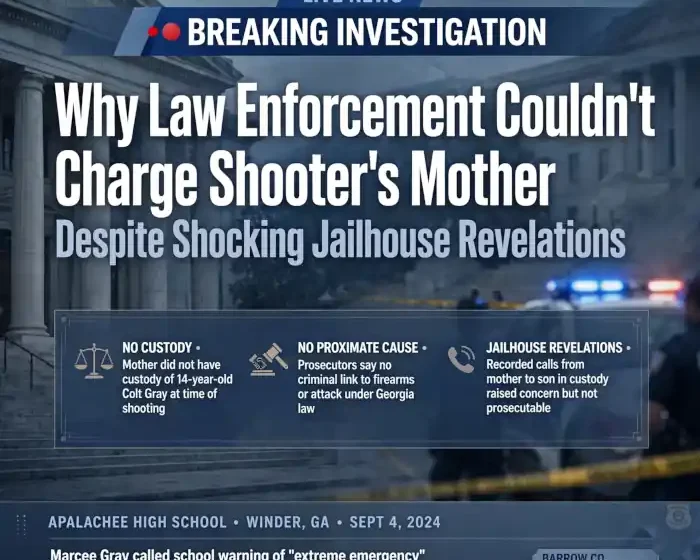
Why Law Enforcement Couldn’t Charge Apalachee High School Shooter’s Mother Despite Shocking Jailhouse Revelations

WINDER, Ga. — As courtroom witnesses detailed the horrific events of the September 4, 2024, mass shooting at Apalachee High School, grief and outrage filled the Barrow County courtroom gallery. Sitting in the second row, Breanna Schermerhorn—mother of 14-year-old victim Mason Schermerhorn—listened as prosecutors unspooled details regarding the shooter’s estranged mother, Marcee Gray.
Between allegations of past physical abuse, long-standing child neglect, and recorded post-arrest jailhouse conversations where Marcee seemed to act as a bridge between her son and online “fans,” Schermerhorn voiced what many victims’ families were feeling: “She should be in jail now.”
Yet, despite intense public scrutiny and anger from the victims’ families, Barrow County District Attorney Brad Smith confirmed that Marcee Gray will not face criminal charges related to the deadly attack that claimed four lives.
Here is a look at the complex legal constraints, procedural boundaries, and prosecutorial decisions that explain why Marcee Gray remains free.
Lack of Custody, Proximity, and Means
Under Georgia criminal law, charging an individual as a party to a crime requires proving proximate cause—a direct legal chain connecting the person’s actions or negligence to the ultimate offense.
In the landmark prosecution of Colt Gray’s father, Colin Gray—who was sentenced to 15 years in prison for second-degree murder and involuntary manslaughter—the state proved that Colin knowingly purchased an AR-15-style rifle for his 14-year-old son as a Christmas gift despite repeated warnings about the teenager’s dangerous mental health deterioration and previous FBI inquiries into online mass shooting threats.
Marcee Gray’s legal standing was starkly different:
-
No Physical Custody: Marcee had lived apart from Colt in the years leading up to the tragedy following domestic disputes, drug addiction struggles, and custody loss.
-
No Access to Firearms: She did not buy, store, or provide the firearm used in the massacre.
-
Mitigating Warnings: Trial testimony revealed Marcee had repeatedly urged Colin to lock up his weapons and tried to organize inpatient psychiatric care for Colt in the weeks prior to the attack. On the morning of the shooting, she even called Apalachee High School to warn counselors after receiving a troubling text message from her son.
“At the end of the day, she did not have custody of Colt, she did not have proximity to Colt, and she was not the one that provided him the firearms,” DA Brad Smith explained. “So we don’t believe we have the ability under the proximate cause law of Georgia to charge her with what happened at Apalachee.”
Post-Crime Jailhouse Conduct Is Not Criminal Assistance
Public outrage reached a boiling point after revelations surfaced regarding Marcee’s interactions with Colt while he was held in a youth detention facility following his arrest. Recorded phone calls showed Marcee screening and delivering online comments, fan mail, and photos from internet supporters fascinated by her son’s crimes.
While these “chummy” communications revolted grieving families, legal scholars emphasize that post-offense behavior does not retroactively construct criminal liability for the shooting itself.
┌─────────────────────────────────────────────────────────┐
│            LEGAL DISTINCTION UNDER CRIMINAL LAW         │
├──────────────────────────────┬──────────────────────────┤
│ Pre-Crime Aiding & Abetting  │ Post-Crime Conduct       │
├──────────────────────────────┼──────────────────────────┤
│ • Providing weapons/ammo     │ • Chummy jail calls      │
│ • Encouraging planned violence│ • Sharing fan messages   │
│ • Disabling safety barriers  │ • Distasteful statements │
│ ➔ CRIMINALLY CHARGEABLE     │ ➔ NOT CRIMINALLY LIABLE  │
└──────────────────────────────┴──────────────────────────┘
“Beforehand, you can be charged with encouraging someone to commit the crime or with aiding them, but she made these comments well after he was in prison,” noted John Acevedo, professor of practice at Emory University School of Law. “They’re definitely distasteful, but not criminal.”
When Georgia’s Department of Juvenile Justice discovered the nature of these communications, state officials intervened by terminating her parental visitation rights and placing Colt under state custody.
The Unpalatable Reality of a Child Abuse Trial
Beyond the shooting itself, state investigators examined Marcee’s history of domestic volatility and alleged physical abuse. A Division of Family & Children Services (DFCS) investigation documented incidents of physical altercations, including a slapping incident that left her son with a swollen lip.
While these findings could theoretically support independent charges of child cruelty or abuse, District Attorney Brad Smith made a deliberate decision not to pursue them—citing the painful moral paradox it would present to the court and the community.
Prosecuting Marcee Grey for child abuse would legally require the District Attorney’s office to frame Colt Gray—a convicted mass murderer sentenced to life without parole plus 20 years—as the victim in a high-profile trial.
“I don’t know that I have the stomach for a trial where Colt Gray is the victim,” Smith stated candidly.
Conclusion
The legal system often struggles to align criminal statutes with moral culpability. While the families of the victims—Richard Aspinwall, Cristina Irimie, Mason Schermerhorn, and Christian Angulo—continue to navigate unimaginable grief, prosecutors must operate strictly within the boundaries of statutory law.
Because Marcee Grey lacked custody, did not furnish the murder weapon, and attempted at times to intervene, Georgia law shields her from criminal homicide charges—leaving surviving families with a painful sense of incomplete justice.