
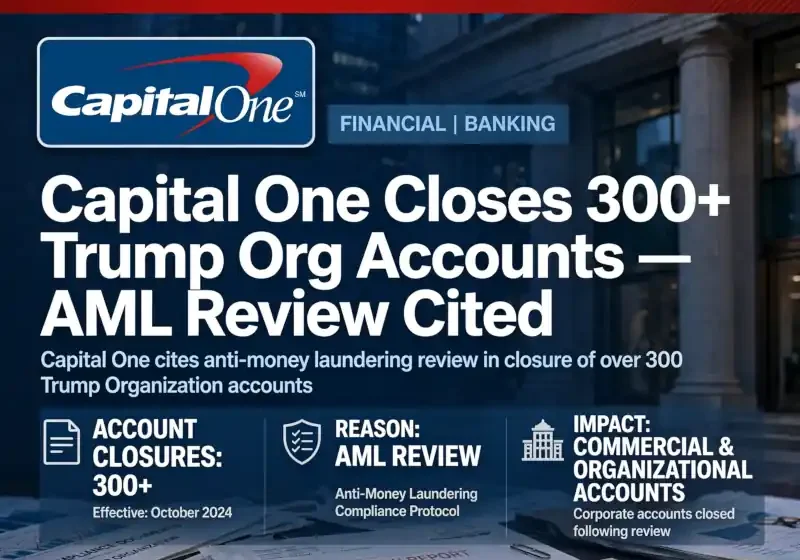
Capital One Cites Anti-Money Laundering Review in Closure of Over 300 Trump Organization Accounts

MIAMI — In a major legal filing that marks a precedent-setting moment in US banking and corporate litigation, Capital One Financial (NYSE: COF) has formally disclosed that its decision to close more than 300 accounts affiliated with the Trump Organisation was driven by an internal anti-money laundering (AML) compliance review rather than political motivations.
The court submission in a Florida federal court represents the first instance in which a major financial institution has explicitly linked AML compliance evaluations to the termination of banking services for President Donald Trump’s family enterprise.
The Legal Filing: Compliance vs. Allegations of Political “Debanking”
In its latest court submission asking a federal judge in Miami to dismiss an ongoing lawsuit brought by the Trump Organization and Eric Trump, Capital One clarified that its decision followed exhaustive internal analysis.
According to the filing reported by Reuters, specialists on the bank’s anti-money laundering team conducted a months-long investigation examining transactional activity across the accounts. The bank noted that the specific transaction patterns flagged during this review mirrored indicators outlined in federal banking guidance regarding risk monitoring and regulatory standards.
Capital One explicitly stated in its filing that it is not accusing the Trump Organisation of illegal money laundering. Instead, the lender emphasised that the account closures were executed in strict adherence to internal policies and federal regulatory standards following routine risk management protocols.
“Documents and Plaintiffs’ own allegations make clear that Capital One closed Plaintiffs’ accounts for anti-money laundering (‘AML’) reasons,” the bank detailed in its filing, characterizing claims of political motivation as misguided and dependent on selective quotations taken out of context.
Timeline of the Legal Battle Between Capital One and the Trump Organisation
The roots of the dispute date back to March 2021, when Capital One formally notified the Trump Organisation that it intended to terminate its banking relationship and shutter more than 300 associated accounts.
Four years after receiving the termination notices, the Trump Organisation and Eric Trump initiated a federal lawsuit in Florida in March 2025. The complaint alleged that Capital One’s decision was politically motivated following the January 6, 2021, riot at the U.S. Capitol, accusing the institution of discriminatory “debanking”.
| Date | Key Event / Legal Milestone |
| April 2019 | Donald Trump previously files lawsuit against Capital One and Deutsche Bank over subpoena disclosures. |
| March 2021 | Capital One officially notifies the Trump Organisation of plans to close >300 accounts. |
| March 2025 | The Trump Organisation and Eric Trump file a federal lawsuit in Florida alleging politically motivated account closures. |
| August 2025 | President Trump signed an executive order barring financial institutions from political/religious debanking. |
| January 2026 | President Trump files a separate lawsuit against JPMorgan Chase & Co (NYSE: JPM) alleging debanking. |
| July 2026 | Plaintiffs submit an amended complaint after the federal court in Miami dismisses two earlier iterations. |
| August 2026 | Capital One files motion to dismiss, officially citing internal AML risk review as the reason for closure. |
A federal judge in Miami has previously dismissed two earlier versions of the Trump Organisation’s complaint, citing legal deficiencies while granting permission for amended submissions. Capital One’s recent motion targets the latest amended complaint filed in July, arguing that it fails to remedy fundamental legal flaws present in earlier drafts.
Regulatory Context and the Broader Political Debanking Debate
The court battle between Capital One and the Trump Organization arrives amid heightened regulatory and political debate surrounding “debanking”—the practice wherein financial institutions terminate or restrict customer accounts over perceived reputation or political risk.
Key Political and Legal Developments:
-
Executive Order on Banking Access: In August 2025, President Trump signed an executive order prohibiting financial institutions from denying services to individuals or commercial entities based on political affiliations or religious beliefs.
-
Litigation Against Major Lenders: Beyond Capital One, President Trump filed a separate lawsuit in January against JPMorgan Chase & Co (NYSE:JPM), alleging similar discriminatory debanking practices.
-
Prior Subpoena Disputes: The conflict follows earlier legal friction in 2019, when Trump previously sued both Capital One Financial and Deutsche Bank AG (NYSE: DB) in an effort to prevent them from complying with congressional subpoenas seeking business financial records.
Banks operate under stringent federal oversight governed by the Bank Secrecy Act (BSA) and anti-money laundering regulations enforced by federal banking authorities. Financial institutions are legally mandated to maintain comprehensive monitoring systems to flag unusual or complex transaction patterns, regardless of customer profile.
Market Reaction & Banking Sector Impact
Shares of major U.S. financial institutions showed varied movement following the court disclosures:
-
Capital One Financial (NYSE: COF): Traded slightly lower, down 0.54% following the filing disclosure.
-
JPMorgan Chase & Co (NYSE: JPM): Shifted upward by 0.27%.
-
Deutsche Bank AG (NYSE: DB): Modestly gained 0.05%.
Industry analysts note that financial institutions face a delicate balancing act between meeting strict federal compliance mandates and managing public relations or legal exposure surrounding high-profile account closures. By formally placing its AML review process on the court record, Capital One aims to establish a clear legal defence based on regulatory compliance standards rather than discretionary corporate ideology.
Key Takeaways & Frequently Asked Questions (FAQs)
Why did Capital One close the Trump Organisation’s bank accounts?
Capital One stated in a Florida federal court filing that the account closures resulted from a months-long review by its anti-money laundering (AML) compliance team, which identified transaction patterns flagged under federal banking guidance.
Did Capital One accuse the Trump Organisation of illegal money laundering?
No. Capital One explicitly clarified that it did not accuse the Trump Organisation of illegal activity, stating the closures were driven by risk management evaluations and internal compliance policies.
What is the core argument of the Trump Organisation’s lawsuit?
The Trump Organisation and Eric Trump allege that Capital One unlawfully terminated over 300 business accounts for political reasons following the January 6, 2021, Capitol riot, asserting that the move constituted discriminatory “debanking”.
What is the current status of the lawsuit in the Miami federal court?
The federal court in Miami has dismissed two previous versions of the lawsuit. Capital One is currently seeking the dismissal of the plaintiffs’ latest amended complaint filed in July.