
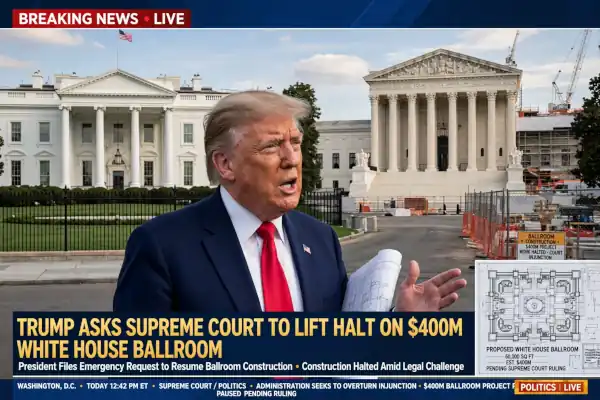

President Donald Trump petitioned the Supreme Court to lift a federal court injunction halting construction on his controversial $400 million White House ballroom. The emergency application asks the nation’s highest court to overturn an appellate ruling that stopped aboveground construction on the historic East Wing site.
The emergency appeal comes one week after the U.S. Court of Appeals for the District of Columbia Circuit ruled 2-1 against the administration. Judges determined the president lacked unilateral constitutional authority to construct a 90,000-square-foot facility without congressional authorisation.
With the injunction scheduled to take full effect on August 21, the legal clash creates a significant constitutional test regarding presidential authority, separation of powers, and the management of historic federal property.
Legal Battle Over the $400M White House East Wing Expansion
The dispute centres on the administration’s decision to demolish the White House East Wing to make way for a grand event venue and secure military installation. Historic preservation advocates filed legal challenges immediately after the demolition began, arguing the executive branch bypassed mandatory statutory oversight and congressional spending approvals.
A federal district judge originally granted a preliminary injunction pausing aboveground building activities, which the D.C. Circuit upheld. The appellate majority concluded that executive power does not extend to unilateral alterations of the Executive Residence without legislative appropriations.
U.S. Solicitor General D. John Sauer filed the administration’s emergency stay application with the Supreme Court on Friday morning. The government argues that halting the construction interferes with executive operations and imperils ongoing security improvements at the complex.
Executive Authority and Separation of Powers
The central legal debate hinges on whether executive privilege and national defence powers override standard congressional property oversight. The administration maintains that Article II gives the president broad latitude to secure and modernise the Executive Mansion without legislative pre-approval.
Conversely, the appellate court ruled that the President is a constitutional custodian rather than an owner of the executive property. The court emphasised that major structural expansions require explicit approval and funding authorisation under Article I property statutes.
National Security and Defence Infrastructure Claims
The Trump administration has reframed the ballroom project as a critical defence and military readiness asset. Court filings outline several defensive installations integrated into the aboveground and subterranean designs:
-
Rooftop Drone Defence Hub: A dedicated launch and defence platform designed to counter aerial threats across the Washington capital airspace.
-
Hardened Underground Bunkers: Reinforced blast shelters equipped with advanced communication arrays for continuity of government operations.
-
Medical Trauma Center: Dedicated surgical facilities designed to support rapid emergency medical treatment on-site.
-
Ballistic Glass and Reinforced Steel: Military-grade structural columns and protective shielding designed to survive missile and drone strikes.
Timeline of the White House Ballroom Litigation
| Milestone Date | Legal Action & Event Description | Status / Outcome |
| Late 2025 | Demolition of the historic White House East Wing structure. | Preservation lawsuits filed. |
| Early 2026 | Federal District Court issues preliminary injunction on aboveground work. | Government files appeal. |
| August 7, 2026 | D.C. Circuit upholds injunction (2-1); allows bunker work but halts ballroom. | Stay set to end Aug 21. |
| August 14, 2026 | Solicitor General files emergency application to U.S. Supreme Court. | Pending High Court ruling. |
Project Scope and Cost Breakdown
Financial records and administration statements show the project scope expanded substantially over recent months. While initially proposed as a $200 million privately funded venue, estimates have risen to $400 million. Investigative analyses indicate that surrounding infrastructure enhancements, including a new South Lawn helipad, could push overall costs higher.
Estimated Project Investment: $400M - $600M
Primary Structure: 90,000 sq. ft. Multi-Level Ballroom & Security Facility
Capacity: Up to 999 Guests & Foreign Dignitaries
Key Components: Rooftop Drone Hub, Underground Medical Center, Hardened Shelters
Frequently Asked Questions (FAQs)
What did the federal appeals court rule regarding the ballroom?
The D.C. Circuit ruled 2-1 to uphold a preliminary injunction, holding that the administration cannot proceed with aboveground construction of the 90,000-square-foot ballroom without explicit congressional approval. The court permitted underground bunker and safety-essential construction to continue while halting the ballroom superstructure.
Why is the administration categorizing the ballroom as a national security asset?
Solicitor General D. John Sauer argued in court filings that the facility serves as an integrated military complex. The design includes a rooftop drone defense installation, hardened ballistic reinforcement, advanced medical suites, and secure communication facilities designed to safeguard the president and foreign dignitaries.
When will the Supreme Court decide on the emergency application?
Because the appellate court’s stay expires on August 21, 2026, the Supreme Court is expected to address the emergency application on an expedited basis before the deadline to prevent a mandatory construction halt.
The Supreme Court’s impending decision on the White House ballroom will set a major benchmark for executive power, constitutional property management, and administrative law. As legal teams submit their briefs ahead of the August 21 deadline, the case underscores the delicate balance between presidential national security mandates and congressional oversight. For detailed public records on government administrative processes, visit Executive Office of the President on Wikipedia, search latest legal filings via Google Search Directory, or join public policy discussions at the NT Live News Forum.