
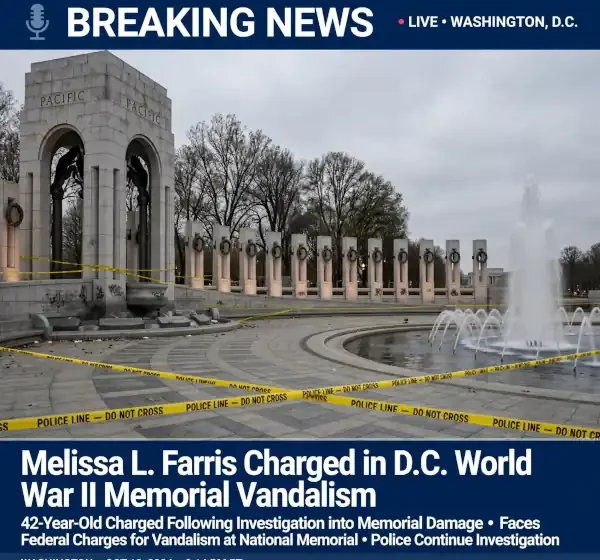

Federal authorities have arrested and charged Melissa Farris in connection with the severe defacement of the National World War II Memorial in Washington, D.C. U.S. Attorney for the District of Columbia Jeanine Pirro announced that the suspect faces multiple felony counts carrying substantial federal prison sentences.
The arrest follows an intense, rapid law enforcement investigation conducted by the United States Park Police and federal investigators. The incident triggered widespread public outrage after visitors discovered bright red paint splattered across the stone plaza and chemical soap churning through the historic fountain system.
Federal prosecutors are prioritizing legal action against the desecration of sacred national landmarks. With strict federal statutes protecting veteran memorials, this high-profile case highlights the legal consequences facing individuals who damage federal property on the National Mall.
Federal Felony Charges Filed Against Melissa Farris
United States Attorney Jeanine Pirro confirmed that the Department of Justice filed two separate felony charges against Melissa Farris in Federal District Court. Prosecutors formally charged the defendant with depredation against property of the United States and the destruction of veterans’ memorials.
Federal prosecutors emphasised that sacred national monuments honouring American service members represent protected historic treasures. Law enforcement officers took Farris into custody shortly after surveillance imagery captured a suspect defacing stone walls and dispensing liquid soap into the central fountain.
If convicted on both felony counts, Farris faces statutory maximum penalties of up to ten years in federal prison. Federal criminal defence attorneys note that prosecutors rarely offer plea leniency in cases involving intentional property damage to prominent war memorials in the District of Columbia.
Damage Assessment and National Park Service Restoration
The defacement occurred just months after the National Park Service concluded a comprehensive four-month, $3 million renovation project at the World War II Memorial. The historic complex, situated on the National Mall between the Lincoln Memorial and the Washington Monument, honours the 16 million Americans who served in the armed forces.
National Park Service conservators rushed to the site to assess physical damage to the granite pylons and the Rainbow Pool fountain mechanisms. Specialised historic preservation crews immediately deployed non-abrasive chemical poultices to draw red spray paint out of the porous stone without damaging the underlying historic stonework.
Engineers also shut down and drained the monument’s filtration system to prevent permanent mechanical failure. The introduction of dense detergent soap created massive foam plumes that threatened to burn out the water pumps and damage underground circulating infrastructure.
Site Impact & Response Log:
- Location: National World War II Memorial, Washington, D.C.
- Defacement Type: Red spray paint graffiti ("Clean Hands Dirty $") & concentrated foaming agents
- Preservation Danger: Porous granite staining & high-pressure pump burnout
- Response Unit: U.S. Park Police & National Park Service Historic Preservation Teams
Criminal Penalties Under Veterans Memorial Protection Laws
Federal statutes impose stringent criminal penalties for the intentional destruction or defacement of national monuments, military cemeteries, and commemorative public installations. Prosecutors utilise a dual statutory framework to pursue felony convictions in federal court:
-
18 U.S.C. § 1361 (Depredation of Government Property): Prohibits willful injury or depredation against any property of the United States. Offences causing damage exceeding $1,000 constitute felonies punishable by fines up to $250,000 and up to ten years’ imprisonment.
-
18 U.S.C. § 1369 (Destruction of Veterans’ Memorials): Specifically criminalises the willful injury or destruction of any structure, plaque, statue, or monument commemorating the service of any person or persons in the armed forces of the United States. Violations carry felony penalties of up to ten years in federal prison.
-
Mandatory Criminal Restitution: Federal judges frequently mandate full financial restitution to cover specialised historic restoration, architectural cleaning, and associated park police investigative costs.
-
Enhanced Supervised Release: Convicted defendants often face up to three years of supervised post-release monitoring, mandatory community service, and permanent bans from all National Park Service properties.
Investigation and Incident Breakdown
The rapid apprehension of the suspect highlights the coordinated surveillance network operating across the National Mall. U.S. Park Police detectives gathered high-resolution camera feeds, witness accounts, and physical evidence recovered from the plaza.
| Case Element | Official Investigative Detail | Legal Status / Potential Consequence |
| Defendant Identity | Melissa L. Farris | Remanded in federal custody |
| Primary Charges | Depredation of U.S. Property & Destruction of Veterans’ Memorials | 2 Federal Felony Counts |
| Maximum Penalty | Statutory prison term up to 10 years per conviction | Federal prison time + asset restitution |
| Site Impact | Red graffiti on granite pylons; suds in Rainbow Pool | Emergency conservation response |
| Lead Agencies | U.S. Attorney’s Office (D.C.) & U.S. Park Police | Case moving to Federal District Court |
Federal law enforcement leaders reiterated that vandalism across national monuments will be met with zero tolerance. Investigators continue to review digital forensic evidence to determine if additional individuals assisted in planning the act.
Frequently Asked Questions About National Mall Vandalism
What specific charges does Melissa Farris face for the memorial defacement?
Federal prosecutors charged Melissa Farris with two distinct felony counts: depredation against property of the United States and the destruction of veterans’ memorials. Both charges fall under federal jurisdiction and are being prosecuted in the U.S. District Court for the District of Columbia.
What is the maximum prison sentence for defacing a federal veterans memorial?
Under federal law, convictions for damaging government property or destroying veterans’ memorials carry statutory penalties of up to ten years in federal prison. Sentences can also include significant criminal fines, supervised release, and mandatory restitution for restoration expenses.
How does the National Park Service clean spray paint from historic granite?
Conservators avoid power washing or abrasive sandblasting, which permanently erodes century-grade granite. Instead, specialized preservationists apply chemical gel poultices that dissolve paint pigments and draw residue out from the stone’s microscopic pores.
Who manages law enforcement and security across the National Mall?
The United States Park Police, an agency of the Department of the Interior, maintains primary law enforcement jurisdiction across the National Mall, working alongside federal intelligence partners and the Metropolitan Police Department.
The arrest of Melissa Farris underscores the federal government’s decisive stance against the defacement of national historic landmarks. As the legal proceedings move forward in federal court, park preservationists continue working to ensure the memorial remains fully restored for the millions of veterans and families who visit each year. For more historical context on national landmarks, visit the National World War II Memorial on Wikipedia. To explore real-time legal updates, search the latest federal court filings via Google Search Directory, or join the active community discussion on public safety and monument protection at the NT Live News Forum.