
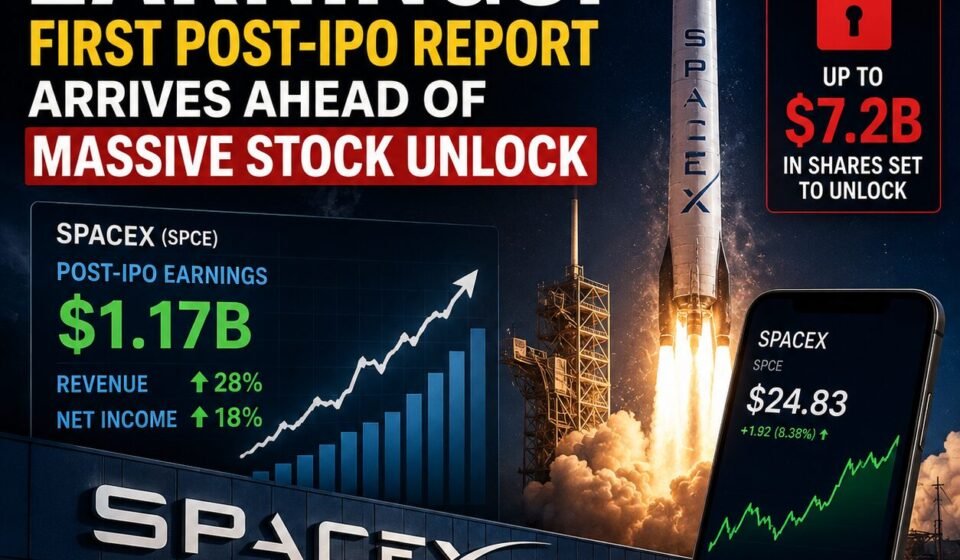
SpaceX Earnings: First Post-IPO Report Arrives Ahead of Massive Stock Unlock

WASHINGTON: Wall Street is bracing for impact as SpaceX prepares to release its fiscal second-quarter 2026 earnings report. Marking the aerospace giant’s official public earnings debut following its record-breaking Initial Public Offering (IPO) in June, the financial results come at a pivotal moment for investors and market watchers alike.
Jittery market sentiment, a substantial drop in equity valuation, and a looming share unlock period have thrust the financial health and operational guidance of Elon Musk’s rocket maker directly into the spotlight.
Key Wall Street Estimates for SpaceX Q2 2026
According to consensus figures compiled by LSEG, analysts expect the following headline numbers for SpaceX’s debut quarter as a publicly traded company:
-
Consensus Revenue: $6.93 billion
-
Expected Earnings Per Share (EPS): Loss of $0.26 per share
Financial analysts caution that initial public earnings reports often include unpredictable non-GAAP adjustments, restructuring costs, and merger integration expenses. As a result, the net reported loss may not align directly with standard street estimates.
Post-IPO Market Plunge and Lockup Expiration Concerns
SpaceX staged the largest IPO in stock market history on June 12, 2026, opening at $150 per share. However, the post-debut euphoria has quickly surrendered to severe market turbulence.
Since its public market debut, SpaceX stock has fallen by 24%, wiping out nearly $500 billion in market capitalisation. From its intraday high of $175 reached shortly after listing, the shares have dropped nearly 50%.
Adding to investor anxiety is the impending expiration of early insider lockup restrictions. As rolling share lockups unlock, a potential wave of secondary market selling from early employees and venture backers could introduce further downward pressure on the stock price. Meanwhile, short sellers have already built substantial positions, marking one of the most aggressive bearish builds seen in a recent mega-cap debut.
Segment Revenue Breakdown: Starlink Leads as Core Profit Engine
Wall Street revenue expectations across SpaceX’s three primary operational arms, according to StreetAccount estimates, highlight a stark contrast between profitable commercial service and capital-intensive development divisions:
| Business Segment | Estimated Q2 Revenue | Strategic Focus & Performance |
| Connectivity (Starlink) | $3.83 Billion | Core growth engine; sole source of net profit |
| Artificial Intelligence (SpaceXAI) | $2.18 Billion | AI infrastructure, compute agreements, Grok integration |
| Space (Launch & Operations) | $835 Million | Falcon 9/Heavy launches, Starship tests, NASA contracts |
Starlink (Connectivity)
Starlink remains the foundational cash cow for SpaceX. Serving millions of individual consumers alongside maritime, aviation, and government defence clients, the direct-to-consumer satellite constellation generates high-margin recurring subscription revenue that funds broader corporate investments.
Launch & Space Operations
While SpaceX maintains a dominant near-monopoly on commercial orbital payload delivery and holds multi-billion-dollar contracts with NASA, its core launch operations continue to operate at a net loss. High operational expenditure associated with the uncrewed flight testing of Starship, infrastructure construction at Starbase, and next-generation satellite deployments continues to weigh on segment margins.
Artificial Intelligence & Data Centres
Following the mega-merger between SpaceX and xAI in early 2026 (forming SpaceXAI), the artificial intelligence division has become a central component of the company’s valuation thesis. The company generates substantial revenue from enterprise compute capacity—including multi-hundred-million-dollar monthly agreements with tech majors—and plans to pioneer solar-powered orbital data centres. However, aggressive capital expenditure on terrestrial supercomputing hubs and software acquisitions (such as the $60 billion buyout of Cursor developer Anysphere) continues to create near-term profit drag.
Heavy R&D Expenditure and Cash Burn Realities
In fiscal year 2025, SpaceX posted a net loss of $4.9 billion. These losses were driven primarily by monumental R&D spending on artificial intelligence infrastructure, planetary defence programs, and Starship rocket iterations.
Public market investors accustomed to traditional software margins are now adjusting to SpaceX’s unique capital profile: a hybrid tech-hardware giant burning billions quarterly to secure a structural competitive advantage in orbital transportation and AI infrastructure.
What Analysts Are Watching on the Conference Call
SpaceX management is set to host its first earnings conference call with Wall Street analysts at 4:30 p.m. ET. Market participants will focus on four crucial metrics:
-
Starship Operational Milestones: Specific timelines for commercial Starship payload capacity and orbital deployment economics.
-
Starlink Subscriber & ARPU Metrics: Updated metrics regarding active global subscriber counts and direct-to-cell expansion.
-
Orbital AI Infrastructure Roadmaps: Technical and regulatory progress regarding space-based GPU deployment.
-
Capital Management & Free Cash Flow: Cash depletion rates following the $75+ billion IPO capital raise.
Outlook
While long-term bulls point to SpaceX’s massive moat in reusable launch vehicles and satellite communications, near-term sentiment remains volatile. How leadership addresses profitability targets and upcoming insider lockup expirations during the conference call will likely set the tone for the stock’s trajectory over the second half of 2026.