

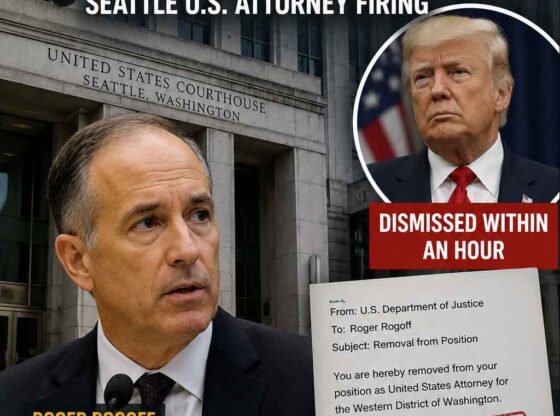

A breaking USA political news updates on Roger Rogoff Trump administration dismissal. In today’s top latest news, we see and hear about President Donald Trump removing Roger Rogoff as the U.S. Attorney for the Western District of Washington less than an hour after federal judges unanimously appointed and swore him into office on Wednesday.
The extraordinary sequence of events has sparked fresh debate over the balance of power between the White House and the federal judiciary. It also raises new legal questions about who ultimately controls temporary appointments for one of the Justice Department’s most important leadership positions. Roger Rogoff, a former King County Superior Court judge and longtime state and federal prosecutor, said he is considering legal action after receiving notice of his dismissal almost immediately after taking office.
A Swearing-In That Lasted Less Than an Hour after Roger Rogof Trump administration dismissal.
Rogoff arrived at the federal courthouse in Seattle early Wednesday morning to begin his duties after receiving unanimous approval from the judges of the U.S. District Court for the Western District of Washington.
According to Rogoff, he completed the oath of office shortly before 8 a.m. He then went to the U.S. Attorney’s Office, where he planned to meet Charles Neil Floyd, whose interim appointment had already expired months earlier.
Instead, while waiting in the office lobby, Rogoff received an email informing him that President Trump had removed him from the position.
Although the appointment was brief, it immediately became one of the most unusual personnel disputes involving the Justice Department during Trump’s second administration.
Why Federal Judges select Roger Rogoff
Normally, U.S. attorneys are nominated by the president and confirmed by the Senate. Federal law also provides another path when a vacancy remains unresolved. If an interim appointment expires before the Senate confirms a nominee, judges in the district may appoint a temporary U.S. attorney until the position is permanently filled.
That process became necessary in Seattle after Charles Neil Floyd’s 120-day interim appointment expired without a Senate-confirmed replacement. Rather than immediately selecting another administration nominee, the district court opened an application process and assembled a bipartisan panel to evaluate candidates.
After reviewing applicants, the court unanimously selected Roger Rogoff. The judges praised his decades of legal experience and deep ties to Washington state’s legal community.
Why Roger Rogoff trump administration dismissal?
The Trump administration defended the decision almost immediately. Acting Attorney General Todd Blanche said district judges have authority to appoint a temporary U.S. attorney but argued that the president also has authority to remove that person.
Blanche criticised the judges for moving forward without consulting the administration, saying the traditional process allows the White House to ensure that a U.S. attorney can effectively serve within the administration’s priorities. The administration therefore made again Charles Neil Floyd to continue leading the office in his existing role as First Assistant U.S. Attorney.
Who Is Roger Rogoff?
Roger Rogoff brings decades of legal experience to the position he briefly held.
During his career, he has served as:
- A federal prosecutor
- A state prosecutor
- A King County Superior Court judge
- Director of Washington State’s Office of Independent Investigations
His legal career spans more than two decades in criminal prosecution before moving onto the state bench and later leading investigations involving police use of deadly force.
Following his job quit, Rogoff said he accepted the appointment knowing it might trigger confrontation with the White House. He also said working as U.S. attorney represented one of the greatest opportunities available to a career prosecutor.
The Larger Dispute Over U.S. Attorney Appointments
The Seattle case reflects a broader national disagreement over how temporary U.S. attorney appointments should work. The Constitution generally gives presidents authority to nominate U.S. attorneys while the Senate provides advice and consent through confirmation.
However, Congress also created procedures allowing district judges to appoint temporary prosecutors when vacancies continue beyond the statutory limit.
Several courts have recently questioned efforts to extend interim appointments through administrative title changes rather than formal Senate confirmation. Legal experts say the dispute centres on competing interpretations of federal appointment statutes and presidential removal powers.
The outcome could shape how future vacancies are handled across the country.
Senator Patty Murray Criticises the Decision
Washington Senator Patty Murray sharply criticised the administration’s decision. She questions that Rogoff was legally appointed under federal law and praised his long record of public service.
Murray also accused the administration of attempting to bypass the traditional Senate confirmation process by relying on temporary appointments instead of permanent nominations. The administration has rejected those criticisms, maintaining that presidential authority includes the ability to dismiss court-appointed temporary prosecutors
U.S. attorneys oversee federal criminal prosecutions, civil litigation involving the United States, public corruption investigations, financial crimes, immigration enforcement, drug trafficking cases, and national security matters.
When vacancies remain unresolved, questions about leadership can affect the administration of justice and create uncertainty inside federal prosecutors’ offices.
The Seattle dispute also highlights the importance of the Senate confirmation process. Traditionally, presidents nominate U.S. attorneys, and the Senate decides whether to confirm them. Temporary appointments exist to ensure continuity, but disagreements over how long those appointments may last have become increasingly prominent in recent years.
The Administration’s Position
The Trump administration argues that the President retains the constitutional authority to remove executive officials, including temporary U.S. attorneys appointed by district judges.
Acting Attorney General Todd Blanche defended the decision after Rogoff’s appointment became public. Blanche said district judges have authority to appoint an interim U.S. attorney under federal law, but he maintained that the President also has the authority to dismiss that official.
Supporters of the administration say presidential control over federal prosecutors promotes accountability because U.S. attorneys enforce federal law on behalf of the executive branch.
Critics Raise Separation of Powers Concerns
Critics view the situation differently. Some lawmakers and legal observers argue that Congress intentionally gave district courts temporary appointment authority to prevent prolonged vacancies when the Senate has not confirmed a nominee.
Washington Senator Patty Murray said Rogoff had been lawfully appointed by the federal judges and praised his long record of public service. She criticised the administration’s decision and argued that the Senate confirmation process should not be bypassed through repeated temporary appointments.
Legal experts say the dispute ultimately reflects a broader constitutional conversation about the separation of powers between the executive and judicial branches.
What Happens Next?
Several important questions remain unanswered after this Roger rogoff trump administration dismissal reports:
- Will Roger Rogoff file a lawsuit challenging his removal?
- Will the Justice Department formally nominate a permanent U.S. attorney for Western Washington?
- Could another federal court ultimately decide whether the President may remove a court-appointed temporary U.S. attorney?
Until those questions receive legal answers, the Seattle case is likely to remain closely watched by constitutional scholars, lawmakers, and federal prosecutors.
Any future court ruling could establish an important precedent for similar appointment disputes nationwide.
Conclusion
Roger Rogoff’s tenure as U.S. Attorney for the Western District of Washington lasted less than an hour, yet the legal and constitutional issues raised by his appointment and removal may continue for months.
The dispute has drawn national attention because it touches on the balance of power between the presidency, Congress, and the federal judiciary. While the Trump administration maintains that the President acted within his constitutional authority, critics argue that the removal undermines a lawful judicial appointment made under federal statute.
Whether the controversy ends with a political resolution or a federal court ruling, the case is expected to become an important reference point in future debates over executive authority and temporary federal appointments.
Frequently Asked Questions (FAQs)
Below are the some popular question about Copurt appointed United states of america Attorney Roger rogoff trump administration dismissal today
1. Why did President Trump remove Roger Rogoff?
The Trump administration said the President has the authority to remove a court-appointed temporary U.S. attorney and disagreed with the judges’ appointment process.
2. Who is Roger Rogoff?
Roger Rogoff is a former King County Superior Court judge and veteran state and federal prosecutor with decades of legal experience.
3. Why did federal judges appoint Rogoff?
Federal judges exercised their authority under federal law after the previous interim appointment expired without a Senate-confirmed replacement.
4. Is Roger Rogoff planning legal action?
Rogoff has said he is consulting attorneys about the possibility of challenging his removal.
5. Who was serving as interim U.S. attorney before Rogoff?
Charles Neil Floyd served as interim U.S. attorney. After his statutory interim term expired, he continued serving in the office as First Assistant U.S. Attorney.
6. What does a U.S. attorney do?
A U.S. attorney serves as the chief federal prosecutor for a judicial district and represents the United States in federal criminal and civil cases.
7. Does the President appoint U.S. attorneys?
Yes. Presidents nominate U.S. attorneys, and the Senate normally confirms them. Federal law also allows temporary judicial appointments under certain circumstances.
8. Why is this case significant?
The case could influence how future disputes over temporary federal appointments and presidential removal powers are resolved.
Sources
Take a look at teh free soure about Roger Rogoff Trump administration dismissal full details
- Associated Press (AP)
- Reuters
- U.S. District Court for the Western District of Washington (official court order)
- U.S. Department of Justice statements
- Public statements from Acting Attorney General Todd Blanche and Senator Patty Murray