
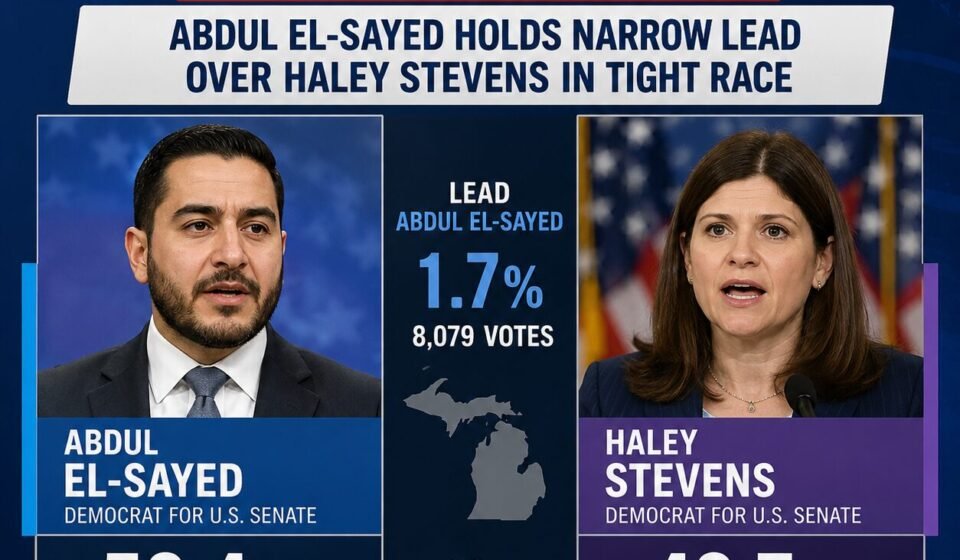
Michigan Democratic Senate Primary Live Updates: Abdul El-Sayed Holds Narrow Lead Over Haley Stevens in Tight Race

DETROIT, MI: The high-stakes Democratic primary for Michigan’s open U.S. Senate seat remains unresolved early Wednesday morning as vote counting stretches past 5:00 a.m. ET. Progressive health official DDrAbdul El-Sayed holds a razor-thin lead over centrist U.S. Representative Haley Stevens in a high-profile battle that highlights ongoing ideological and foreign policy divides within the Democratic Party.
With more than 95% of expected votes tallied, El-Sayed leads Stevens by slightly more than one percentage point. However, key tranches of mail-in and absentee ballots from heavily populated Wayne County remain outstanding, leaving the outcome uncertain.
Key Election Results and Current Vote Totals
+---------------------------------------------------------------------------------+
|                       MICHIGAN DEMOCRATIC SENATE PRIMARY                        |
+-------------------+------------------+-------------------+----------------------+
| Candidate         | Total Votes      | Vote Percentage   | Status               |
+-------------------+------------------+-------------------+----------------------+
| Abdul El-Sayed    | 735,625          | 48.6%             | Leading (+1.3%)      |
| Haley Stevens     | 716,222          | 47.3%             | Trailing             |
+-------------------+------------------+-------------------+----------------------+
| Total Reporting   | >95% Expected    | Margin: ~19,403   | Too Close to Call    |
+-------------------+------------------+-------------------+----------------------+
Source: Associated Press / State Election Data
Late-Night Counting in Wayne County Holds the Key
The primary centres on Wayne County, home to Detroit as well as surrounding suburban municipalities. Election workers continue processing remaining absentee and mail-in ballots early Wednesday morning, releasing updates in batches of several hundred to a few thousand votes at a time.
-
Detroit Proper: Representative Haley Stevens has maintained strong margins within urban Detroit precincts, benefiting from established party network support and strong turnout in key neighbourhoods.
-
Wayne County Suburbs: Dr Abdul El-Sayed has posted solid leads in several adjacent suburban cities across the county, offsetting Stevens’ gains in the city core.
Because the bulk of uncounted ballots consists of mail-in votes from Detroit proper, election analysts note that Stevens could close the ~19,000-vote gap as final precincts report. However, statistical forecast models maintain that El-Sayed remains favoured to hold his narrow advantage as the remaining universe of votes shrinks.
Ideological Divide and Key Issues
The primary campaign between El-Sayed and Stevens developed into one of the most expensive and closely watched intra-party contests of the 2026 election cycle. The race served as a major testing ground for competing wings of the Democratic coalition in a state crucial to determining control of the U.S. Senate this fall.
1. Foreign Policy and Israel-Gaza Relations
Foreign policy emerged as a central point of contrast throughout the campaign. El-Sayed, a former Detroit health director who gained national prominence during his 2018 gubernatorial run, drew support from progressive groups, Arab-American advocacy organisations, and grassroots labour coalitions. Stevens, representing Michigan’s 11th Congressional District, secured endorsements from establishment Democratic figures, moderate political action committees, and pro-Israel advocacy groups.
2. Healthcare and Economic Policy
El-Sayed centred his platform on structural economic reforms, environmental justice, and single-payer healthcare, leveraging his background as a physician and public health leader. Stevens emphasised her legislative record in the House, highlighting constituent service, federal manufacturing investments, and pragmatic policy solutions tailored for general election swing voters.
Polling Discrepancies and Survey Accuracy
Regardless of the final winner, the narrow margin represents a notable deviation from pre-election polling averages in Michigan:
-
Pre-Election Surveys: Three out of four major nonpartisan polls conducted in the final weeks of the campaign showed El-Sayed holding double-digit leads over Stevens.
-
Outlier Polling: A fourth major survey projected a seven-point lead for Stevens.
-
Polling Performance: With the final margin settling near one percentage point, polling models across the spectrum significantly misread turnout dynamics and late-deciding voters in key suburban and urban districts.
Broader Midwest Primary Landscape
Michigan was one of five states holding major primary elections on Tuesday, alongside Kansas, Missouri, Virginia, and Washington.
+---------------------------------------------------------------------------------+
|                       KEY MIDWEST PRIMARY RACES AT A GLANCE                     |
+-------------------+-----------------+-----------------------+-------------------+
| State / Race      | Democratic Side | Republican Side       | Key Context       |
+-------------------+-----------------+-----------------------+-------------------+
| MI Governor       | Jocelyn Benson  | John James            | General match     |
| MI-13 District    | McKinney (+3%)  | Nykoriak              | 73% reporting     |
| MI-08 District    | McDonald Rivet  | Smith (+17%)          | >95% reporting    |
| MO Amendment 5    | N/A             | N/A                   | Measure trailing  |
| VA Senate         | Mark Warner     | Mizusawa              | General match     |
+-------------------+-----------------+-----------------------+-------------------+
In Michigan’s gubernatorial primary, Secretary of State Jocelyn Benson secured the Democratic nomination, while U.S. Representative John James claimed the Republican nomination, setting up a marquee general election matchup in November.
Next Steps for the Uncalled Senate Race
State election officials expect the remaining precincts in Wayne County to finalise their vote tallies by Wednesday afternoon. Because the margin remains near 1%, local canvassing boards will begin verifying vote totals ahead of official certification.
The eventual Democratic nominee will advance to the November general election to face Republican nominee Mike Rogers in a battleground state race that will play a pivotal role in deciding the balance of power in the U.S. Senate.