‘Making Too Much Money’: Trump Blasts ExxonMobil and Chevron Over Record Profits as Gas Prices Soar

WASHINGTON : In a dramatic friction point between the White House and corporate America, President Donald Trump launched a direct verbal assault on top oil executives, accusing ExxonMobil and Chevron of taking advantage of global supply disruptions to reap tens of billions in profits while everyday motorists face painful prices at the pump.
Speaking to reporters during an executive order signing in the Oval Office, Trump called out America’s two largest oil producers by name, demanding that they immediately cut retail gasoline prices and return a portion of their windfall profits to the public. The rare public rebuke of two long-standing corporate allies comes just days after the energy behemoths posted eye-watering second-quarter earnings, powered by geopolitical conflict in the Middle East and razor-thin global refining capacity.
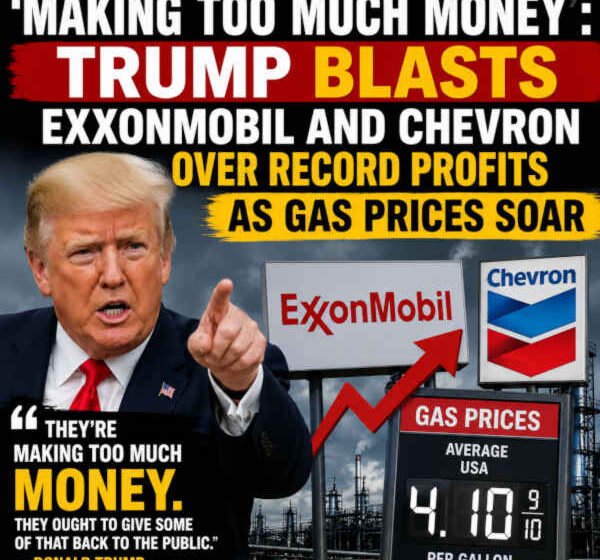
“Based on a shortage, they’re making too much money,” Trump told reporters. “I don’t like it, and I should be the last one to say because I’m a big free enterprise guy — nobody bigger. But Chevron, too much money. ExxonMobil, too much, too much money. They ought to give some of that back to the public, and they better cut the retail price, the consumer price.”
The president’s sharp rhetoric highlights mounting political anxiety within the White House as high energy costs threaten consumer sentiment ahead of the upcoming midterm elections. With national average gasoline prices hovering near $4.10 per gallon—up from less than $3 earlier in the year—the administration is under immense pressure to show voters it is taking action against corporate profiteering and broader inflationary strains.
Bumper Quarter for Big Oil
Trump’s criticism came on the heels of major financial disclosures from the oil sector. On Friday, ExxonMobil and Chevron reported combined second-quarter net income of $26.5 billion, rewarding Wall Street investors with massive share repurchases and dividend payouts.
-
ExxonMobil reported $14.5 billion in net income for the quarter—more than double its performance from the same period last year. Chief Financial Officer Neil Hansen attributed the quarter’s strength to tight product markets, noting that global refining constraints and supply disruptions created historically strong margins for diesel and gasoline. Exxon touted $9.4 billion in shareholder distributions, including $5.1 billion spent on stock buybacks.
-
Chevron posted $12 billion in quarterly profit, marking its strongest financial result in six years. The surge was driven by record domestic output—boosted in part by its acquisition of Hess—and maximum throughput across its U.S. refineries.
While investors celebrated the financial windfall, consumer advocacy groups and lawmakers jumped on the reports as proof that energy producers are capitalizing on geopolitical turmoil at the expense of working families. A recent Harris survey showed that 95% of Americans view the country as facing an affordability crisis, with fuel and groceries listed as primary pressure points.
Geopolitics and the Bottleneck at the Pump
The underlying surge in global crude and fuel prices stems largely from military conflict and supply bottlenecks in the Middle East. Heightened hostilities and military operations involving Iran have severely hampered transit through the Strait of Hormuz—the vital maritime corridor through which roughly one-fifth of the world’s petroleum passes.
Though crude oil benchmark prices have experienced intermittent drops due to fluctuating diplomatic signals, refining capacity remains severely constrained. Industry analysts point out that while crude oil costs represent one part of the equation, the bottleneck is occurring at the refinery level.
“The pain point on prices is not so much with crude… but rather with products such as petrol and diesel,” Exxon’s Hansen noted in an interview, pointing to global refinery closures, Ukrainian strikes on Russian facilities, and reduced export quotas from international markets.
However, for ordinary consumers, the distinction between crude traders and refining margins offers little relief when filling up their vehicles. CBS News polling indicates that eight out of ten Americans believe the federal government is not doing enough to address consumer costs, creating a high-stakes political challenge for the administration.
Clashing Statements and Social Media Pressure
Trump’s Oval Office remarks were accompanied by direct public calls on social media targeting corporate leadership. Earlier in the day, Trump posted a scathing message on Truth Social aimed at Chevron Chairman and CEO Mike Wirth, following Wirth’s appearance on Fox Business.
Trump expressed frustration that Wirth did not explicitly credit administration policy for the energy sector’s profitability.
“Mike Wirth, chairman and CEO of Chevron, just gave, in an interview with the fabulous Maria Bartiromo, all of the reasons that his company is doing so well,” Trump wrote. “The only thing he conveniently forgot to mention is that, without the genius, foresight, strength, and stability of the Trump Administration, the Oil Industry, and our Country itself, would be dead!”
Trump also referenced Chevron’s expanded operations in Latin America, noting that the company was capitalizing on reopened avenues in Venezuela after previously facing operational restrictions. “They threw Mike and Chevron out of Venezuela, but now they’re back, far bigger and stronger than ever before, expecting to make a fortune!” Trump wrote, concluding with a warning: “Get your consumer (retail!) Oil Prices down, now!”
The confrontation marks a striking shift in tone for Trump, who has traditionally positioned himself as an uncompromising advocate for traditional fossil fuels and deregulation. His current posture mirrors previous political tactics, leveraging public pressure and threats of executive regulatory oversight to push corporate sectors into line.
The Industry Defends Its Position
Energy industry representatives and economists pushed back against claims that oil corporations are engaging in market manipulation or artificial price inflation.
The American Petroleum Institute (API), the primary trade group representing U.S. oil and gas producers, emphasized that fuel prices reflect global market dynamics rather than decisions made in corporate boardrooms.
“Driven by global supply, demand and continued uncertainty around the Strait of Hormuz and other critical shipping lanes—not by any one company,” API spokesperson Andrea Woods said in a statement defending the sector.
Industry experts also pointed out that major integrated oil companies like ExxonMobil and Chevron do not directly set retail pump prices for most gas stations across the nation. The vast majority of retail stations in the United States are independently owned and operated by small business owners or franchised distributors who adjust local prices based on regional wholesale fuel costs, state taxes, and real-time competition.
Furthermore, oil executives warned on their earnings calls that unless international shipping bottlenecks ease and domestic refining throughput stabilizes, pump prices could remain elevated through the autumn season.
Political Fallout Ahead of the Midterms
The clash underscores a delicate balancing act for the White House. While the administration seeks to maintain domestic energy independence and encourage robust oil production, it cannot ignore voter dissatisfaction over daily living costs.
Trump previously directed the Department of Justice to monitor energy markets for potential price gouging—a move designed to signal tough oversight. However, antitrust experts note that establishing legal evidence of price collusion among oil majors is extraordinarily difficult when price increases track broader global supply shocks.
The administration has already deployed short-term interventions, including targeted releases from the Strategic Petroleum Reserve (SPR) and temporary maritime transport waivers to alleviate domestic logistical snags. Yet analysts caution that without a permanent resolution to Middle Eastern supply disruptions, structural pressure on fuel prices will persist.
As midterms approach, the White House appears intent on ensuring that if voters remain angry about gas prices, the blame lands squarely on corporate profits rather than administration policies. Whether public rhetoric will translate into lower prices at the pump remains to be seen, but Trump’s willingness to publicly take on Big Oil signals that energy affordability will remain at the very center of the political battlefield.