
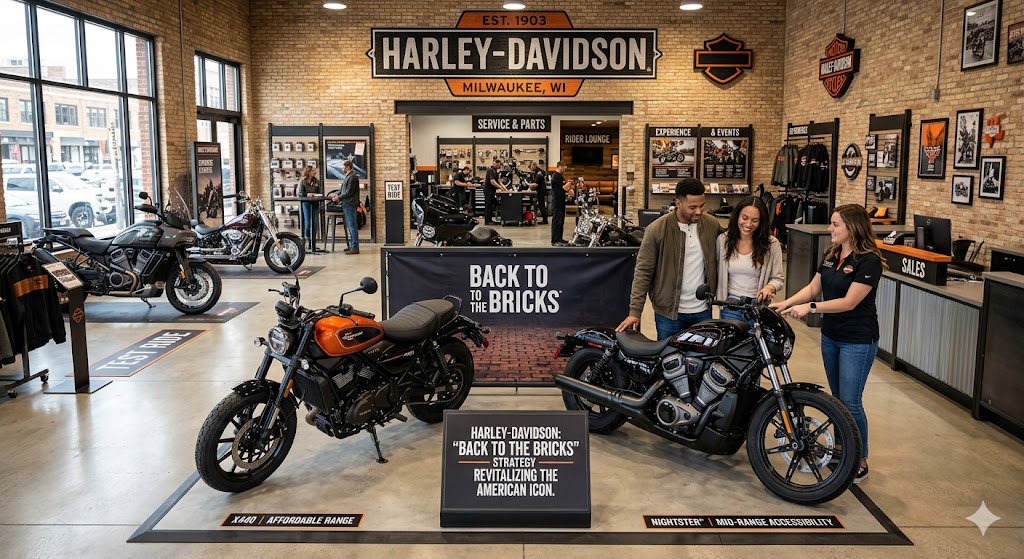
The roar of a Harley-Davidson engine has long been the soundtrack of the American highway, symbolising freedom, rugged individualism, and premium craftsmanship. However, in recent years, the Milwaukee-based heavyweight has faced a crossroads. On May 5, 2026, Harley-Davidson Inc. (HOG.N) unveiled its most ambitious pivot yet: the “Back to the Bricks” strategy. Under the leadership of new CEO Artie Starrs, the company is betting its future on a combination of lower-priced entry-level motorcycles and a fortified dealer network to reverse declining volumes and attract a new generation of riders.
The Turning Point: Why “Back to the Bricks”?
For over a decade, Harley-Davidson’s business model was comfortably cushioned by its core demographic: affluent, older riders with a preference for heavy, high-margin touring bikes. These “chrome-heavy” machines often carry price tags exceeding $30,000, catering to a loyal but aging audience.
As this traditional customer base enters its non-riding years, Harley-Davidson has struggled to fill the void. The “Back to the Bricks” plan represents a tactical retreat from “exclusivity at all costs” toward “inclusive performance.” The strategy aims for over $350 million in core profit from the motorcycle division by 2027, underpinned by $150 million in cost reductions.
The Rise of the “Sprint” and the 440cc Revolution
The centrepiece of this turnaround is the Harley-Davidson Sprint. Breaking away from the massive V-twins that define the brand, the Sprint is powered by a nimble 440cc engine.
“We see the Sprint at a price point of approximately $6,000,” CEO Artie Starrs told Reuters. This marks a radical departure for a brand where the entry-level price has historically hovered well above the $10,000 mark. By targeting the $6,000 bracket, Harley is directly challenging mid-sized offerings from Japanese and European competitors like Honda, Kawasaki, and Royal Enfield.
The Sprint is designed with the urban, younger rider in mind. With a focus on manoeuvrability, lightweight architecture, and modern tech features, it seeks to lower the “barrier to entry” for those who find traditional Harleys too heavy, too expensive, or too intimidating for city commuting.
Reviving the Legend: The Return of the Sportster
While the Sprint targets the newcomer, Harley is not forgetting the “purists on a budget.” The company announced the revival of the Sportster, a nameplate with a legacy spanning nearly 70 years.
The Sportster was traditionally the gateway into the “real” Harley experience. By reviving this model with a focus on affordability and classic aesthetics, Harley hopes to recapture the mid-range market. This move is intended to provide a bridge for riders who start on the Sprint but want to move up to a bike with more heritage and “rumble” without jumping straight into the $20,000+ price bracket.
The Dealer Network: Beyond the Showroom Floor
A motorcycle is only as good as the service behind it. Part of the new strategy involves a massive overhaul of the dealer network. Harley-Davidson plans to leverage its physical locations not just as showrooms, but as community hubs and high-margin service centres.
Key pillars of the dealer strategy include:
- Parts and Accessories (P&A) Focus: The company identifies P&A as a high-margin revenue stream that remains resilient even when new bike sales fluctuate.
- Enhanced Promotions: More aggressive financing and trade-in programs to lower the initial cost of ownership for younger buyers.
- Urban Integration: Expanding the footprint of “boutique” or service-oriented shops in metropolitan areas where traditional large-scale dealerships aren’t feasible.
Financial Outlook and Market Reaction
Wall Street’s reaction to the news was cautiously optimistic. Despite reporting a weaker first quarter—a byproduct of shifting manufacturing lines and clearing older inventory—shares of Harley-Davidson rose approximately 2.3% in early trading following the announcement.
Investors are looking closely at the $150 million cost-reduction goal. Harley intends to achieve this through supply chain optimisation and streamlining the assembly of its new smaller-displacement engines. If the company can maintain its “premium” brand image while selling $6,000 motorcycles, it could unlock a massive untapped market in both North America and emerging international markets.
Challenges Ahead: Brand Equity vs. Market Share
The “Back to the Bricks” plan is not without risk. The primary challenge lies in “brand dilution.” For decades, Harley-Davidson has marketed itself as a luxury lifestyle brand. Moving into the 440cc space puts them in direct competition with brands that have mastered the art of high-volume, low-margin manufacturing.
To succeed, the Sprint and the revived Sportster must feel like “authentic” Harleys. They cannot simply be generic motorcycles with a Bar and Shield logo slapped on the tank. They must retain the soul—the sound, the feel, and the community—that riders expect from the brand.
Conclusion: A New Chapter
Harley-Davidson’s shift toward affordability and dealer-centric growth marks the end of an era and the beginning of a survival-focused evolution. By embracing younger riders and smaller engines, the company is acknowledging that the future of motorcycling is diverse, urban, and price-sensitive.
If Artie Starrs can successfully navigate this transition, Harley-Davidson may once again become the dominant force on the road—not just for the veteran cruiser, but for the next generation of commuters and enthusiasts alike.
Frequently Asked Questions (FAQs)
1. What is the Harley-Davidson “Sprint”?
The Sprint is Harley-Davidson’s new entry-level motorcycle featuring a 440cc engine. It is designed for younger, urban riders and is expected to retail for approximately $6,000.
2. When will the new affordable models be available?
The company plans to introduce the Sprint later in 2026. Details on the revived Sportster’s release date are expected to follow in the coming months.
3. How does Harley-Davidson plan to increase its profit by 2027?
The “Back to the Bricks” plan targets over $350 million in core profit through a combination of increased sales volume from affordable models, $150 million in cost reductions, and a heavier focus on high-margin parts and accessories.
4. Why is Harley-Davidson moving away from large touring bikes?
Harley isn’t abandoning its touring models, but it is diversifying. Its traditional customer base is aging, and the company needs smaller, more affordable bikes to attract younger riders who have different needs and lower budgets.
5. What makes the revived Sportster different from the new Sprint?
While the Sprint is a modern, entry-level 440cc bike, the Sportster is a heritage model aimed at “purists on a budget.” It will likely feature a larger engine than the Sprint and classic styling that pays homage to its 70-year history.
6. Will the quality of Harley-Davidson motorcycles drop with lower prices?
CEO Artie Starrs emphasises that the new models will maintain the “features and benefits” consistent with the brand’s reputation, focusing on manoeuvrability and modern tech to ensure a high-quality riding experience at a lower price point.
