
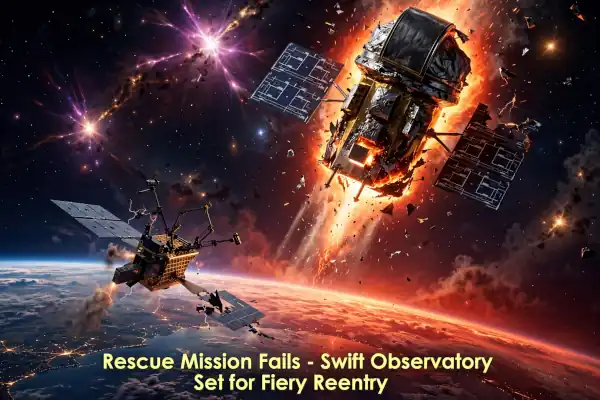
Daring In-Orbit Rescue Mission Fails: NASA’s Neil Gehrels Swift Space Observatory Set for Fiery Atmospheric Reentry

A high-stakes commercial attempt to save one of astrophysics’ most celebrated orbital observatories has officially come to an end. NASA and Arizona-based aerospace startup Katalyst Space Technologies announced that their joint “Swift Boost” mission will not capture or elevate the falling Neil Gehrels Swift Observatory, sealing the spacecraft’s fate for an uncontrolled atmospheric reentry.
The announcement ends an ambitious, high-risk attempt to pioneer private in-orbit satellite servicing on a legacy spacecraft. Despite intensive emergency manoeuvres from flight controllers, ongoing attitude control failures aboard Katalyst’s experimental rescue probe, named LINK, forced mission managers to abandon docking manoeuvres.
Without propulsion systems of its own, the $500 million Swift telescope is now on an irreversible trajectory that will see it burn up in Earth’s atmosphere.
Anatomy of a Rescue: What Went Wrong in Orbit
NASA awarded Katalyst Space Technologies a $30 million contract under an accelerated timeline to build and launch LINK. The goal was ambitious: execute the first commercial mission to autonomously rendezvous with, grapple, and boost an uncooperative satellite that lacked standard docking ports.
  [July 3, 2026] LINK Launches aboard Northrop Grumman Pegasus XL
        │
        ▼
  [Late July 2026] LINK suffers critical loss of attitude control; begins 9°/sec spin
        │
        ▼
  [Early August 2026] Engineers upload patch; recover partial control using electric thrusters
        │
        ▼
  [August 19, 2026] 2 of 3 reaction wheels disabled; NASA & Katalyst cancel capture attempt
        │
        ▼
  [Late 2026] Swift observatory to undergo natural atmospheric reentry and burnout
Trouble began in late July, three weeks after LINK reached low Earth orbit. The 425-kilogram servicing craft experienced a hard bus reset that triggered an uncontrolled tumble, spinning at roughly 9 degrees per second.
Engineering teams stabilized the spin rate down to 1.47 degrees per second using two-axis gimballed electric propulsion thrusters. However, thermal spikes caused by the reset knocked out two of LINK’s three primary reaction wheels, while its cold gas thruster system sustained severe degradation. Without functional reaction wheels, the spacecraft could not guarantee the millimetric precision required to grapple Swift’s ground-handling flanges without risking a catastrophic collision.
Mission Profile and Critical Flight Parameters
| Parameter / Milestone | Neil Gehrels Swift Observatory | LINK Servicing Spacecraft |
| Primary Operator | NASA / Goddard Space Flight Center | Katalyst Space Technologies |
| Launch Date | November 20, 2004 | July 3, 2026 |
| Launch Vehicle | Delta II 7320-10C | Northrop Grumman Pegasus XL |
| Original Orbit | ~600 km (370 mi) altitude | ~362 × 392 km insertion orbit |
| Current Orbital Altitude | ~347 km (216 mi) (decaying) | Co-planar rendezvous altitude |
| Propulsion Capability | None (passive drag minimization) | Gimballed electric & cold gas thrusters |
| Mission Objective | Deep-space gamma-ray burst detection | Autonomous capture & orbit boost to 600 km |
| Final Revised Status | End-of-life atmospheric burnup | Proximity operations demonstration only |
Why Swift Was Falling: The Solar Maximum Threat
Swift has spent over two decades serving as astrophysics’ primary early-warning system for high-energy cosmic detonations. Orbiting Earth at an initial altitude of 600 kilometers, the observatory had survived far past its original operational timeline. However, the 2024–2026 Solar Maximum drastically accelerated its orbital demise.
Intense solar flares and coronal mass ejections heated and expanded Earth’s upper thermosphere. The increased atmospheric density generated drag on Swift’s chassis, pulling it down toward Earth at an unsustainable rate.
By early 2026, flight controllers put the observatory into an emergency drag-minimization orientation, turning off scientific instruments and tilting solar panels to slice through the rarefied air. Despite these measures, Swift dipped below 350 kilometers, where aerodynamic drag makes active maneuvering impossible for non-propulsive spacecraft.
The Scientific Legacy of the Swift Observatory
Astronomers worldwide consider the loss of Swift a major blow to time-domain astrophysics and transient astronomy. Equipped with three synchronized instruments—the Burst Alert Telescope (BAT), the X-ray Telescope (XRT), and the Ultraviolet/Optical Telescope (UVOT)—Swift offered a capability unmatched by any other asset in space:
-
Rapid Slew Capability: Swift could detect a sudden gamma-ray burst (GRB) across the cosmos and autonomously reorient its entire chassis within 20 to 75 seconds to capture the fading afterglow.
-
Monumental Discoveries: Over its 22-year tenure, the observatory catalogued thousands of GRBs, monitored supermassive black hole ejections, observed supernovae shock breakouts, and identified tidal disruption events where stars were shredded by black holes.
-
Global Alert Network: Swift provided automated real-time alert data to terrestrial observatories and space-based platforms like the James Webb Space Telescope and Hubble, enabling synchronised multi-wavelength astronomical observations.
With no direct successor operational, the global scientific community faces a critical blind spot in real-time cosmic transient alerts.
What Happens Next?
Despite calling off the orbital boost, NASA and Katalyst will not decommission LINK immediately.
-
Proximity Testing and Flyby Operations: LINK will use its remaining xenon fuel to approach Swift, conducting non-contact rendezvous and proximity operations (RPO). These manoeuvres will validate computer vision algorithms and sensors to refine flight software for future satellite-servicing missions.
-
Controlled De-orbit for LINK: After completing optical imaging and proximity testing, Katalyst engineers will fire LINK’s remaining propellant to intentionally lower its perigee for a swift disposal.
-
Swift Reentry Timeline: NASA trajectory specialists will track Swift’s descent path. Because most of Swift’s scientific hardware consists of aluminium, beryllium, and optical glass, models indicate the majority of the structure will disintegrate harmlessly due to aerodynamic heating in the upper atmosphere. Any surviving debris is projected to fall over open ocean zones.
Frequently Asked Questions (FAQ)
-
Why couldn’t NASA send astronauts to fix Swift as they did with Hubble?NASA retired the Space Shuttle fleet in 2011, which was the only crewed vehicle equipped with an airlock, robotic arm, and cargo bay suited for orbital servicing. Furthermore, Swift was never engineered with astronaut-accessible handrails, replaceable modular instruments, or docking mechanisms.
-
Does Swift’s reentry pose any danger to people on Earth?No significant danger is expected. Satellites of this mass class reenter Earth’s atmosphere regularly. Most of the spacecraft will vaporise from extreme frictional heating, and remaining fragments are tracked closely to ensure they fall within unpopulated ocean corridors.
-
What does this mean for the future of in-orbit servicing?While the capture attempt failed, the rapid design and deployment of the LINK spacecraft proved that commercial providers can field low-cost servicing missions on short notice. The flight data gathered during upcoming rendezvous manoeuvres will directly inform the next generation of autonomous robotic servicing craft.