
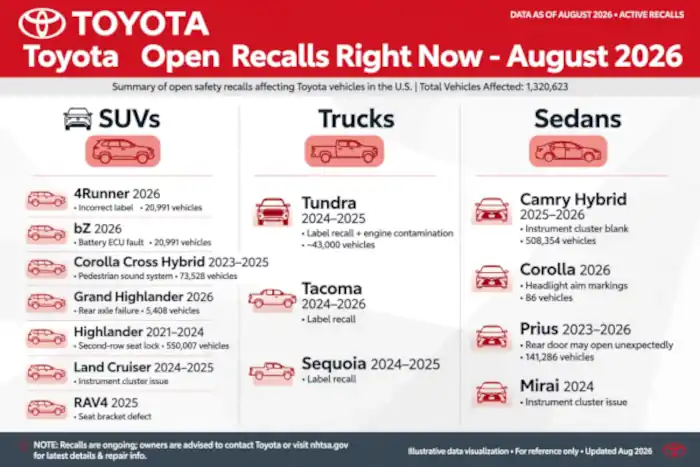
Toyota Vehicle Recalls: Comprehensive Breakdown of Affected Models, Safety Risks, and Remedy Actions
WASHINGTON / TOKYO — Toyota Motor Corporation, long regarded as a global benchmark for automotive manufacturing and reliability, has initiated a series of significant safety recalls across a broad cross-section of its vehicle portfolio. Safety campaigns monitored by the National Highway Traffic Safety Administration (NHTSA) and international transport authorities span sedans, hybrid family cruisers, full-size pickup trucks, and luxury SUVs.
From critical software glitches that disable primary instrument clusters to mechanical faults involving engine block machining debris, unlatching doors, and seat-locking mechanisms, millions of late-model Toyotas and Lexus sister models are scheduled for dealer remediation.
At-a-Glance: Key Recalled Toyota Models & Issues
| Model | Model Years | Primary Issue | Risk / Consequence |
| Toyota Camry / Camry Hybrid | 2025–2026 | Combination meter startup failure | Blank digital display, disabled turn signals & hazards |
| Toyota Highlander / Hybrid | 2021–2024 | Second-row seat latch failure | Increased passenger injury risk during collision |
| Toyota Tundra / Hybrid | 2022–2025 | Machining debris in V35A engine / Camera failure | Total engine stall; lost backup camera view |
| Toyota Prius / Prius Prime | 2023–2026 | Rear door latch water intrusion | Rear doors opening unexpectedly while driving |
| Toyota Grand Highlander | 2024–2026 | Curtain airbag deployment & axle carrier strength | Non-deployment with window open; structural axle failure |
| Toyota RAV4 / Hybrid / Prime | 2023–2025 | Front seat welds & pedestrian warning acoustics | Seat failure in collision; low-speed pedestrian collision risk |
| Toyota Land Cruiser & Crown | 2024–2025 | Digital instrument cluster blanking | Loss of speedometer and active safety alerts |
| Toyota Tacoma & Sequoia | 2023–2025 | Starter motor overheating & load-label discrepancies | Electrical thermal/fire hazard; vehicle overloading |
1. Midsize Sedans: Toyota Camry and Camry Hybrid (2025–2026)
One of the largest individual actions impacts the redesigned Toyota Camry lineup, encompassing more than 655,000 vehicles worldwide—with over 508,000 units in the United States alone.
+--------------------------------------------------------------------------------+
| RECALL PROFILE: 2025–2026 TOYOTA CAMRY / HYBRID                                |
+--------------------------------------------------------------------------------+
| Component:         | 7-inch Combination Digital Meter Software                 |
| Defect:            | Intermittent boot-up initialization crash                  |
| Safety Hazard:     | Extinguishes turn signals, hazards, and cabin warnings   |
| Remedy:            | Complimentary dealership software reflash                 |
+--------------------------------------------------------------------------------+
According to filings submitted to NHTSA, an intermittent software sequencing flaw within the 7-inch digital instrument cluster causes the screen to go completely blank upon vehicle startup. When the screen fails to initialize, vital functional systems running through that control module are disabled simultaneously—including external turn signals, emergency hazard flashers, seatbelt reminder chimes, and ignition key-left alerts.
Toyota identified that driving without turn signals or visual cluster data violates Federal Motor Vehicle Safety Standards (FMVSS) Nos. 101 and 108, dramatically elevating collision hazards. Dealers are updating the meter control software free of charge.
2. Family SUVs: Toyota Highlander & Grand Highlander (2021–2026)
Toyota Highlander (2021–2024)
Encompassing approximately 550,000 vehicles, the standard three-row Highlander was flagged for a mechanical defect in its second-row seating system. If an occupant adjusts the seatback recline or slides the second row to access cargo, the internal locking pawls can fail to fully engage. In a crash, an unlatched seatback cannot properly restrain passengers, significantly heightening injury risks.
Toyota Grand Highlander (2024–2026)
The larger Grand Highlander (and its luxury counterpart, the Lexus TX) faced a stop-sale and multi-stage recall campaign:
-
Curtain Shield Airbags: Testing revealed that if the driver’s or front passenger’s window is rolled down during certain side-impact crashes, the curtain airbag can fail to deploy outside the door frame as designed, reducing head-strike protection.
-
Rear Axle Carrier Assembly: Select 2026 Grand Highlander models were recalled due to casting defects in the rear axle carrier that could crack under load, potentially causing wheel separation or loss of vehicle control.
3. Pickup Trucks: Toyota Tundra & Tacoma
V6 Twin-Turbo Engine Replacements (Tundra & Lexus LX600)
One of the most complex mechanical recalls in Toyota’s modern history involves over 102,000 Tundra pickup trucks (and Lexus LX600 SUVs) equipped with the non-hybrid 3.4-liter twin-turbo V6 (V35A-FTS).
During engine manufacturing, metallic machining debris was inadvertently left inside engine blocks. Over time, these metal shavings contaminate engine oil paths, causing main crankshaft bearing wear, knocking, rough idling, and catastrophic engine seizure. Due to the inability to reliably flush embedded debris from contaminated engines, Toyota undertook complete short-block or full engine assembly replacements for affected owners at zero cost.
Backup Camera Displays (Tundra 2024–2025)
Over 161,000 2024–2025 Tundras were additionally recalled for a panoramic view monitor / rearview camera fault where digital video processing chips intermittently freeze or fail to display live reverse imagery, violating FMVSS 111.
4. Hybrids & Electrified Vehicles: Prius, RAV4, and bZ4X
Toyota Prius & Prius Prime (2023–2026)
Over 141,000 fifth-generation Prius models were recalled due to electronic rear door release switches. Water entering through exterior door handle seals can short-circuit the electronic solenoid latch. If the short occurs while the vehicle is moving or stationary with doors unlocked, the rear passenger door can unlatch and swing open unexpectedly.
                +-------------------------------+
                |  Prius Door Handle Assembly   |
                +---------------+---------------+
                                |
                   ( Water Intrusion via Seal )
                                |
                                v
                +-------------------------------+
                |  Electronic Switch Short-Out  |
                +---------------+---------------+
                                |
                                v
    [ Risk: Rear Door Unlatches Automatically While Driving ]
Dealers replace the left and right rear door switch assemblies with redesigned, waterproofed mechanical-electronic units.
Toyota RAV4 & RAV4 Prime (2023–2025)
As America’s best-selling non-pickup vehicle, several targeted RAV4 campaigns were enacted:
-
Seat Frame Welds: Specific batches of 2024–2025 RAV4s featured improper laser welds along the front passenger seat frame, requiring full seat skeleton replacements.
-
Pedestrian Acoustic Alert Systems: Certain hybrid models received software modifications because exterior low-speed synthetic sound generators (FMVSS 141 compliance) failed to broadcast required decibel levels to alert blind or distracted pedestrians.
Toyota bZ4X (2023–2026)
Toyota’s dedicated electric crossover faced high-voltage battery management ECU updates to prevent erroneous contactor disconnects that could cut propulsion power at highway speeds.
5. Off-Road & Utility: Land Cruiser, 4Runner, and Sequoia
-
Toyota Land Cruiser (2024–2025): Approximately 81,800 Land Cruisers and Mirai fuel-cell vehicles were included in a digital instrument cluster campaign where the meter would fail to wake up from vehicle sleep states.
-
Toyota Sequoia & Tundra Starter Relay (2023–2024): Over 318,000 full-size vehicles were investigated for starter motor solenoid overheating, where repeated ignition attempts in cold conditions could create sustained high-resistance electrical arcs, posing an under-hood thermal/fire hazard.
Root Causes: Technological Complexity & Supplier Coordination
Industry analysts attribute this wave of campaigns to two structural factors shaping modern automotive engineering:
-
Electronic Architecture Centralization: As automakers transition from analog dials to unified software displays (combining ADAS warnings, speedometer, turn signals, and cameras onto one bus), a single operating system crash disables multiple federally regulated safety features at once.
-
Platform & Engine Sharing: Toyota’s TNGA (Toyota New Global Architecture) enables manufacturing efficiencies, but when a component defect occurs—such as a seat latch pawl or engine block machining protocol—it reverberates across numerous model lines simultaneously.
What Affected Owners Should Do
Toyota and NHTSA advise all owners of Toyota, Lexus, and Scion vehicles to verify their vehicle status immediately:
-
Locate Your 17-Character VIN: Found on the driver’s side dashboard (visible through the lower windshield) or on the driver-side door jamb label.
-
Check the NHTSA Recall Database: Visit nhtsa.gov/recalls or use the free SaferCar mobile application.
-
Use the Toyota Owners Portal: Enter your VIN directly at toyota.com/recall.
-
Schedule Free Dealer Service: By federal law, all safety recall repairs—including parts, labor, software re-flashing, and full engine replacements—must be performed 100% free of charge by authorized Toyota dealerships.
If your vehicle exhibits active warning lamps, strange engine metallic knocking, or unresponsive combination displays, contact your local dealership service department immediately for priority inspection and potential loaner vehicle accommodations.
