
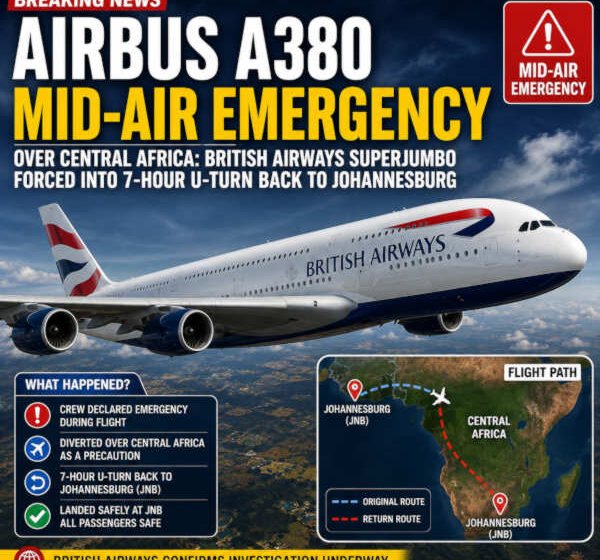
AIRBUS A380 Mid-Air Emergency Over Central Africa: British Airways Superjumbo Forced into 7-Hour U-Turn Back to Johannesburg

JOHANNESBURG — What was meant to be an overnight transcontinental journey across the African continent turned into an exhausting seven-hour “flight to nowhere” for hundreds of passengers aboard a British Airways Airbus A380-800.
Flight BA54, a flagship service connecting South Africa’s economic hub of Johannesburg with London Heathrow, was deep into its journey over Central Africa when a critical navigation and safety component suffered a complete failure. Deprived of essential situational awareness tools while entering one of the most meteorologically volatile flight corridors on Earth, the flight crew made the high-stakes operational decision to abort the long-haul journey, turn the world’s largest passenger airliner completely around, and fly all the way back to their point of origin.
A Troubled Start at O.R. Tambo International Airport
The disruption began long before the massive double-decker aircraft left the ground. Scheduled to depart O.R. Tambo International Airport (JNB) in Johannesburg at 21:15 South African Standard Time (SAST) on Friday, August 7, 2026, Flight BA54 was hit with ground delays right out of the gate.
For over five hours, the Airbus A380-800—registered as G-XLEJ—remained on the tarmac while ground crews, logistics teams, and flight operations worked through preliminary delays. Passengers waited patiently inside the spacious cabins of the superjumbo, anticipating a long night flight north across the African continent toward Europe.
Finally, at 02:36 SAST on the morning of Saturday, August 8, the four Rolls-Royce Trent 900 engines roared to life, and the heavy aircraft lifted off into the night sky. Operating the 11-hour, 15-minute scheduled flight path to London Heathrow, the crew established a steady climb, reaching a cruising altitude of 34,000 feet (FL340).
Flight Timeline Overview: BA54 (August 8, 2026)
-----------------------------------------------------------------------------------
21:15 SAST (Aug 7) : Scheduled Departure Time from O.R. Tambo (JNB)
02:36 SAST (Aug 8) : Actual Takeoff (5+ hour initial ground delay)
02:36 - 05:00 SAST : Cruise at 34,000 ft through Botswana & Zambia into DRC
~05:15 SAST        : Weather radar failure detected over Central Africa (DRC)
~05:30 SAST        : U-turn executed over DRC airspace; return leg begins
07:30 - 09:30 SAST : Racetrack holding pattern north of JNB (25,000 ft) to burn fuel
09:39 SAST         : Safe touchdown back at O.R. Tambo International Airport
22:48 SAST         : Repaired A380 departs JNB; successfully arrives in London
-----------------------------------------------------------------------------------
For the first few hours, the flight proceeded smoothly. The aircraft tracked northward through the serene airspaces of Botswana and Zambia before crossing into the Democratic Republic of Congo (DRC). Passengers settled in for sleep, completely unaware that a severe technical dilemma was brewing in the flight deck.
Blind in the Equatorial Skies: The Failure of Onboard Radar
As Flight BA54 pushed deeper into the airspace of the Democratic Republic of Congo, the flight crew identified a critical avionics malfunction: the aircraft’s airborne weather radar system had completely ceased functioning.
In modern commercial aviation, an operational weather radar system is not merely an optional luxury—it is an indispensable safety requirement, particularly when traversing equatorial regions. The equatorial belt of Africa sits directly inside the Intertropical Convergence Zone (ITCZ), a weather belt notorious among long-haul pilots for generating massive, rapidly developing cumulonimbus storm cells, intense turbulence, severe icing conditions, and heavy electrical activity.
During nighttime transits over vast regions of Central Africa, visual identification of these towering storm clouds is nearly impossible. Thunderstorm tops in the ITCZ frequently extend past 50,000 feet, far above the cruising altitude of any commercial jetliner. Without a functioning weather radar, the flight crew would be flying blind into potential convective turbulence and severe icing zones, with no way to detect convective cores or navigate safely around destructive weather cells.
Faced with thousands of miles of unpredictable tropical weather ahead over the Sahara and Mediterranean before reaching European airspace, continuing onward was deemed an unacceptable safety risk. The flight crew evaluated their options and chose the safest course of action: execute a 180-degree U-turn over the DRC and head back south toward Johannesburg.
Why the A380 Couldn’t Land Immediately
While turning around resolved the immediate danger of entering severe equatorial weather, it introduced a major mechanical challenge: landing weight.
When a double-decker airliner like the Airbus A380 departs on an 11-hour transcontinental flight, it carries dozens of tons of jet fuel. The Maximum Takeoff Weight (MTOW) of an A380 can reach up to 575 metric tons, whereas its Maximum Landing Weight (MLW) is significantly lower—around 394 metric tons. Landing an aircraft above its MLW risks severe structural damage to the airframe, landing gear failure, or overshooting the runway due to increased stopping distances.
Although the A380 had been airborne for more than three hours, it had not burned enough fuel to reach a safe landing weight. Upon returning to northern South African airspace, the crew descended from their cruise altitude down to 25,000 feet and entered a designated racetrack holding pattern north of Johannesburg.
For roughly two hours, the massive aircraft circled in steady loops, intentionally burning off its remaining fuel payload. Inside the cabin, passengers watched their flight tracking screens loop repeatedly over the South African countryside—a surreal realization that after seven hours in the air, they were returning exactly to where they started.
Touchdown and Rapid Maintenance Turnaround
At approximately 09:39 SAST on Saturday morning—nearly seven hours after taking off—Flight BA54 made a smooth, safe touchdown on the runway at O.R. Tambo International Airport. Ground emergency crews monitored the landing as a standard precaution for overweight/extended holding arrivals, but the superjumbo taxied back to the gate without further incident, bringing all passengers and crew back to safety
Upon arrival at the terminal, passengers were disembarked while British Airways engineering teams immediately went to work on aircraft G-XLEJ. Technicians diagnosed the faulty radar hardware, conducted component replacements, and performed rigorous systems checks to re-certify the avionics suite for high-altitude transcontinental operations.
Second Time’s a Charm: Reaching London Heathrow
Remarkably, the engineering team resolved the radar issue in time to clear the superjumbo for departure later that same evening.
At 22:48 SAST on Saturday, August 8—just over an hour past the flight’s regularly scheduled departure slot for that night—the fully repaired Airbus A380 lifted off from Johannesburg once again. Re-designated under the same flight number, BA54 safely retraced its path north, successfully navigating the weather systems over Central Africa with a fully operational radar system, and touched down smoothly at London Heathrow Terminal 5 on Sunday morning.
While a 7-hour “flight to nowhere” is a frustrating experience for travellers, aviation safety experts commended the crew’s decisive action. The incident serves as a textbook example of modern aviation safety protocols: prioritizing redundantly verified systems over schedule adherence, ensuring that even the world’s largest passenger jets never compromise on airworthiness.