Jamie Dimon Warns US Dollar Will Lose Global Reserve Status Without Military and Economic Supremacy

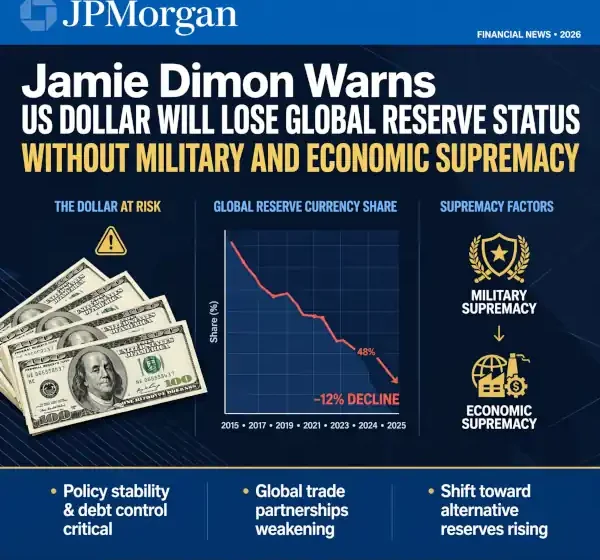
USA Tech : In a sobering warning to political and business leaders, JPMorgan Chase & Co. Chairman and Chief Executive Officer Jamie Dimon cautioned that the United States dollar risks losing its global reserve currency status over the next 25 years if the nation fails to maintain both its economic leadership and military dominance.
Speaking on PBS’s Firing Line with host Margaret Hoover, the head of America’s largest bank directly linked the international supremacy of the greenback to the nation’s geopolitical strength. Dimon emphasized that financial supremacy and national security are inextricably tied, warning that a decline in American power would lead to a fractured and increasingly hazardous global order.
“If America is in a weakened state… like if we’re not the strongest military in 25 years and the strongest economy, we won’t be the reserve currency either,” Dimon said. “The world will be fragmented, and it’ll be very dangerous for us.”
Dimon’s remarks highlight growing concerns among top financial executives regarding rising geopolitical multipolarity, fragile global supply chains, and the long-term sustainability of American economic hegemony.
The Indivisible Link Between Economic Might and Military Power
At the heart of Dimon’s assessment is the premise that global deterrence—and by extension, the preservation of global democracy—relies on American economic and defense capabilities.
Dimon framed the relationship between economic output and defense readiness as a self-reinforcing cycle. Without a dominant economy, a nation cannot fund cutting-edge defense technology or sustain long-term military readiness. Conversely, without the security umbrella provided by a formidable military, international trade networks fracture, weakening currency trust and global commerce.
                     THE CYCLE OF AMERICAN HEGEMONY

    ┌────────────────────────────────────────────────────────┐
    │                Dominant U.S. Economy                  │
    └───────────────────────────┬────────────────────────────┘
                                │
                                ▼
    ┌────────────────────────────────────────────────────────┐
    │             World-Class Military Readiness            │
    └───────────────────────────┬────────────────────────────┘
                                │
                                ▼
    ┌────────────────────────────────────────────────────────┐
    │           Global Trust in U.S. Security               │
    └───────────────────────────┬────────────────────────────┘
                                │
                                ▼
    ┌────────────────────────────────────────────────────────┐
    │       U.S. Dollar Preserves Reserve Currency Status     │
    └────────────────────────────────────────────────────────┘
“To be safe, have the best military in the world. If you wanna have the best military in the world, you have the best economy in the world,” Dimon stated on the broadcast.
Dimon stressed that preparing for potential conflicts, while expensive, is far less costly than enduring a strategic defeat. “Fighting a war is very expensive. Losing the war is the most expensive,” he observed.
National Security Takes Precedence Over Corporate Profits
Dimon’s public warnings coincide with an aggressive strategic effort by JPMorgan Chase to realign private capital toward national interest priorities. The bank previously unveiled its $1.5 trillion Security and Resiliency Initiative (SRI), a 10-year capital commitment designed to finance, invest in, and support critical domestic industries.
The initiative directs equity, venture capital, and commercial lending toward four core national security sectors:
-
Supply Chain & Advanced Manufacturing: Accelerating domestic production of critical minerals, active pharmaceutical ingredients, and industrial robotics.
-
Defence & Aerospace: Funding defence technologies, autonomous systems, naval shipbuilding, drone capabilities, and secure satellite communications.
-
Energy Independence & Grid Resilience: Financing next-generation battery storage, nuclear power infrastructure, and grid modernisation to meet the power demands of artificial intelligence.
-
Frontier Technologies: Scaling domestic capabilities in artificial intelligence, semiconductors, quantum computing, and cybersecurity.
Dimon made clear that corporate America must prioritise national security over short-term quarterly performance or narrow commercial interests.
Strategic Vulnerabilities: Critical Supply Chains Under Threat
A primary driver behind Dimon’s urgency is America’s continued reliance on foreign adversaries for essential defence and industrial components. The CEO pointed out glaring vulnerabilities in supply chains that could hobble U.S. industrial capacity during a major geopolitical crisis.
Key dependencies identified across U.S. defence and industrial sectors include:
-
Critical Minerals & Rare Earth Elements: Near-total reliance on foreign processing for neodymium, dysprosium, and lithium required for guided missiles, electric vehicle motors, and radar systems.
-
Active Pharmaceutical Ingredients (APIs): Heavy reliance on overseas suppliers for key compounds used in life-saving domestic medications.
-
Microelectronics & Semiconductors: Ongoing exposure to supply bottlenecks in East Asia for advanced logic chips essential to military communications and commercial computing.
-
Shipbuilding and Naval Capacity: A severely constrained domestic industrial base relative to competing naval powers, limiting fleet maintenance and expansion.
Dimon urged business leaders, policymakers, and financial institutions to dismantle regulatory roadblocks and permitting delays that hinder rapid domestic industrial expansion.
                     PRIMARY SUPPLY CHAIN EXPOSURES

 ┌───────────────────────────┬────────────────────────────────────────────┐
 │ Sector                    │ Primary Strategic Vulnerability            │
 ├───────────────────────────┼────────────────────────────────────────────┤
 │ Precision Munitions       │ Foreign sourcing of rare earths & magnets  │
 ├───────────────────────────┼────────────────────────────────────────────┤
 │ Healthcare & Pharmaceuticals│ Offshore processing of essential APIs   │
 ├───────────────────────────┼────────────────────────────────────────────┤
 │ Defense Technology        │ Concentrated semiconductor fabrication     │
 ├───────────────────────────┼────────────────────────────────────────────┤
 │ Defense Logistics         │ Underfunded domestic naval shipbuilding    │
 └───────────────────────────┴────────────────────────────────────────────┘
De-Dollarization Trends and the Future of the US Dollar Index
Dimon’s comments arrive against the backdrop of shifting global currency dynamics and attempts by economic blocs like BRICS (Brazil, Russia, India, China, and South Africa) to settle bilateral trade in local currencies.
Despite rhetoric surrounding de-dollarization, the U.S. Dollar Index (DXY)—which measures the greenback against a basket of six major foreign currencies—reflects short-term resilience even as long-term structural questions persist.
                        US DOLLAR INDEX (DXY) PERFORMANCE

  ┌─────────────────────────────────┬──────────────────────────────────┐
  | Metric                          | Recent Performance               |
  ├─────────────────────────────────┼──────────────────────────────────┤
  | Year-to-Date (YTD) Change       | +1.42%                           |
  | Monthly Change                  | -1.28%                           |
  | Year-over-Year Change           | Unchanged (0.00%)                |
  | Current Spot Level              | 99.6950 (+0.16%)                 |
  └─────────────────────────────────┴──────────────────────────────────┘
While the dollar continues to account for nearly 85% to 90% of global foreign exchange transactions and roughly 58% of discloseable global central bank reserves, market analysts note that prolonged fiscal deficits, rising national debt, and trade fragmentation could slowly erode those structural advantages over a multi-decade horizon.
Corporate America’s Alignment with Public Policy
Dimon’s call to action signals a growing alignment between major Wall Street institutions and Washington’s broader national security strategy. The shift toward reshoring, nearshoring, and industrial policy represents a sharp departure from the hyper-globalised, just-in-time manufacturing models that dominated corporate boardrooms over the past three decades.
By deploying $10 billion in direct equity and venture capital investments alongside $1.5 trillion in broader financing through the SRI initiative, JPMorgan Chase is attempting to catalyse private sector investment into sectors traditionally deemed too slow-growing or capital-intensive for conventional venture capital.
Industry observers note that for the U.S. to maintain its economic and military lead over the next quarter-century, other financial institutions, industrial conglomerates, and government agencies must coordinate to address critical infrastructure gaps.
The Road Ahead: Time Running Out for Reindustrialization
Dimon concluded his warning by emphasising that the window for securing domestic supply chains and preserving the international monetary system is narrowing rapidly.
Without aggressive public-private investment in defence manufacturing, energy resilience, and technological innovation, the U.S. risks ceding ground to strategic competitors a scenario Dimon believes would shatter the stability of the global financial system.
“I do believe that America is what makes the world safe and secure for democracy,” Dimon said. As corporate leaders and Washington policymakers weigh his warnings, the consensus on Wall Street is clear: maintaining the dollar’s status as the world’s premier reserve currency will require far more than financial policy—it will demand an unyielding commitment to industrial strength and national defense.