
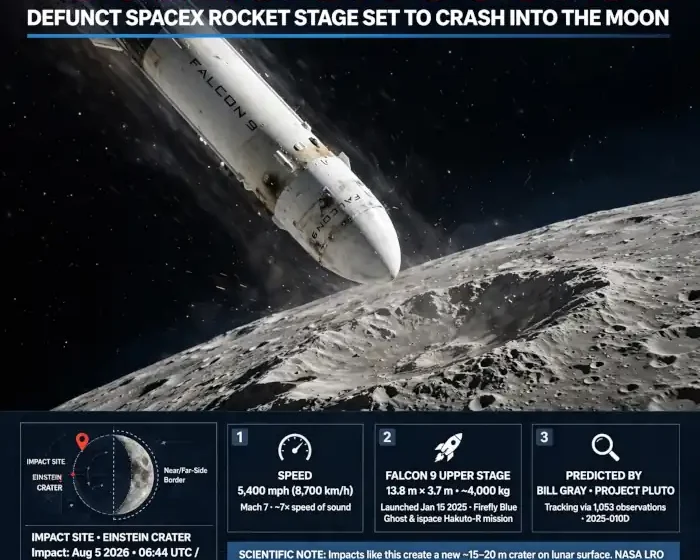

An abandoned upper stage of a SpaceX Falcon 9 rocket is hurtling through deep space on an unavoidable path toward the Moon. Scheduled to make an impact on August 5, 2026, at approximately 06:35 UTC, this event marks an exceedingly rare instance of human-made hardware unintentionally colliding with Earth’s nearest celestial neighbour.
Cruising at a staggering speed of roughly 5,400 miles per hour (8,700 km/h), the five-story-tall rocket stage will slam near the Einstein Crater on the western limb of the Moon. While the event poses no physical danger to Earth or the Moon’s orbit, it highlights growing international concerns surrounding deep-space debris and offers scientists a unique opportunity to study lunar impact cratering.
Key Highlights of the Imminent Lunar Impact
-
Impact Date & Time: August 5, 2026, at ~06:35 UTC (2:35 a.m. EDT / 12:05 p.m. IST).
-
Target Location: Near the Einstein Crater on the Moon’s sunlit western limb.
-
Impact Velocity: Approximately 5,400 mph (2.41 km/s).
-
Expected Crater Size: Between 65 and 100 feet (20 and 30 meters) in diameter.
-
Origin: A Falcon 9 upper stage launched in January 2025, carrying commercial lunar landers.
How Did a SpaceX Rocket Get Bound for the Moon?
The trajectory to this cosmic collision began in January 2025, when SpaceX launched a Falcon 9 rocket carrying two commercial lunar missions—including Firefly Aerospace’s Blue Ghost Mission 1.
Unlike the reusable Falcon 9 first-stage booster, which performs a controlled landing back on Earth or a drone ship shortly after launch, the rocket’s second (upper) stage is designed to burn its engines in high altitude to push payloads into deep space trajectories. Once its job was complete, the upper stage was left without sufficient fuel reserves to return to Earth’s atmosphere for a destructive re-entry or to escape entirely into a stable solar orbit.
For over a year and a half, the four-ton piece of rocket hardware drifted in an elongated, chaotic Earth-Moon transfer orbit. Influenced by gravitational tugs from both the Earth, the Moon, and the Sun, its orbit gradually destabilised until orbital mechanics locked it onto a final, unalterable collision path with the lunar surface.
What Will Happen During the Impact?
When the rocket stage makes contact with the lunar surface, the kinetic energy released will be immense. Moving at roughly 7 times the speed of sound, the collision will occur in a fraction of a second.
The Sequence of Events:
-
Instantaneous Kinetic Transfer: Upon impact, the thin metal shell of the Falcon 9 upper stage will collapse entirely, releasing energy equivalent to several tons of TNT.
-
Plume Excavation: The force will blast away layers of fine lunar soil (regolith) and subsurface rock, throwing up a dust plume several kilometres high.
-
Crater Formation: A brand-new crater spanning 20 to 30 meters wide will be etched into the lunar crust, joining millions of ancient impact scars.
Because the Moon lacks an atmosphere, there will be no atmospheric friction to burn up the debris beforehand and no sound created by the shockwave.
A Golden Opportunity for Lunar Scientists
While an uncontrolled crash is technically an anomaly, planetary scientists view the August 5 impact as a rare, real-world laboratory experiment.
| Factor | Known Parameters | Scientific Advantage |
| Mass & Dimensions | ~4,000 kg / ~39 ft long | Allows precise kinetic energy calculations. |
| Trajectory & Speed | ~5,400 mph at ~19.4° N, 266.4° E | Predicts the exact location for orbital imaging. |
| Impact Composition | Aluminum and aerospace alloys | Helps distinguish human debris from meteoritic material. |
By knowing the exact mass, speed, angle, and timing of the incoming object, researchers can calibrate computer models that simulate natural asteroid and comet impacts.
Spacecraft currently orbiting the Moon—such as NASA’s Lunar Reconnaissance Orbiter (LRO)—are expected to adjust their camera passes over the target coordinates near Einstein Crater in the days following the event. High-resolution images of the newly minted crater will provide fresh data on how deep regolith layers are structured beneath the surface.
Can You Watch the Impact from Earth?
Seeing the crash with the naked eye will be impossible due to the relatively small scale of the object and the vast distance of nearly 240,000 miles (384,000 km).
However, because the impact is predicted to happen on the sunlit western limb of the Moon, specialised ground-based observatories and advanced amateur astronomers armed with high-grade telescopes may capture a brief dust plume or light flash as regolith reflects sunlight. Organisations like The Virtual Telescope Project plan to monitor and stream observations live during the calculated impact window.
Deep Space Junk: The Growing Orbital Tracking Dilemma
This marks only the second widely confirmed instance of a human-made rocket upper stage accidentally hitting the Moon—the previous major occurrence involved a discarded rocket body impacting the lunar far side in March 2022.
The incident shines a spotlight on a critical issue: space sustainability beyond Low Earth Orbit (LEO).
While organisations like the U.S. Space Force track over 30,000 pieces of space debris in LEO using ground radar, tracking objects in cis-lunar space (the region between Earth and the Moon) is significantly harder due to immense distances. Radar loses precision at hundreds of thousands of kilometres, leaving astronomers reliant primarily on optical survey telescopes.
As dozens of nations and private firms prepare lunar landers, communication satellites, and habitats under initiatives like NASA’s Artemis program, experts emphasise that international regulatory bodies must establish stricter disposal guidelines for deep-space upper stages to avoid potential hazards near future lunar outposts.
Frequently Asked Questions (FAQs)
1. Will the rocket crash change the Moon’s orbit?
No. The mass of the Falcon 9 upper stage (around 4 metric tons) is infinitesimally small compared to the mass of the Moon ($7.3 \times 10^{22}$ kilograms). It will have zero effect on the Moon’s orbit, gravity, or tide-generating effects on Earth.
2. Is this the first time human hardware has hit the Moon?
No. Dozens of human objects have hit the Moon intentionally (such as Apollo lunar module stages, impactor probes, and retired landers) and accidentally. However, uncontrolled collisions from discarded rocket stages drifting for years remain very rare.
3. Will the crash endanger astronauts or future missions?
No. The impact location near Einstein Crater is far removed from the current planned human landing zones or operational robotic landers.
The Verdict
The upcoming August 5 lunar impact serves as both an exciting astronomical spectacle and a gentle warning. While researchers prepare their telescopes to analyse the fresh crater left behind near Einstein Crater, the event highlights the urgent need for clearer space traffic management as humanity expands its footprint beyond Earth orbit.