Boeing Airforce One contract Incurs $280 Million Q2 Loss as Overruns Approach $2.8 Billion

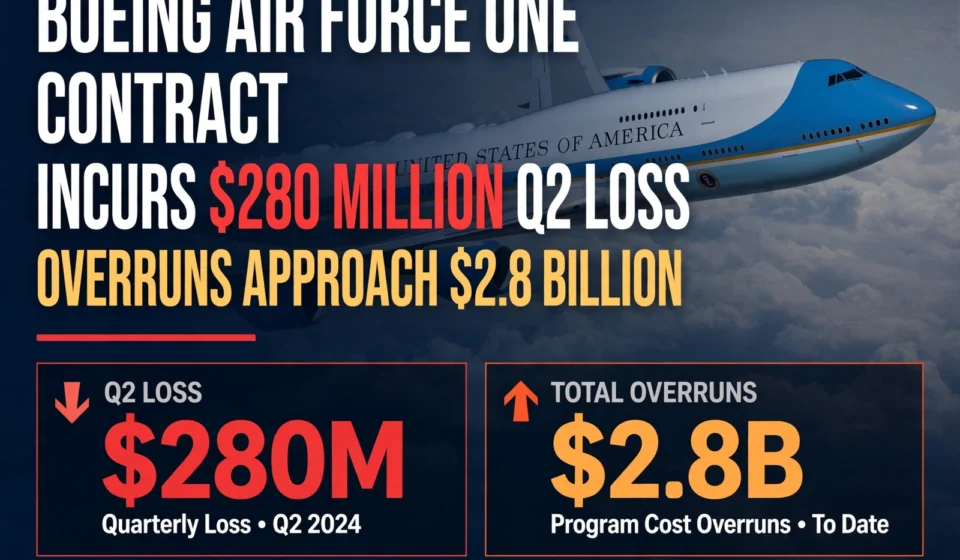
USA: The Boeing Air Force contract reported another substantial financial blow to its Defence, Space & Security segment. The aerospace giant took a fresh $280 million pre-tax charge during the second quarter of 2026 on its high-profile contract to build two new VC-25B aircraft, which serve as the presidential Air Force One.
The latest charge reflects swelling production and certification costs required to keep the deeply delayed presidential plane program on track for a revised 2028 delivery target. Since signing a fixed-price agreement with the U.S. government in 2018, Boeing has absorbed cumulative losses approaching $2.8 billion on the Air Force One program alone.
Despite the heavy defence drag, Boeing demonstrated encouraging operational progress across its commercial aviation and cash flow metrics. Driven by rising commercial deliveries and a ramping 737 MAX assembly line, the company generated positive free cash flow, beating Wall Street estimates and reaffirming its full-year financial outlook.
Executive Summary: Key Financial and Operational Metrics
-
Air Force One Program Charge: $280 million in Q2 2026 due to engineering, manufacturing, and certification resources.
-
Cumulative Program Losses: Estimated at $2.8 billion since the contract was inked in 2018.
-
Overall Q2 Net Loss: $428 million (or an adjusted core loss of $0.76 per share), narrowing from a $612 million loss ($1.24 per share) in Q2 2025.
-
Quarterly Revenue: $24.56 billion, an 8% year-over-year increase supported by commercial jet deliveries.
-
Free Cash Flow Inflexion: Positive $631 million, marking a sharp turnaround from negative $200 million in Q2 2025.
-
Commercial Aircraft Deliveries: 171 planes delivered—up 14% year-over-year—representing Boeing’s highest quarterly delivery output since 2018.
-
Total Order Backlog: Closes at a record $715 billion, covering more than 6,200 commercial aircraft orders.
The Air Force One VC-25B Dilemma: How Fixed-Price Contracts Hurt Defence Contractors
The VC-25B replacement program represents one of the most prominent cautionary tales in defence procurement history. In 2018, Boeing entered into a $3.9 billion fixed-price contract with the U.S. Air Force to modify two commercial 747-8 airframes into highly specialised presidential transport vehicles.
Under fixed-price terms, the defence contractor agrees to absorb any expenses that exceed the initial budget, effectively shielding the federal government and taxpayers from cost overruns. At the time of signing, government officials touted the deal as saving taxpayers over $1.4 billion. However, former Boeing leadership later admitted that agreeing to those rigid terms was a significant strategic misstep.
+-----------------------------------------------------------------------+
|                 Boeing Air Force One (VC-25B) Timeline                |
+-----------------------------------------------------------------------+
| 2018: Fixed-price contract signed for $3.9B                           |
| 2024: Original planned delivery date (Missed)                         |
| 2026: Q2 $280M charge brings total losses to ~$2.8 Billion            |
| 2028: Revised target delivery window for primary presidential aircraft |
+-----------------------------------------------------------------------+
Why Presidential Jets are Exceptionally Complex
Transforming a standard Boeing 747-8 wide-body airliner into a “Flying White House” involves engineering demands far beyond standard commercial aviation:
-
Hardened Avionics & Defence: The aircraft must feature military-grade missile defence systems, electromagnetic pulse (EMP) shielding, and hardened wiring networks.
-
Secure Global Communications: Installation of advanced, jam-resistant satellite linkup suites capable of functioning as a mobile national command authority.
-
Internal Architecture: Custom physical configurations including executive suites, conference facilities, medical operating facilities, and specialised galley systems.
-
Aerial Refuelling Capabilities: Modifications allowing long-duration airborne survival during national security emergencies.
Addressing these technical requirements has led to engineering delays, labour shortages, and stringent regulatory review processes. Executive leadership within Boeing’s Defence, Space & Security division acknowledged that additional cost growth may continue as the aircraft moves through final wiring, structural completion, and military flight certification ahead of its targeted 2028 delivery.
Financial Overview: Q2 2026 Performance Breakdown
Despite the $280 million drag from the defence segment, Boeing’s broader second-quarter earnings report delivered signals of operational recovery.
| Metric | Q2 2025 | Q2 2026 | Year-Over-Year Change |
| Total Revenue | $22.74 Billion | $24.56 Billion | +8% |
| Net Financial Loss | -$612 Million | -$428 Million | Loss Narrowed |
| Core Loss Per Share | -$1.24 | -$0.76 | Improved |
| Commercial Deliveries | 150 Jets | 171 Jets | +14% |
| Operating Cash Flow | $227 Million | $1.36 Billion | +499% |
| Free Cash Flow | -$200 Million | +$631 Million | Swung Positive |
While core earnings per share missed consensus estimates due to the one-time defence charge, institutional investors responded positively to the company’s surging cash position. Boeing shares gained altitude during morning trading following the release, driven by strong commercial delivery momentum.
Commercial Aviation Recovery Drives Cash Flow Surge
The fundamental engine behind Boeing’s stabilisation is its Commercial Aeroplanes unit, which generated $11.75 billion in revenue during the second quarter—an 8% improvement year-over-year. The operating loss for the commercial division narrowed to $322 million from $557 million in the prior-year period.
                 ┌───────────────────────────────────────────┐
                 │ Boeing Commercial Deliveries (Q2 2026)     │
                 └─────────────────────┬─────────────────────┘
                                       │
        ┌──────────────────┬───────────┴───────────┬──────────────────┐
        ▼                  ▼                       ▼                  ▼
┌──────────────┐   ┌──────────────┐        ┌──────────────┐   ┌──────────────┐
│  129 Jets    │   │   25 Jets    │        │   10 Jets    │   │    7 Jets    │
│   737 MAX    │   │ 787 Dreamliner│       │   767 Freighters │ 777 Wide-body│
└──────────────┘   └──────────────┘        └──────────────┘   └──────────────┘
Ramping 737 MAX Production Rates
Boeing’s flagship narrow-body aircraft, the 737 MAX, reached a crucial production milestone during the quarter, transitioning to an assembly rate of 47 aircraft per month. Expanding production stability reflects progress in overcoming factory disruptions and supply chain bottlenecks that constrained output over the previous years.
Additionally, Boeing opened a fourth production line for the 737 MAX, bolstering manufacturing capacity to service its expansive order book. Regulators at the Federal Aviation Administration (FAA) have gradually normalised oversight as quality assurance protocols stabilised across assembly plants.
Key Product Line Progress
-
787 Dreamliner Expansion: Production capabilities expanded at the North Charleston facility in South Carolina, delivering 25 wide-body aircraft to international air carriers.
-
777X Flight Certification Testing: The upcoming 777X flagship wide-body jet formally initiated FAA certification flight testing, moving the long-awaited program closer to commercial airline entry.
-
Variant Approvals: Boeing continues working toward final regulatory certification for the 737-7 and high-capacity 737-10 variants, which will unlock pending deliveries to major global fleets.
Cash Generation Reaffirmed for Full-Year 2026
The standout highlight of the second-quarter report was Boeing’s free cash flow generation. Generating $631 million in free cash flow significantly outperformed initial market expectations, which had projected a cash burn of roughly $331 million.
The cash generation surge was propelled by higher customer advance payments upon delivery, increased unit shipments, and leaner inventory overhead.
Boeing reiterated its full-year 2026 guidance, expecting to generate between $1 billion and $3 billion in free cash flow. If achieved, this will mark the planemaker’s first full year of positive cash flow generation since 2023, marking an important operational milestone in paying down corporate debt accumulated during past manufacturing crises.
Conclusion: Balancing Defence Drag with Commercial Momentum
Boeing’s second-quarter 2026 results illustrate a sharp dichotomy within the world’s largest aerospace manufacturer. On one hand, legacy fixed-price military contracts—headlined by the troubled Air Force One replacement program—continue to produce unexpected charges that weigh on quarterly net profit.
On the other hand, core commercial aeroplane manufacturing is undergoing a steady operational recovery. Higher delivery volumes, improving cash flows, expanding factory output, and a record $715 billion backlog demonstrate that Boeing’s long-term business model remains structurally resilient.
As Boeing works through final wiring, structural assembly, and military certification to deliver the presidential aircraft by 2028, investors and industry analysts will keep a close eye on factory output rates, FAA regulatory milestones, and defence cost containment.