
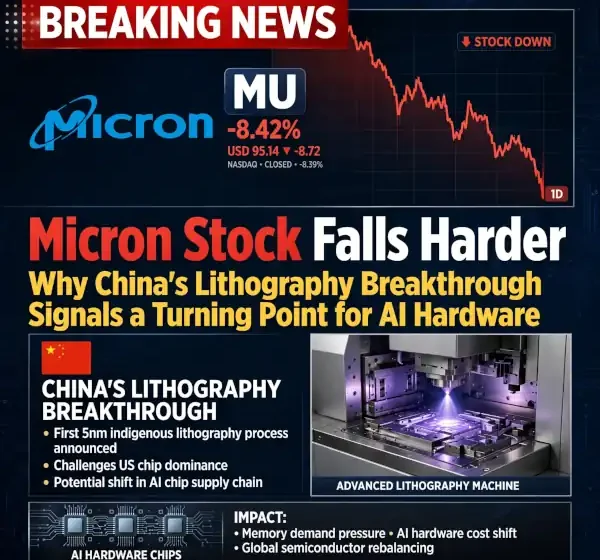
Micron Stock Falls Harder: Why China’s Lithography Breakthrough Signals a Turning Point for AI Hardware

Stock Updates US: Another financial news on Micron Stock USA. After a monster rally that saw its stock soar more than 200% in 2026, Micron Technology ($MU) is facing its toughest reality check of the year.
On Tuesday, July 28, 2026, Micron stock dropped around 10% shortly after the opening bell. The slump followed a 2.3% decline on Monday, triggering a broader sell-off across memory and storage peers. SanDisk ($SNDK) and Western Digital ($WDC) slid roughly 13%, while the tech-heavy Nasdaq Composite dropped 1.3%.
While profit-taking after a historic run is normal, this steep pullback carries an ominous sign for the artificial-intelligence trade. What began as general market digestion has mutated into fear over a double threat: rising Chinese semiconductor self-sufficiency and emerging circular-financing risks in AI infrastructure.
1. The Trigger: China’s Domestic DUV Lithography Breakthrough
The primary catalyst behind the sudden sell-off was a bombshell report revealed by The Information: a state-backed Shanghai semiconductor company has officially begun mass-producing domestic immersion deep ultraviolet (DUV) lithography machines.
┌────────────────────────────────────────────────────────────────────────┐
│               THE CHINA LITHOGRAPHY BREAKTHROUGH MATRIX               │
├─────────────────────────┬──────────────────────────────────────────────┤
│ Key Technology          │ Homegrown Immersion DUV Lithography          │
│ Monopoly Disrupted      │ ASML (Netherlands)                           │
│ Primary Domestic Users  │ CXMT, SMIC, Hua Hong Semiconductor           │
│ Projected Output        │ ~5 machines in 2026; ~20 machines in 2027    │
│ Strategic Impact        │ Bypasses U.S. export controls on legacy/     │
│                         │ mid-tier memory production                   │
└─────────────────────────┴──────────────────────────────────────────────┘
For years, Netherlands-based ASML ($ASML) held a near-monopoly on advanced lithography tools. U.S. export controls explicitly aimed to restrict Chinese access to cutting-edge equipment. However, domestic mass production of DUV scanners enables leading Chinese chipmakers—including ChangXin Memory Technologies (CXMT)—to expand wafer output without relying on Western machinery suppliers.
Investors are now panicking that a surge of cheap, state-subsidized Chinese domestic memory supply could flood global markets over the next 18 to 24 months, shattering the tight pricing power Western chipmakers have enjoyed throughout the AI boom.
2. CXMT’s Blockbuster $480B Shanghai IPO
Compounding the lithography news was the explosive market debut of ChangXin Memory Technologies (CXMT) on Shanghai’s STAR Market.
CXMT’s stock skyrocketed over 465% on its first day of trading, temporarily vaulting its market capitalization past $480 billion and raising roughly $8.6 billion in fresh capital.
ChangXin Memory Technologies (CXMT) Market Impact
----------------------------------------------------------------------------------
IPO Capital Raised:             ~$8.6 Billion (Largest mainland semiconductor IPO)
Day 1 Price Surge:              +465%
Global DRAM Market Share Target: Scaling toward 18% by 2028 (Nomura Projection)
Monthly Wafer Production:       Closing in on 350,000 WSPM (Nearing Micron's scale)
----------------------------------------------------------------------------------
While over 98% of CXMT’s current output consists of commodity DRAM—where it remains 1 to 2 generations behind Micron in High-Bandwidth Memory (HBM)—its sheer production volume poses a serious long-term threat. As CXMT uses its multi-billion-dollar war chest to scale up production, commodity DRAM prices could face downward pressure, indirectly squeezing Micron’s gross margins.
3. “Circular Financing” Fears in Big Tech AI Infrastructure
Beyond geopolitical competition, institutional investors are becoming uneasy about the financial mechanics funding the AI spending spree.
The market sell-off accelerated alongside reports that Nvidia ($NVDA) is in talks to provide a $250 billion credit backstop to assist startup OpenAI in funding a massive 10-gigawatt AI data center project in Ohio.
                 The AI Circular-Financing Loop
┌────────────────────────────────────────────────────────────────────────┐
│ 1. Hardware Supplier (Nvidia) provides credit guarantees/backstops.   │
│ 2. AI Startup (OpenAI) uses guaranteed credit to raise massive debt.   │
│ 3. Debt funds are used to buy hardware (GPUs & Micron HBM memory).     │
│ 4. Market Risk: If end-user software monetization lags, debt collapses.│
└────────────────────────────────────────────────────────────────────────┘
Analysts point out that when chip suppliers guarantee the debt of their primary buyers to fund hardware purchases, it creates a circular dynamic reminiscent of the late-1990s dot-com bubble. If end-user AI monetisation fails to justify these half-trillion-dollar infrastructure commitments, memory suppliers like Micron—which supply HBM3e and HBM4 chips for AI clusters—face severe balance-sheet exposure.
4. Why Micron Is Falling Harder Than Peers
While the broader chip sector took a hit, Micron was hit particularly hard on Tuesday. Several factors explain why $MU bears took control:
-
High Expectations & Extended Valuations: Having gained more than 200% year-to-date, Micron had zero margin for error. Any headline threatening future pricing power triggers aggressive profit-taking.
-
Commodity Memory Vulnerability: Unlike pure-play processor makers (like Nvidia or AMD), memory is inherently cyclical. When overcapacity fears emerge, spot and contract prices for DRAM and NAND flash react immediately.
-
Loss of Asian Market Share: Reports that domestic smartphone brands in China are testing CXMT memory modules signal potential market-share loss for Western suppliers operating in mainland Asia.
Technical Outlook: Crucial Support Levels to Watch
From a chart standpoint, Micron’s sharp reversal below the $900 level has broken key short-term moving averages.
Micron Technology ($MU) Technical Support Matrix
----------------------------------------------------------------------------------
Previous Peak (2026 High):       Above $1,000
Current Trading Level:           ~$864 - $890 (Down ~10% intraday)
Primary Short-Term Support:      50-Day Moving Average ($900 - Broken)
Secondary Structural Support:   100-Day Moving Average / $800 Support Zone
----------------------------------------------------------------------------------
Technical analysts warn that if Micron fails to reclaim the $900 handle quickly, algorithm-driven momentum trading could push the stock toward secondary support near $800 before institutional buyers step back in.
The Bottom Line for Investors
Is the AI memory rally over, or is this a temporary bump?
While China’s DUV breakthrough and CXMT’s expansion present genuine long-term competition in commodity DRAM, Micron retains a substantial technological lead in High-Bandwidth Memory (HBM4)—the specialised, high-margin memory required for top-tier AI training.
For long-term investors, the current sell-off serves as a stark reminder: the AI trade is shifting from a rising tide that lifts all boats to an environment defined by geopolitical risk, capacity discipline, and hardware monetisation scrutiny.
-
Meta Title: Micron Stock Falls 10% as China DUV Breakthrough & CXMT IPO Rattle Chip Sector
-
Meta Description: Micron stock ($MU) plunges as reports of China mass-producing domestic DUV lithography machines and CXMT’s $480B IPO trigger fears of AI memory oversupply.
-
URL Slug:
micron-stock-falling-harder-china-duv-lithography-cxmt-ipo-ai-selloff
Learn how DUV lithography works
This video explains the technical fundamentals of deep ultraviolet (DUV) lithography machines and how they are used to print microscopic circuit patterns onto silicon wafers.