
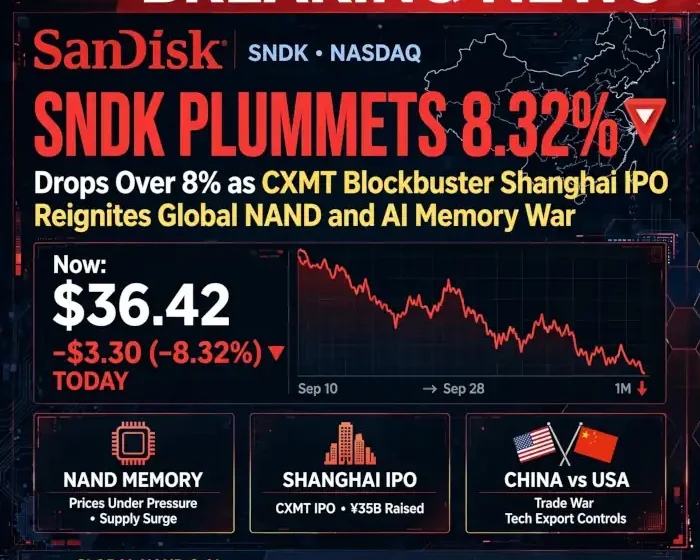
SanDisk (SNDK stock) Drops Over 8% as CXMT’s Blockbuster Shanghai IPO Reignites Global NAND and AI Memory War

US Stock Market News: SNDK Stock today -The global semiconductor landscape experienced a sharp recalibration after a historic initial public offering (IPO) in Asia sent shockwaves through Wall Street. Shares of SanDisk (NASDAQ: SNDK stock) fell heavily, sinking as much as 11% to 12% intraday before hovering down 8.1% to 9% in active trading. The broader memory and solid-state storage sector experienced parallel declines, with Micron Technology (NASDAQ: MU), Western Digital (NASDAQ: WDC), SK Hynix, and Samsung Electronics all facing intense selling pressure.
The primary catalyst behind this aggressive sector sell-off was the explosive Shanghai debut of ChangXin Memory Technologies (CXMT), China’s premier domestic memory chipmaker. CXMT raised an estimated $8.6 billion to $9.8 billion in Asia’s largest semiconductor IPO of the year. Upon listing on Shanghai’s tech-heavy STAR Market, CXMT’s stock skyrocketed over 466% on its first day of trading, briefly pushing its market capitalisation past $480 billion to $540 billion.
While CXMT currently specialises in Dynamic Random-Access Memory (DRAM), institutional investors fear that CXMT’s newly minted multi-billion-dollar war chest—backed heavily by Chinese state capital and the National Integrated Circuit Industry Investment Fund—will inevitably be channelled into expanding capacity across both DRAM and NAND flash memory.
This sudden shift in market sentiment has raised urgent questions regarding SanDisk’s gross profit margins, pricing power, enterprise data centre growth, and overall moat within the AI hardware supply chain.
1. Breakdown of the CXMT Blockbuster IPO and SNDK Stock Fall
To understand why a Chinese DRAM producer’s public listing triggered a steep decline in a U.S. flash memory giant, it is essential to analyse the unprecedented sheer scale of CXMT’s public market debut.
CXMT Shanghai STAR Market IPO Key Metrics
----------------------------------------------------------------------------------
IPO Capital Raised:             $8.6 Billion - $9.8 Billion (Asia's Largest in 2026)
Day 1 Stock Price Surge:        +466% (Peak intraday gain >500%)
Post-Debut Valuation:           ~$484 Billion - $540 Billion
Market Rank in Mainland China:  #1 Most Valuable Listed Enterprise
Current Global DRAM Share:      ~7.7% to 8.0% (Ranked #4 globally behind Samsung, SK Hynix, Micron)
----------------------------------------------------------------------------------
CXMT began trading at an issue price of 8.66 yuan before rocketing to close at 49 yuan, reaching intraday highs near 55.03 yuan. By the end of its first trading session, CXMT temporarily surpassed domestic banking giants like the Industrial and Commercial Bank of China (ICBC) to become mainland China’s most valuable publicly listed company.
The Capital War Chest
Before this IPO, Western incumbents viewed CXMT primarily as a domestic supplier restricted by U.S. export controls and trailing 2 to 3 generations behind top-tier high-bandwidth memory (HBM) technology. However, the influx of nearly $10 billion in fresh public equity capital—combined with extensive state subsidies—changes the competitive equation.
With massive balance-sheet firepower, CXMT can:
-
Accelerate its domestic capital expenditure (CapEx) schedules.
-
Subsidise manufacturing costs to capture the domestic tier-one consumer electronics market share (e.g., Apple reportedly testing CXMT memory modules for mainland devices).
-
Expand beyond legacy DRAM nodes into high-stack 3D-NAND flash architecture—directly threatening SanDisk’s primary product lines.
2. DRAM vs. NAND Flash: Why SanDisk Is Caught in the Crossfire
A central question for semiconductor investors is why SanDisk—a company primarily known for NAND flash memory, solid-state drives (SSDs), and enterprise storage solutions—suffered greater percentage losses than pure-play DRAM makers like Micron or SK Hynix during the sell-off.
             DRAM vs. NAND Market Structural Dynamics
┌──────────────────────────────────┬──────────────────────────────────┐
│ DRAM (Dynamic RAM)               │ NAND Flash Memory                │
├──────────────────────────────────┼──────────────────────────────────┤
│ • High moat, consolidated top 3  │ • Moderately consolidated top 5  │
│ • Critical for AI training / HBM │ • Standardized commodity pricing │
│ • High technical barrier to entry│ • Faster technological catching  │
│ • Higher profit margin defensive │ • More vulnerable to Chinese     │
│   cushion                        │   overcapacity expansion         │
└──────────────────────────────────┴──────────────────────────────────┘
The “NAND Catch-Up” Threat
Semiconductor analysts note that the technological barriers to entering standard 3D-NAND manufacturing are lower than developing leading-edge, high-density DRAM or HBM4 modules required for modern AI accelerators.
China has already demonstrated rapid technological execution in flash memory via YMTC (Yangtze Memory Technologies Corp). Institutional investors fear that if CXMT or its affiliated domestic supply chains pool capital into flash memory production, global NAND pricing could face severe oversupply pressure.
Profit Margin Vulnerability
Throughout early 2026, memory manufacturers enjoyed expanding gross margins, driven by tight supply-demand dynamics and booming enterprise SSD adoption for AI data centres. Because NAND flash is more commoditized than DRAM, any looming expectation of Chinese industrial overcapacity immediately hits NAND valuations hardest.
SanDisk, which relies heavily on sustained NAND flash contract pricing to maintain its gross operating margins, became the primary target for algorithmic momentum selling and profit-taking.
3. Sector-Wide Impact: The Broader Memory Stock Reaction
The fallout from CXMT’s Shanghai listing was not confined to SanDisk. It triggered a coordinated sell-off across all major global memory, storage, and semiconductor equities.
Global Memory & Storage Sector Reaction Board
----------------------------------------------------------------------------------
Ticker / Asset                       Single-Session Impact      Primary Focus
----------------------------------------------------------------------------------
SanDisk (NASDAQ: SNDK)               -11.02% (Pre-market -5%)   NAND Flash, Enterprise SSDs
Western Digital (NASDAQ: WDC)        -7.00% to -8.00%           Hard Drives, NAND Storage
Samsung Electronics (KRX: 005930)    -13.39%                    DRAM, HBM, NAND
SK Hynix (OTC: SKHY)                 -7.47%                     HBM3e/HBM4 Leader, DRAM
Micron Technology (NASDAQ: MU)       -2.25% (Pre-market -5.7%)  DRAM, HBM, NAND
Roundhill Memory ETF (NASDAQ: DRAM)  -4.00%                     Consolidated Memory ETF
----------------------------------------------------------------------------------
Profit-Taking After Extraordinary 2026 Runs
It is vital to context-switch between short-term news catalysts and broader macroeconomic positioning. Prior to this sell-off, global memory stocks had surged dramatically throughout 2026. Generative AI infrastructure built from cloud hyperscalers like Microsoft, Amazon Web Services, Google, and Meta has pushed demand for high-capacity enterprise SSDs (eSSDs) and high-bandwidth memory to record levels.
The CXMT IPO provided institutional asset managers with an immediate catalyst to lock in massive year-to-date capital gains. With SanDisk breaking below technical support levels near $1,300 and its 100-day moving average, automated quantitative strategies accelerated the downward pressure.
4. Fundamental Analysis: SanDisk’s Strategic Positioning & AI Moat
Despite near-term market panic, evaluating SanDisk’s long-term investment thesis requires separating cyclical market sentiment from core operating fundamentals.
                  SanDisk (SNDK) Bull vs. Bear Case
┌──────────────────────────────────┬──────────────────────────────────┐
│ Bull Thesis                      │ Bear Thesis                      │
├──────────────────────────────────┼──────────────────────────────────┤
│ • Enterprise AI data center SSD  │ • Commodity NAND pricing cycles  │
│   demand remains robust          │   remain highly volatile         │
│ • Long-term supply agreements    │ • Subsidized Chinese competition │
│   with Tier-1 cloud providers    │   threatens long-term margins    │
│ • Technological lead in high-    │ • Geopolitical trade friction    │
│   layer 3D-NAND architectures    │   and U.S. export control changes│
└──────────────────────────────────┴──────────────────────────────────┘
The Bull Argument: High-Density AI Data Centre Demand
Bulls argue that the market’s reaction to CXMT is an overextension of fear that ignores the immediate structural realities of the AI hardware ecosystem.
-
AI Workloads Require Extreme Density: Modern generative AI clusters require ultra-high-density PCIe Gen5 enterprise SSDs that can deliver rapid read/write speeds for large language model (LLM) training and inference checkpointing.
-
Technological Lead: SanDisk’s proprietary multi-layer 3D-NAND architectures and custom controllers cannot be easily replicated by low-cost commodity producers.
-
Tight Hyperscaler Pricing: Contract prices for data centre enterprise memory expanded by over 20% to 25% in Q3 2026 alone. Industry checks indicate that hyperscaler supply shortages remain acute through late 2026 and into 2027.
-
Valuation Reset: Institutional firms, including Morgan Stanley and KeyBanc, highlighted the pullbacks across memory leaders as compelling re-entry points, noting that Chinese domestic capacity cannot meet strict Western enterprise compliance and performance standards in the near term.
The Bear Argument: Structural Margin Compression
Bears emphasise that memory remains an inherently cyclical, commodity-driven industry.
-
The Classic Playbook at Scale: Chinese state-backed semiconductor firms have historically expanded low-cost production capacity to flood mature commodity markets, eroding global spot prices and squeezing gross margins for non-subsidised Western competitors.
-
Market Share Erosion in Asia: As domestic Chinese consumer electronics manufacturers shift their procurement to local suppliers like CXMT and YMTC, SanDisk risks losing high-volume device market share in mainland Asia.
-
Supply/Demand Inversion: If overall NAND supply expands faster than enterprise AI demand can absorb it over the next 18 to 24 months, blended average selling prices (ASPs) across SanDisk’s product portfolio could face significant downward pressure.
5. Strategic Implications: Industry Consolidation & M&A Rumours
The sudden entrance of a $500 billion domestic competitor in China is accelerating strategic restructuring across Western memory manufacturers.
A prime example is the renewed urgency surrounding Western Digital’s potential merger discussions with Japan’s Kioxia Holdings.
NAND Industry Restructuring Matrix
----------------------------------------------------------------------------------
Current Market Structure:   Fragmented across 5 major global flash producers
Proposed Strategic Move:     Western Digital / Kioxia NAND Asset Combination
Primary Objective:           Achieve massive operational scale to counter
                             rising Chinese state-subsidized capacity
Strategic Impact on SNDK:    Potential consolidation could stabilize global NAND
                             supply discipline and bolster long-term pricing power
----------------------------------------------------------------------------------
As the Chinese state capital aggregates semiconductor manufacturing capabilities, Western players are under increasing pressure to achieve operational scale. Combining flash manufacturing assets allows producers to pool research and development budgets for next-generation 3D-NAND technology while optimising capital expenditure efficiency.
6. What Investors Should Watch Next
As SanDisk prepares to release its upcoming quarterly financial results on August 5, investors must track three primary operational metrics to determine whether the 8.1% drop represents a buying opportunity or a structural warning sign:
-
Enterprise SSD Revenue Mix: Monitor the proportion of total revenues derived from high-margin enterprise data center SSDs versus cyclical consumer flash products. High enterprise mix shields gross margins against commodity pricing pressure.
-
Blended Average Selling Price (ASP) Guidance: Pay close attention to management’s forward guidance regarding NAND ASP trends for the second half of 2026.
-
Capital Expenditure & Supply Discipline: Look for updates on global capacity utilisation and joint venture spending plans to ensure supply discipline remains intact across Western manufacturing hubs.
Conclusion: Temporary Noise or Long-Term Shift?
SanDisk’s 8.1% to 11% stock decline following CXMT’s blockbuster $480+ billion Shanghai debut underscores how sensitive technology investors have become to shifts in global semiconductor competition.
While CXMT’s staggering market capitalisation provides it with an unprecedented capital war chest, the immediate operational threat to SanDisk’s high-performance enterprise data centre business remains contained by technological lead times, export controls, and surging global demand for AI storage capacity.
For long-term tech investors, the sell-off highlights the evolving realities of the semiconductor industry: a market driven simultaneously by unprecedented AI hardware demand and intensifying geopolitical rivalries for chip supremacy.