

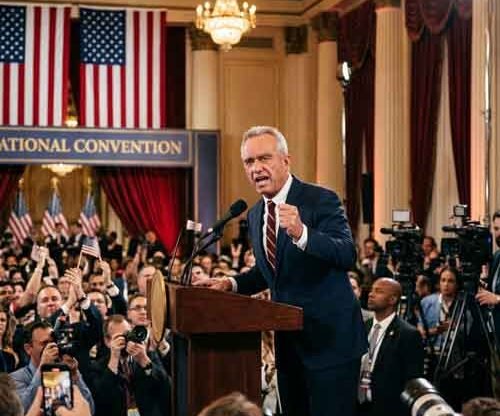

President Donald Trump’s recent prime-time address was not only a political event—it also became a major test for American television news organisations. While some networks aired the speech live, others chose to provide delayed coverage with extensive fact-checking or moved the broadcast to digital platforms. Those different editorial choices sparked renewed debate about journalism, presidential communications, and the responsibility of news organisations during politically sensitive events.
A Rare Prime-Time President Trump Address
Prime-time presidential speeches have traditionally been reserved for national emergencies, massive policy announcements, military actions, or significant moments in American history. Due to this, any request from the White House to interrupt evening television programming immediately attracts attention.
Before Thursday night’s speech, the White House requested that major broadcast networks carry President Trump’s remarks live. The speech focused on election security and included discussion of newly declassified documents related to the 2020 election.
However, unlike many previous presidential addresses, not every network agreed that live national coverage was the best editorial decision.
Why Networks Reached Different Conclusions of Trum Addresss News
The divide among broadcasters reflected more than political disagreement. Each newsroom faced the same central question:
Should a president always receive uninterrupted live television coverage, or should editors provide context first when previous statements on the same topic have been widely disputed?
Meanwhile, There was no universal answer. Some office executives concluded viewers should hear the president directly. Others believed journalists should verify claims before broadcasting them to millions of viewers.
The result was one of the most visible differences in network coverage during a presidential address in recent years.
Who Aired the Speech Live on TV and streaming channels?
Fox News carried President Trump’s address live across its television programming. Join our free forum discussion on trump speech tonight topics
CBS also interrupted regular programming to broadcast the speech. Following the remarks, CBS immediately returned to journalists and guests who discussed the president’s statements, explained background information, and examined several of the claims raised during the address.
Media observers sometimes describe this approach as providing viewers with immediate context before and after controversial remarks.
Why ABC, NBC and CNN Took Another side
ABC, NBC and CNN made different editorial decisions. Rather than interrupt their primary television schedules, ABC and NBC offered coverage through their digital streaming news services.
CNN chose not to broadcast the speech live on its main television channel. Instead, anchors monitored the event, aired selected clips, and added reporting and fact-checking alongside the president’s remarks.
These decisions reflected concerns about balancing public access with factual verification.
Trump Conclusion During His Speech
President directly criticised networks that declined to carry the address live. He singled out ABC and NBC during his remarks and argued they should have interrupted their scheduled programming.
The president also suggested broadcasters refusing to air the speech should face consequences involving their broadcast licenses.
USA Legal experts note that broadcast licensing is governed by federal law, while editorial decisions generally receive First Amendment protection.
Election Claims over Coverage Debate
The subject matter itself shaped many newsroom decisions. President Trump again discussed the 2020 election and referenced newly declassified documents that he said supported concerns about election security.
Those claims remain controversial. Previous court rulings, election officials from both political parties, and earlier investigations have rejected widespread claims that fraud changed the outcome of the 2020 presidential election. At the same time, the newly released documents announced during the speech had not yet undergone independent public verification when the address aired.
Because of that uncertainty, some editors concluded that immediate fact-checking should accompany any broadcast.
Editorial says
The event highlighted a broader issue facing modern journalism. Television networks regularly decide whether to interrupt entertainment programming for presidential speeches.
While editing , contetn editors consider several factors, including:
- National importance
- Public safety
- Breaking developments
- News value
- Availability of independently verified information
Those decisions are made independently by each news organisation. Thursday’s address demonstrated that editorial independence can lead different broadcasters to reach different conclusions while covering the same event.
The Rise of Digital News Changed the Equation
Television coverage no longer depends only on traditional broadcast channels. Today, nearly every major American news organisation operates streaming services, websites, mobile apps and social media platforms. That allows networks to offer live access online while choosing different programming for their primary television audiences.
In practical terms, viewers still had multiple ways to watch President Trump’s speech even when certain broadcast networks continued their scheduled prime-time programming.
Political Pressure and Media Responsibility
The differing coverage also renewed discussion about how news organisations should respond to political pressure. Presidents have long criticised media coverage they believe is unfair. At the same time, journalists argue that independent editorial judgment remains essential to maintaining public trust. Supporters of live coverage believe voters should hear a president’s remarks directly before any analysis occurs.
Others believe immediate fact-checking helps audiences distinguish verified information from disputed claims. Neither approach has universal agreement, which explains why broadcasters adopted different strategies.
What This Means Ahead of the Midterm Elections
The timing of the speech added another layer of significance. With the United States preparing for the 2026 midterm elections, election security has returned to the centre of political debate.
Coverage decisions surrounding the president’s address illustrate how news organisations may approach future speeches involving politically sensitive issues.
Media analysts expect broadcasters to continue relying on a mix of live coverage, digital streaming, expert analysis and real-time fact-checking during major political events throughout the election season.
Public Trust Remains the Biggest Challenge
Perhaps the most important lesson from the evening had little to do with television ratings. Instead, it centred on public confidence. Audiences increasingly expect journalists not only to report what public officials say but also to explain what is known, what remains uncertain and what evidence supports public claims.
Whether networks aired the speech live or provided edited coverage later, most sought to give viewers additional reporting beyond the president’s remarks themselves.
Conclusion
President Donald Trump’s latest prime-time address became significant for more than its political content. It also highlighted the difficult choices facing modern television news organisations. Discuss online now on Trump speech toppics forum talks USA tonight
Fox News and CBS chose traditional live coverage, while ABC, NBC and CNN relied more heavily on digital distribution, delayed reporting or immediate fact-checking.
Those differing approaches reflected broader questions about journalism, editorial independence and the role of news organisations in an increasingly polarised political environment.
As the 2026 midterm elections approach, similar editorial decisions are likely to remain part of the national conversation whenever major presidential addresses involve disputed claims or politically sensitive topics.